








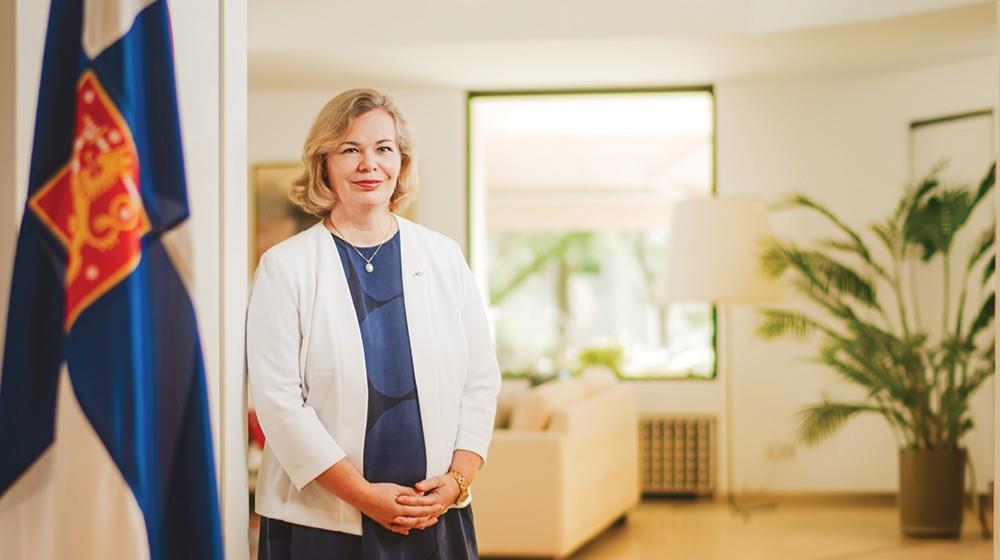
“Although both countries are located on opposite edges of Europe, we are united by shared European values and our role as EU external border countries. This geographical distance has never translated into political distance,” Paivi Peltokoski, the Ambassador of Finland in Cyprus says.
In an interview with GOLD magazine, Peltokoski discusses how bilateral relations have deepened over the past 65 years, identifies areas in which they can grow further and suggests ways in which Cyprus can benefit from Finland’s experience in the fields of energy, defense and recycling. As EU external border countries, Finland and Cyprus play an important shared role and, as partners, they are seeking to expand their cooperation across a range of sectors, including digitalisation, ICT, tech start ups, the circular economy, renewable energy and education.
Finland and Cyprus have maintained diplomatic relations since 1961. How has this partnership grown over the years and in what sectors can relations be expanded?
Over the decades, the partnership between Finland and Cyprus has grown steadily, free of setbacks or political turbulence. Although both countries are located on opposite edges of Europe, we are united by shared European values and our role as EU external border countries. This geographical distance has never translated into political distance.
For many Cypriots, Finland first became familiar through our peacekeepers. Between 1964 and 2004, more than 10,000 Finns served in UNFICYP, contributing to stability on the island and building a foundation of goodwill that still resonates today. When Cyprus joined the EU in 2004, both countries opened embassies, marking a new era of cooperation shaped by the shared European Union agenda.
Tourism has become one of the most visible bridges between our nations, as over 40,000 Finns visit Cyprus every year. I hope that more Cypriots will discover Finland in return! Our summers are warm and filled with 180,000 lakes, various cultural events and endless daylight, while our winters offer snow, northern lights and a unique northern charm. With direct flights from Larnaca to Helsinki taking just four and a half hours, the distance between us is shorter than many imagine.
In trade, Finland exports mainly paper and cardboard products to Cyprus. From Cyprus we import mostly cheese, as Finns are the eighth largest consumers of halloumi in the world. Finnish companies and products such as Kone elevators, Wärtsilä maritime solutions, Valio dairy products and Planmeca dental devices have a strong presence in Cyprus.
Looking ahead, I see significant opportunities to expand our partnership. Digitalisation, ICT, tech start ups, the circular economy, renewable energy and education are all sectors where we can deepen cooperation. Finland’s expertise in energy efficient construction is another area with strong potential. There is also one niche field I often highlight: civil defense shelters. In Finland, both public and building specific shelters are designed to protect the entire population in emergencies. Given today’s geopolitical realities, this is an area where our experience could be valuable to Cyprus. Defense cooperation is becoming increasingly important across Europe. Finland’s defense industry is open for new partnerships. At the same time, we remain committed to supporting Ukraine with military equipment and humanitarian aid. This support is not only a moral responsibility; it is essential for the security and freedom of Europe as a whole. Academic collaboration is another promising field. Strengthening research partnerships, student exchanges and university cooperation can help to prepare our societies for the technological and social challenges ahead.
The two countries have also been seeking to expand relations in shipping sector. What are the latest developments in this area?
Finland and Cyprus share a deep maritime tradition. As EU partners, we are committed to ensuring that maritime transport remains sustainable, safe, resilient and competitive. Our collaboration spans EU and IMO maritime policies as well as industry-level initiatives. Cyprus, as one of the world’s largest flag states, understands the importance of safe shipping in challenging conditions. Finland sincerely appreciates Cyprus’ support to our concerns regarding safe shipping in the harsh ice conditions of the Baltic Sea. One recent highlight was the Maritime Business Forum held in Helsinki ahead of President Nikos Christodoulides’ visit in May 2025. The Forum brought together Cyprus Shipping Deputy Minister Marina Hadjimanolis with her Finnish counterparts as well as industry representatives. I see particular promise for cooperation in the following fields: automated and digitalised maritime solutions, advanced ship energy systems, cybersecurity, new maritime fuels, maritime education and training as well as gender equality and equal employment opportunities in the shipping sector. Cooperation in many of these fields is already underway.
Finland aims to be carbon neutral by 2035 and has implemented policies to build a more sustainable world in various economic sectors. How can these practices be translated to Cyprus as part of the island’s green transition?
Climate change is a global challenge and Finland’s experience shows how even a small country can move rapidly towards a low-carbon future with a clear strategy, strong institutions and coordinated investment. Some aspects of our green transition could inspire Cypriot businesses and policymakers. Finland’s energy mix is among the cleanest and most diversified in Europe. Our electricity production is nearly carbon-free, relying heavily on nuclear power, wind, hydro and bioenergy. Fossil fuels play only a limited role, and 96% of our electricity demand is met domestically. Our grid is highly integrated with that of our Nordic neighbours, ensuring stability and efficiency. Our electricity mix consists of nuclear power (40%), wind (25%), hydro (17%), biofuels and waste (13%) and solar (1%). Even though solar energy represents a small share, household produced solar power is well integrated into the grid.
One of my personal passions is recycling. In Finland, recycling is easy, cost-effective and widely embraced. We have a dense network of collection points, mandatory sorting rules and high public participation. Only about 1% of municipal waste ends up in landfills. Nearly everything else is recycled, reused, composted or converted into energy in waste to energy plants that supply district heating and electricity. Our deposit refund system achieves a 97% return rate for glass bottles, and overall glass packaging recycling reaches 94%. Paper and cardboard recycling rates range from 94% to 99%, supported by a strong forest industry that uses recycled fibre as a key raw material. I personally love wearing “Marimekko” dresses made of recycled birch wood fibre.
I believe than some of these practices could offer valuable insights to Cyprus in our joint battle against climate change and global warming.
Finland and Cyprus have been deepening ties in education. How do you see this partnership moving forward and are there specific areas that could benefit further?
Both countries are committed to the goals of the European Education Area and actively promote international learning opportunities through programmes such as Erasmus.
Finnish teacher education often attracts interest. All our basic education teachers hold a Master’s degree, and kindergarten teachers hold a Bachelor’s degree. Only about one in ten applicants is accepted into teacher training, reflecting the profession’s high status.
I would like to encourage more exchange between teachers and schools from our countries for sharing best practices. Integrating migrant children into the classes, increasing STEM lessons and inspiring children to play and read without mobile phones are our common goals. Looking ahead, I believe that AI, ICT and technology-based research will be crucial areas for collaboration. Joint projects in these fields can help both countries prepare for the future.
Given Finland’s longstanding participation in UNFICYP, what is your country’s stance on the current state of the island’s longstanding conflict? What can be done to get the ball rolling towards a settlement?
Finland has a long history of supporting peace efforts in Cyprus. In 1964, Finnish diplomat Sakari Tuomioja served as the United Nations’ first mediator on the island, laying the foundations for our continued involvement. Today, Finnish police officers serve in the UNFICYP operation. I recall the words of former Finnish President Martti Ahtisaari in his Nobel Peace Prize speech in Oslo in 2008: “Peace is a question of will. All conflicts can be settled, and there are no excuses for allowing them to be eternal.”
Together with other EU member states, we share the goal of restarting reunification talks under UN leadership as soon as conditions allow. Diplomatic initiatives and constructive dialogue remain essential.
The Bank of Finland forecasts modest growth for the country in the coming years, slowed by high public debt, geopolitical uncertainty and tightening trade policy. How will the country return to steady economic growth?
Economically, Finland is facing a difficult period. Our Government is implementing a substantial growth package that includes reductions to earned income taxation, increases in child-related tax deductions and lower supplementary pension taxation. These measures aim to expand the labour supply, support household purchasing power and stimulate private consumption at a time when domestic demand is vital. Green transition projects and data centre development are expected to become major engines of growth. Investment activity is forecast to recover from 2026 onward, supporting exports and productivity as global financial conditions improve. By 2029, Finland will have allocated €3.6 billion in additional defence funding to strengthen national stability and bolster investor confidence in an uncertain world.
Finally, how has your time in Cyprus been since your arrival in 2024? Have you had to adjust to any cultural change, compared to other countries where you have served as Ambassador?
My time in Cyprus has been deeply rewarding. The island’s beauty, the warmth of its people and the sense of community have made this posting special. Before coming here, I served in Palestine, where my work revolved around the war in Gaza and unrest in the West Bank. I witnessed immense human suffering and losses, including violent attacks by illegal settlers in the West Bank. Yet even there, I encountered extraordinary hospitality, resilience and people striving in various ways for peace and a better future for all nations in the region. Much of my career has been connected to Russia, Eastern Europe and Central Asia, where the last decade has been shaped by Russia’s aggression against Ukraine, beginning with the occupation of Crimea in 2014. These experiences have shaped me profoundly. I have left a piece of my heart in every country and with every people where I have served, and I know that the same will happen here on the island of Aphrodite. When the time comes for me to move on, a part of me will remain in beautiful Cyprus.
(Photo: TASPHO)
This interview first appeared in the March edition of GOLD magazine. Click here to view it.
