







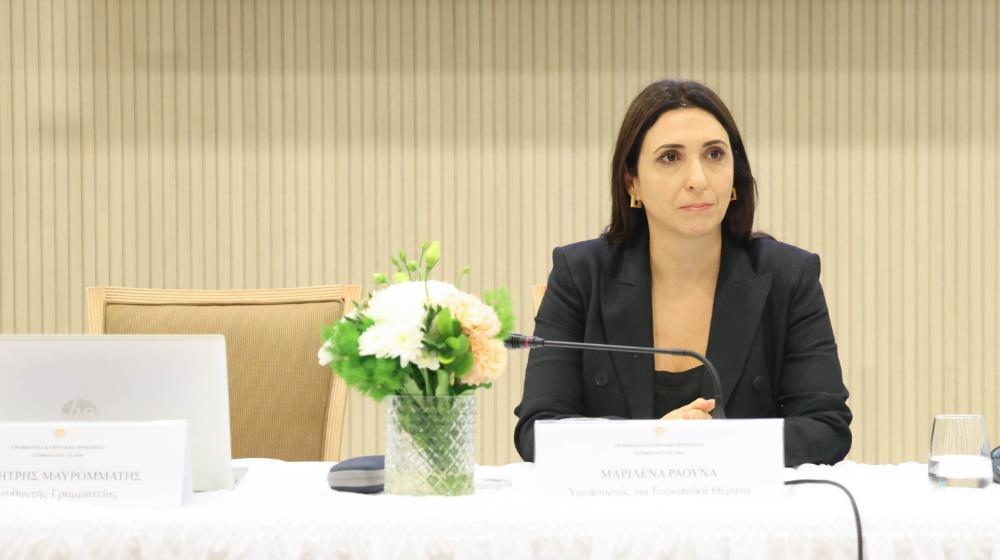
Deputy Minister for European Affairs Marilena Raouna, representing the Council of the EU, has highlighted the impact of developments in the Middle East and the EU’s need for unity to safeguard energy security during a plenary discussion on energy security at the European Parliament in Brussels.
Speaking on 25 March, she noted that last week, at the Spring European Council, European leaders discussed the impact of the situation in Iran and the Gulf region, including the potential closure of the Strait of Hormuz, on energy security, energy prices, and, consequently, the competitiveness of the European Union. She added that the discussion will continue with European Council President António Costa regarding the outcomes of the summit.
Raouna pointed out that in today’s interconnected world, a war in Europe’s neighbourhood inevitably affects the Union, pointing to the significant rise in oil and gas prices. While there is currently no immediate threat to the EU’s energy supply, she stressed that the situation remains volatile and requires preparation for a possible further deterioration.
Addressing the challenge of rising energy prices, she underlined that there is no simple or quick solution, stressing that the EU must demonstrate the same unity it showed during the energy crisis of 2022 to mitigate risks to citizens, security, and competitiveness. She noted that the Commission and Member States are exploring targeted, temporary, and financially sustainable measures to reduce pressure on households and industry.
No one-size-fits-all solution for all Member States
At the same time, she highlighted that there is no one-size-fits-all solution for all Member States, as each country has a different energy mix. Nevertheless, she emphasised that coordination and solidarity remain crucial. She added that the implementation of measures proposed by the Commission, as outlined in the Action Plan for Affordable Energy, must continue.
In the long term, the Deputy Minister stressed the need to remain committed to the goals of electrification and decarbonization in the energy sector, noting that these are not abstract objectives. She explained that they constitute a key guarantee for strengthening the EU’s energy independence and protecting against future crises. She also referred to the emissions trading system and the marginal pricing mechanism of the electricity market, highlighting that these tools have contributed significantly to progress in the green transition. “We must ensure that this path remains ambitious while remaining achievable,” she added.
Raouna noted that European industry and households are under significant pressure, emphasising that the conflict in the Middle East highlights the need for targeted short-term solutions to ensure affordable energy and address excessive volatility. She stressed that such measures must take into account technological neutrality and the specificities of Member States without undermining predictability or a level playing field.
A review of the Emissions Trading System (ETS)
She also pointed out that this includes, among other measures, a review of the Emissions Trading System (ETS) by July 2026 at the latest, as agreed at the last European Council. She noted that the current crisis has shown the need to further reduce dependence on fossil fuel imports.
She highlighted that one of the key initiatives supporting this objective is the European Grids Package. She added that this package will play a crucial role in strengthening EU energy infrastructure and enhancing the integration of the European energy market, making the Union more resilient to external shocks such as those it faces today.
Raouna explained that the Cyprus Presidency is prioritising the package and is working intensively to reach a general approach on this file by June, paving the way for an early start to trilogue negotiations with the European Parliament.
In conclusion, she stressed that the vision of the Cyprus Presidency is for a more autonomous Union, which is inextricably linked to energy independence and deeper integration toward a true energy union.
(Source: CNA)
