






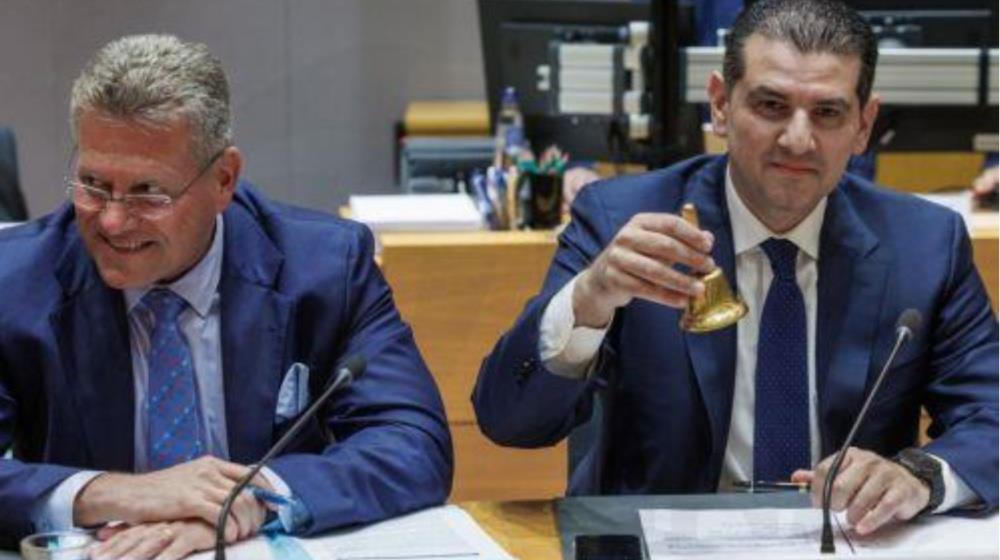
The strong political momentum behind the Industrial Accelerator Act (IAA) was reaffirmed at Thursday's Competitiveness Council on Internal Market, Industry and Tourism, according to Cypriot Minister of Energy, Commerce and Industry Michalis Damianos, who chaired the meeting as the last COMPET session of this configuration under the Cyprus Presidency.
Speaking at the press conference following the Council, Minister Damianos stressed that the Act aims to create the right conditions for European industry to innovate, decarbonise and remain competitive, at a time marked by high energy costs, intense global competition and geopolitical uncertainty.
"The Act is about creating the right conditions for European industry to innovate, decarbonise and stay competitive," Damianos said, adding that it is also about "protecting quality jobs, supporting industrial regions in transition, and strengthening Europe's manufacturing base."
The Minister recalled that European leaders, at the informal summit held in Cyprus last April, had identified the IAA as a priority under the "One Market, One Europe" vision, with a clear ambition to reach agreement by the end of 2026. "Today's first discussion of Competitiveness Ministers on this file reaffirmed the strong political momentum attached to it," he noted, adding that the Cyprus Presidency will reflect Ministers' political guidance in a partial compromise text, while supporting the incoming Irish Presidency in advancing work towards a swift conclusion of the file.
Also on the agenda was the 28th Regime – EU Inc., aimed at making Europe a simpler, faster and more attractive place for innovative companies to create, grow and scale. The first ministerial debate on this file underlined that competitiveness and trust must go hand in hand, with emphasis on the need for a balanced framework with strong safeguards on transparency, workers' rights, anti-fraud measures and legal certainty.
Over lunch, ministers turned to the pressures facing Europe's chemicals industry — a sector that Minister Damianos described as essential to many industrial value chains, from automotive and construction to agriculture, pharmaceuticals and clean technologies. There was broad agreement on the need for coordinated European action to address high energy costs, unfair global competition and declining investment, while maintaining Europe's high environmental and safety standards.
A key outcome of the session was the adoption of Council Conclusions on "Building a Sustainable and Competitive Tourism for the Future." According to the Minister, "tourism is one of Europe's greatest strengths. It supports millions of jobs, drives regional development, and connects people and cultures across the Union," Damianou said. Ministers also exchanged views on the impact of geopolitical tensions in the Middle East on the tourism sector, highlighting its vulnerability to external shocks and the need to strengthen its resilience through European coordination.
Closing the press conference, Damianos marked the handover to the Irish Presidency, due to take over in July, with a characteristically warm note: "From one island to another, I wish the Irish Presidency every success in its forthcoming mandate."
On his part, Executive Vice-President of the European Commission, Stéphane Séjourné highlighted the high degree of convergence among ministers on the core principles of the IAA, calling the outcome encouraging given the urgency of the situation. He cautioned, however, that "there are no miracle texts" and that the coming weeks would be decisive, with focus shifting to identifying specific points of convergence and compromise. He also announced a forthcoming visit to Hungary for consultations on the file.
On EU-China relations, Séjourné reaffirmed Europe's strategy of de-risking rather than decoupling, pointing to a trade deficit of one billion euros per day with China as evidence of the urgent need to rebalance the relationship. He stressed that the EU must accelerate the implementation of existing trade defence tools, review its toolbox and move with greater speed given the current geopolitical climate.
