





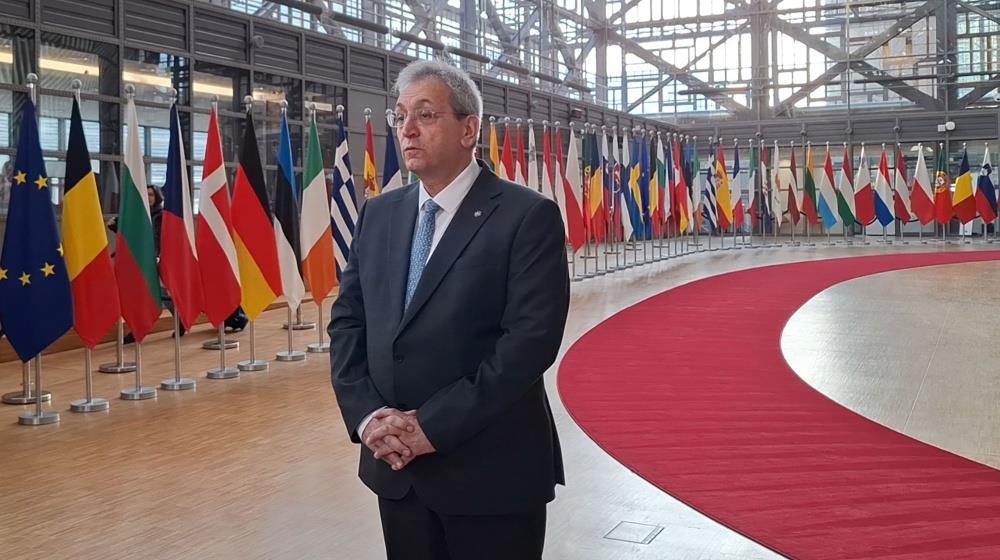
Minister of Labour and Social Insurance, Marinos Moushouttas, described the conclusion of the Employment and Social Policy Council (EPSCO), which convened in Brussels, as a significant step in fulfilling the Cypriot Presidency’s commitment to building a socially inclusive and resilient Europe.
Speaking on Monday, 9 March, the Minister underscored the Cypriot Presidency’s belief that "at the core of a strong, competitive, and cohesive Europe lies the well-being of its citizens," focusing the attention of the 27 Member States’ ministers on four key areas: leveraging artificial intelligence and innovation to promote quality jobs and appropriate skills for a stable, competitive, and fair labour market; investing in children; breaking the cycle of poverty, and ensuring affordable housing.
Within the framework of the 2026 European Semester, the Ministers, under the Cypriot Presidency, adopted the Joint Employment Report, which outlines the strategy for strengthening labour markets, modernising social protection, and promoting upward social convergence across the Union. Simultaneously, as the Minister noted, the Council adopted the Recommendation on Human Capital, aimed at addressing skill shortages and mismatches in the European labour market through coordinated training and education policies.
Upholding workers' rights
"We had the honour of hearing Sir Christopher Pissarides, the distinguished Cypriot Nobel laureate in Economics, whose contribution enriched the discussion on the transformative role of artificial intelligence in labour markets. We must ensure that technological progress contributes to upholding workers' rights and creates opportunities for new, quality jobs for all, especially for young people," Mousiouttas emphasised.
In this direction, with today’s presentation of the key messages to the Council regarding the enhanced Youth Guarantee framework, "we aim to provide young people with access to sustainable and quality jobs for a more competitive and cohesive Europe," the Minister added.
Additionally, the Minister referred to the Council’s approval of conclusions on strengthening the well-being and social inclusion of children, noting that "child poverty has long-term consequences, not only for the children themselves but for society as a whole." He stressed, however, that the adoption of these conclusions "reaffirms our commitment to coordinated action to ensure that every child has an opportunity for a better future."
The Council also highlighted the need to combat the cycle of poverty and discussed the development of people-centered services. "These services are critical not only to help people escape poverty but also to prevent them from returning to vulnerable situations," the Minister added.
Sustainable housing policy
Concluding the agenda, the Minister addressed sustainable housing policy, which he described as "a priority for the Cypriot Presidency." He explained that, following the presentation of the first-ever European Plan for Affordable Housing by the European Commission, "we are intensifying discussions on housing. Today’s discussion provided an opportunity to present experiences from national policies and exchange views on actions at the European level." As he noted, "the goal is to maintain momentum and ensure that today’s exchange of views contributes to shaping the Council’s conclusions in June." He also pointed out that during Monday’s session, "it was re-emphasised that housing policies must respond to real needs, as reflected in demographic changes. The issue is not only about increasing the housing stock but also about adopting smarter and more sustainable approaches to housing."
On her part, Executive Vice President of the European Commission for Social Rights and Skills, Quality Jobs and Readiness, Roxana Mînzatu, focused on the discussion about artificial intelligence in the workplace, which she described as "particularly lively." As the Vice President emphasised, "there was agreement that fairness, transparency, and accountability must be ensured in automated monitoring and decision-making systems to protect workers from the risks of algorithmic management." At the same time, she stressed the need to harness the opportunities offered by AI for both businesses and workers by building trust and supporting the use of algorithmic tools, regardless of size or sector. "We must strike the right balance between competitive economies, innovation, and the protection of workers," she noted.
Quality Jobs Act
According to Mînzatu, this is linked to the upcoming Quality Jobs Act, where measures such as workers' right to be informed about the use of algorithmic systems, access to personal data generated about them, human oversight of automated systems, and the promotion of ethical use of algorithmic management are being considered. Regarding combating poverty and social inclusion, Mînzatu noted that the EU "reaffirmed its determination to enhance child well-being and tackle child poverty, which unfortunately is on the rise." As she stressed, "child poverty is increasing despite our efforts. We need to do more and better."
On the posting of workers from third countries, the Executive Vice President noted that "workers from third countries are often more vulnerable and are sometimes used to reduce labour costs, creating unfair competitive conditions." She emphasised that the Commission is working closely with the European Labour Authority to strengthen the Authority’s mandate to conduct inspections involving non-mobile third-country nationals, especially in high-risk sectors such as agriculture, and to clarify the legal framework to prevent abuses of migration rules and ensure fair competition. "We must ensure that the posting of workers is not used to circumvent migration rules or create unfair conditions," she stressed.
Asked about Regulation 883/2004 on the coordination of social security systems, Minister Mousiouttas pointed out that "Regulation 883 has been a challenge for the EU for almost a decade," noting that 20 presidencies have come close to a conclusion twice. He said that, on behalf of the Cyprus Presidency, "our commitment regarding the Regulation is that we will do everything possible to reach an agreement."
The Minister described the negotiation process at the bilateral level with Member States in each Council and through continuous consultations by the Cyprus' Permanent Representation to the EU, aiming to achieve an agreement in a single trilogue with the European Parliament by the third week of April. "This is something we all hope for, and the promise we have given is that, as the Cypriot Presidency, we will do everything we can to reach an agreement on this Regulation, which expands the rights of mobile workers. We will not stop until the final discussion takes place and a final conclusion is reached. The discussions continue, but I believe we are on the right track," he concluded.
(Source: CNA)