







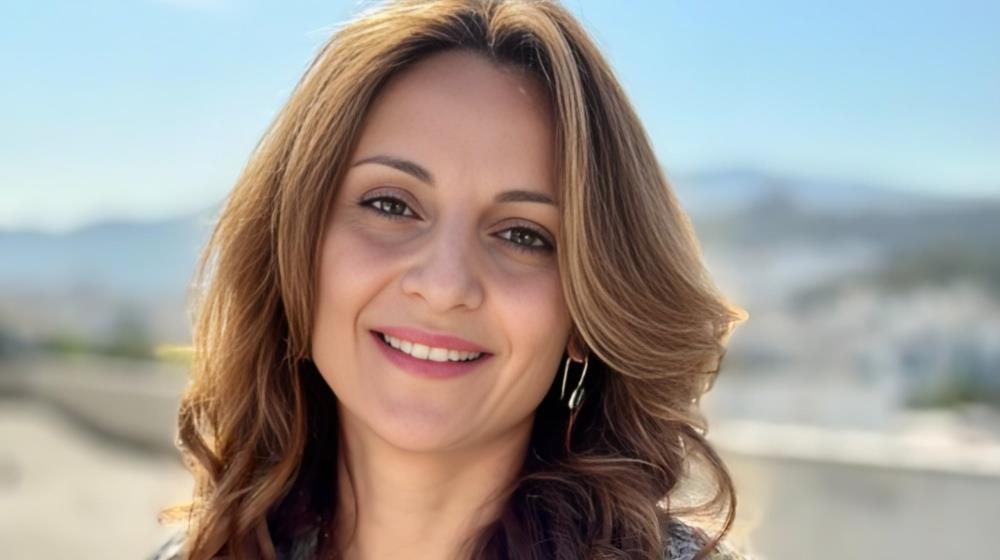
Sustainable development for Cyprus, as for any country, is not merely an environmental choice. It is a prerequisite for economic resilience, social cohesion, and geopolitical stability, Professor Phoebe Koundouri of the Athens University of Economics and Business and the University of Cambridge has said.
Koundouri is Co-Chair of the United Nations Global Sustainable Development Report 2027, President of the World Council of Environmental and Resource Economists Associations, Chair SDSN Global Climate Hub and Director AE4RIA. Last year, she was honoured with the Award of Excellence of the Republic of Cyprus, conferred by the Academy of Sciences, Letters and Arts of the Republic of Cyprus.
In an interview with CNA, Koundouri talked about the challenges for Cyprus as a climate-vulnerable region, and how the energy transition could be a strategic opportunity.
More specefically, asked about the main challenges for Cyprus, she said that Cyprus lies in one of the most climate-vulnerable regions of the Mediterranean.
"Rising temperatures, water scarcity, and ecosystem pressures require integrated, long-term planning," she noted.
Koundouri said that at the same time, the energy transition presents a strategic opportunity.
"The country can invest in renewable energy, storage and interconnections, smart water management, and high value-added sustainable tourism. Developing green and digital skills can further enhance competitiveness and create new jobs," she explained.
The key, she continued, is a systemic approach: linking data, modeling scenarios, conducting cost-benefit analysis, and translating strategic goals into bankable projects.
"Sustainable development for Cyprus — as for any country — is not merely an environmental choice. It is a prerequisite for economic resilience, social cohesion, and geopolitical stability," she underlined.
Ultimately, Koundouri said, "the transition is not only a technological or economic issue. It is a matter of governance, institutional maturity, and collective responsibility. If we act with scientific evidence, social participation, and strategic consistency, we can transform the polycrisis into an opportunity for systemic transformation".
"Cyprus shaped me"
Asked about her Cypriot origin, she said that she was born in Cyprus where she lived until she was 17 before leaving for England for studies at the University of Cambridge. She stayed in the UK for 18 years, where she taught at the University of Cambridge, UCL, LSE and the University of Reading.
"Cyprus, however, is not just my place of origin, it is the place that shaped me," she told CNA and talked about her family, who taught her values and self-confidence.
The main global challenges today - interconnected polycrisis
Asked about the main global challenges our planet is facing today, Koundouri said that "we are living in an era of permanent and interconnected polycrisis."
"Climate change, biodiversity loss, social and economic inequalities, energy and food insecurity, migration flows, and geopolitical instability are not isolated phenomena. They form a single, dynamic system of interlinked risks that reinforce one another," she pointed out.
Humanity now, she said, possesses the scientific knowledge, technology, and financial resources required to achieve the 17 Sustainable Development Goals (SDGs).
"Yet global implementation progress remains below 20%. The core problem is not the lack of solutions, but the inability to implement them at scale and the absence of mechanisms that translate public goals into mature, investable projects," she stressed.
Moreover, Koundouri said that the window to 2030 is decisive.
"The decisions taken in the next three years will determine whether the transition is orderly, just, and science-based, or whether fragmented policies will deepen inequalities and instability," she pointed out.
Sustainable development
Asked how she works towards sustainable development, she said that her approach is grounded in a human-centered, interdisciplinary, and mathematically rigorous systemic transformation framework.
"We develop integrated analytical tools that unify nature, the economy, and society within a single decision-making system," she said.
Referring to the research center she directs, the Alliance of Excellence for Research and Innovation on Aeiphoria (AE4RIA), she noted that it is one of the largest international research alliances working on transformative sustainability solutions, with more than 250 researchers, over €500 million in competitive funding, and activities in more than 120 countries, it focuses on linking environmental, social, and economic variables and designing holistic transition pathways toward sustainability.
Our framework, she added, is structured in three stages: 1. Continuous measurement and monitoring of SDG progress, 2. Design of dynamic and spatial transition pathways through scientific modeling and 3. Development of investment portfolios that integrate climate and social risks.
In parallel, she said that as Chair of the SDSN Global Climate Hub, they develop integrated models connecting energy, water, land use, transport, marine ecosystems, and economic valuation beyond GDP.
"We use geospatial data, planetary boundaries analysis, and dynamic systems modeling to assess ex-ante the impacts of policy choices".
Additionally, as Chief Scientist of the United Nations Global Sustainable Development Report 2027 (GSDR 2027), she contributes to shaping the scientific foundation that will guide governments in accelerating SDG implementation and designing policies beyond 2030.
She explained that the GSDR 2027 is the UN’s flagship scientific instrument for assessing progress and formulating evidence-based policy directions. Our aim, she continued, is to provide concrete, actionable guidance and strengthen global accountability.
Finally, as President of the World Council of Environmental and Resource Economists Associations (WCEREA), which coordinates associations of environmental and resource economists across Asia, Africa, Europe, North and Latin America, we promote international scientific collaboration and strengthen the interface between research and public policy, reinforcing the role of environmental economics in addressing the climate crisis and advancing sustainable development, she said.
Participation in the World Economic Forum in Davos
Koundouri, who participated in the World Economic Forum in Davos, told CNA that the message was clear: the global economy stands at a turning point.
"Geopolitical developments, value chain restructuring, and the energy transition are generating uncertainty, but also accelerating the need to redesign the development model," she said.
Policies, she noted, such as the European Green Deal, the “Fit-for-55” package, and the Nature Restoration Law signal a shift toward a new growth paradigm, where competitiveness is linked to decarbonization, innovation, and resilience.
"The critical question is whether we will move toward a fragmented world with low-cooperation national strategies, or toward a multilateral approach grounded in global public goods. Science can and must serve as the common denominator, bridging political and economic divides," she stressed.
Biography
Professor Dr. Phoebe Koundouri is a world-leading economist renowned for pioneering human-centred, interdisciplinary, mathematical systems for sustainable nature–society–economy interaction. She holds an MPhil/PhD (Univ. of Cambridge) and has held positions at the Univ. of Cambridge, UCL, LSE, Univ. of Reading, and Tehcnical University of Denmark (DTU). Currently, she is a Professor at the Athens University of Economics and Business, Visiting Professor at the Dept. Earth Sciences Univ. of Cambridge and Founder and Director Alliance of Excellence for Research and Innovation in Aeforia AE4RIA (250 researchers). Ranked in the top 2% of scientists (e.g., Stanford list) with 20 books, 700 peer-reviewed publications, she has led more than 100 research and innovation projects in 120 countries. In 2025, she was invited by the UN Secretary-General to Co-Chair the Global Sustainable Development Report (GSDR) 2027.
She serves on the Nominating Committee for the Nobel Prize in Economics. She is a Fellow of Academia Europaea, World Academy of Arts and Sciences (Trustee), European Academy of Sciences and Arts, Academy of Engineering & Technology of the Developing World, IAP, the European Association of Environmental and Resource Economists (EAERE), and European Forest Institute. She served as Commissioner for the Lancet COVID-19 Commission and a member of the Fraternal Economy of Integral and Sustainable Development, Pontifical Academy of Social Sciences. Other major distinctions include the ERC Synergy Grant, the Academy of Athens Award of Science, the Award of the Academy of Sciences, Letters, and Arts of the Republic of Cyprus, named World Ambassador of Happiness and Peace (2022), a title conferred by the Government of India at the House of Lords in London.
She is the President European Association of Environmental and Resource Economists; President World Council of Environmental Resource Economists Association; Chair UN SDSN Global Climate Hub (2,000 universities); Co-chair UN SDSN Europe (900 universities); Selected editorial roles, editor Cambridge University Press Elements Book Series in Environmental and Resource Economics; co-editor Official Journal of EAERE Environmental and Resource Economics; associate editor Nature: Climate Action. She is an ERC Ambassador, EU Climate Pact Ambassador, member of the EIB Climate Leaders Network, and contributor to the IPCC. She advises the UN, G20, World Bank, EC, EIB, EBRD, OECD, WHO, and national governments.
(Source: CNA)
