







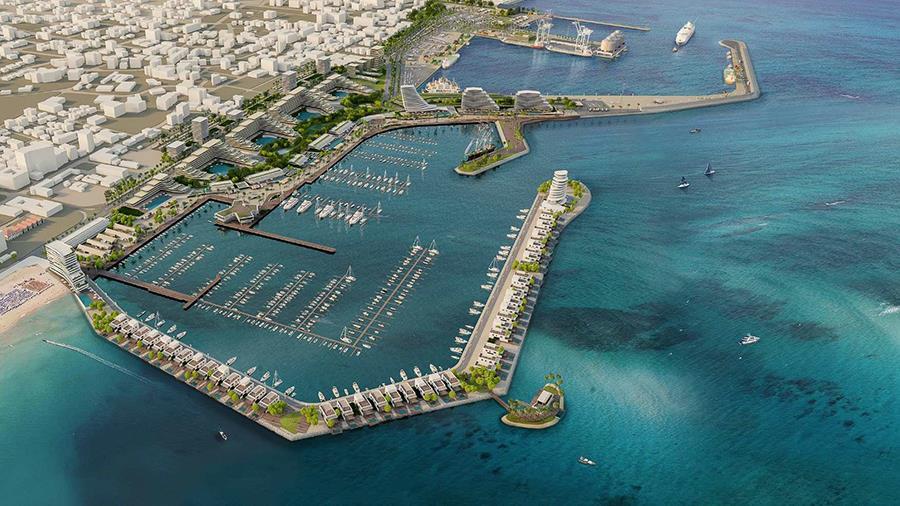
Any decision must be based on realistic data, documented analysis and a clear development strategy guided by the long-term interests of Larnaca and the public interest, Prosperity Group has underlined, emphasising that the public debate surrounding the future of the Port and Marina of Larnaca is of crucial importance for the city and the wider region.
“From the evaluation of the proposals to date, it appears thatSuperfund’s (Greece's National Investment Fund's) proposal largely converges with the philosophy and approved design of Kition Ocean Holdings. The principal point of differentiation concerns the separation of management,” the Group states in a relevant announcement.
According to recent press reports, the Superfund appears to be proposing — without sufficient supporting documentation — the following:
-
The separation of management of the Port and the Marina in Larnaca;
-
The preservation of all existing uses and functions of the Port, without exception;
-
The development of the Marina in line with the approach considered necessary by the local authorities;
-
The assessment that existing proposals regarding the location and creation of a conference centre may not fully meet demand.
Separation of functions or unified management?
Prosperity Group notes that Kition successfully managed the Port and Marina of Larnaca for more than two years, during which time it significantly increased turnover and traffic in the city centre. This, the Group argues, demonstrates in practice that the joint and unified operation of the two infrastructures is entirely feasible.
It further recalls that during Kition’s management, the port attracted new cruise companies such as Virgin Voyages, Celestyal and Royal Caribbean, as well as routes linking Greece and Cyprus — something that had not previously been achieved, including after the termination of the contract.
“The close proximity of the port and the marina, combined with the fact that their functions are inextricably linked and exert significant influence on one another, strengthens the argument that the two activities should remain under unified management,” the announcement states.
Examining the port’s functions more closely, the Group raises what it considers reasonable questions: what would happen if a new manager were to transform the port into a purely container terminal or an industrial facility, particularly if, as suggested, no function is to be excluded?
Such an approach, it argues, would not be consistent with the character of a port located in the centre of a city and which, according to existing strategic planning and studies, should emphasise:
-
Attracting cruise ships;
-
Strengthening the tourism product;
-
Promoting Larnaca as a modern tourist and commercial destination.
“At the same time, the impact of such a strategic shift on the wider area must be taken into account. Hotels, apartments, commercial and residential developments, as well as the entire coastal front, would be directly affected if, for example, the port manager were to undertake disruptive operations on a 24-hour basis, taking advantage of the port’s capacity for continuous activity,” the announcement explains.
Furthermore, it asks what would occur if it were deemed more profitable to manage nuisance cargo or oil and gas services rather than attract cruise ships. Who, it questions, would ensure that the port operates in the best interests of the city, its residents, the marina and the overall development strategy, if the port manager has no direct interest in the broader development of the area?
Prosperity Group maintains that any attempt to separate the two functions would introduce significant uncertainty and serious delays in project implementation. A new competition, redesign, planning permits and various government approvals would be required — processes which, based on the company’s experience, are highly time-consuming.
In addition, such separation would create further administrative and financial costs, as well as potential conflicts of interest between different managers — issues that are avoided under a unified management structure.
“Larnaca requires coordination, coherence and clear strategic direction — not fragmentation,” the Group underlines.
Development based on the city’s real needs
As has been repeatedly highlighted — both during the most recent competition and throughout the study, design and licensing phase of the Masterplan, a process that took approximately five years to complete and secure agreement — Larnaca is in urgent need of substantial and targeted infrastructure.
This position has recently been reaffirmed by the competent local authorities, including the Municipality of Larnaca, EVEL and the Larnaca Regional Development Authority.
The city requires infrastructure that will:
-
Support already licensed developments;
-
Connect the development projects in the Dhekelia area with the centre of Larnaca;
-
Act as a catalyst for improved and sustainable entrepreneurship and commercial activity in the city centre.
It is further estimated that such infrastructure will significantly enhance the standard of living for residents of the city and district of Larnaca, as well as Cyprus more broadly, given that implementation would involve consulting and construction companies from across the country.
More specifically, as the Mayor of Larnaca recently stated, in addition to improvement projects already under way, the city requires essential development projects including:
-
Expansion and upgrading of the existing Marina to attract vessels;
-
Creation of new hotel units;
-
Development of university infrastructure;
-
Establishment of a modern health centre;
-
Creation of recreational and green spaces;
-
Development of conference facilities;
-
Improvement and upgrading of the road network.
Studies conducted by international experts indicate that the successful implementation of these developments also requires the creation of new catering establishments, retail outlets, residential projects and entertainment venues, which would contribute to population growth and further improvement in living standards in Larnaca.
All of these elements were taken into account and incorporated into the design that formed the basis of the Larnaca urban plan, as well as into the schedules and financial studies presented by the previous contractor. These proposals received the necessary approvals and were positively received by all government bodies and local authorities without exception.
“Based on the above, the discussion cannot remain theoretical. The data is clear. Unified management of the Port and Marina has already been tested and has delivered measurable results. Their functional interdependence is evident. The city’s development needs are immediate. The Masterplan has been studied, licensed and approved following a multi-year process,” Prosperity Group states.
The public interest, it argues, is not served by reintroducing uncertainty through new competitions, redesigns and delays that may extend for years. Nor is it served by fragmented strategy and potential managerial conflicts.
According to the company, the public interest is served when:
-
Jobs are created immediately;
-
Revenue flows to the state;
-
Approved projects are implemented without delay;
-
The character of the city is safeguarded;
-
Stability and coherence in planning and management are ensured.
“The choice is therefore both political and substantive: either we proceed with a unified strategy and immediate implementation, or we choose a path leading to uncertainty, delays, risk and the abandonment of a tested approach,” the Group adds.
Prosperity Group concludes that separating the management of the Port and the Larnaca Marina demonstrably does not serve the public interest and offers no tangible benefit in achieving proper development of the city and district.
“Larnaca requires responsible decisions, not redesigns that generate new cycles of uncertainty. The moment demands clarity, and the only clear choice for proper development at this time is unified management and implementation of the already licensed plan,” the statement concludes.
Finally, Prosperity Group reiterates its readiness to engage in substantive and direct dialogue to address any concerns regarding the implementation of the licensed development, maintaining that it has always been — and remains — part of the solution rather than the problem.
(Soure: InBusinessNews)
