







At the core of IKEA’s supply chain, artificial intelligence is evolving from a supporting tool to a catalyst for holistic transformation. The next generation of AI is no longer limited to individual optimizations, but is redefining how decisions are made, operations are automated and operational resilience is scaled globally.
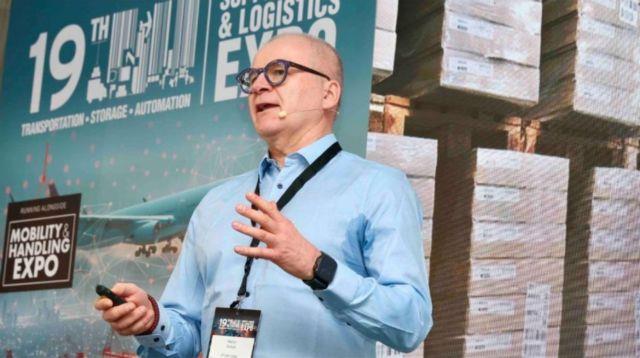
As part of the presentation 'Leveraging the Next Generation of AI to Transform Supply Chain Operations', during the 19th Supply Chain & Logistics EXPO, Marco Dütsch, AI Lab Lead of IKEA Supply AG (SCD Data & Technology), highlighted how AI is strategically integrated across the entire IKEA ecosystem from design and production to distribution and customer experience.
One brand, many organisations and a common vision
The starting point for the approach is IKEA's unique structure: many companies with different owners, united under one brand, one concept and one common mission, creating a better everyday life for the many people. The IKEA Concept acts as a unifying mechanism that enables scale, consistency and collaboration in a highly complex global network.
In this environment, the supply chain is treated as a "life cycle", which begins and ends with the customer: understanding needs, product design based on the principles of Democratic Design, industrial production, efficient and sustainable distribution, inspiration at the points of sale and continuous feedback.
From data to knowledge and from knowledge to people
A central outcome of IKEA's AI strategy is the transition from data to knowledge and from knowledge to action. AI acts as the intermediary that transforms huge volumes of data into immediate, understandable and actionable information for the people in the business.
The targeting is clear:
· automated data analysis in real time,
· smart answers to business questions,
· dynamic visualizations that adapt to the respective business context,
· AI that doesn't just present data, but actively helps interpret it.
Role automation and business efficiency
The next generation of AI is expanding dynamically into blue-collar and operational roles, with measurable results in productivity, security, and stability of operations. Automation at scale reduces variability, limits human error, and allows workers to focus on higher-value activities.
At the same time, AI is seen not as a replacement for humans, but as a capability enhancer in a demanding and constantly changing business environment.
AI-enabled decisions and agentic capabilities
Another critical takeaway concerns decision-making. Through end-to-end supply chain simulations and the use of emerging agentic AI, IKEA is moving towards faster data-driven decisions, increased resilience to disruptions, and proactive risk management rather than reactive.
AI acts as an orchestrator of a complex system, where each decision takes into account multiple scenarios, constraints, and impacts across the chain.
From experiment to scaling
Particular emphasis was placed on moving from experimental use cases to sustainable scaling. The real challenge lies not in proving that AI “works”, but in how it is responsibly, safely and consistently integrated into a global organization.
The path towards more autonomous supply chains requires:
· realistic assessment of current limitations,
· clear business objective,
· architectures that allow scale without exponential cost increases.
The message of his presentation is clear: AI is a strategic tool for long-term transformation, not a technological trend. And when harnessed with a focus on people, customers, and real business problems, it can transform supply chain complexity into a competitive advantage.
(Source: InBusinessNews)
