







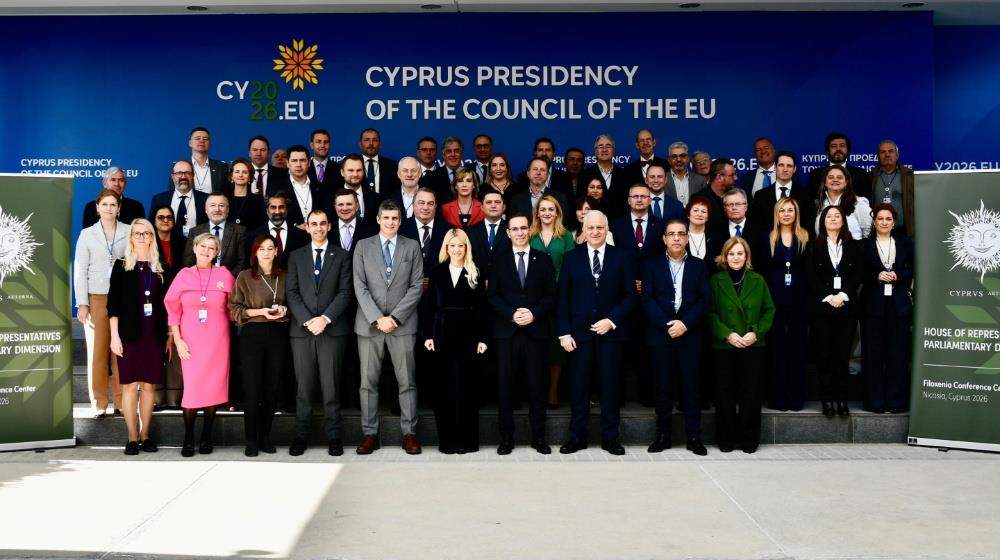
An interparliamentary conference on AI, opportunities and challenges has wrapped up in Nicosia, in the framework of Cyprus' Presidency of the EU Council.
The third session in the afternoon of 15 January discussed employment challenges and opportunities in the era of AI and was chaired by Chair of the Parliamentary Committee on Labor, Welfare and Social Security, Andreas Kafkalias, according to a House announcement.
Chair of the Committee on Employment and Social Affairs of the European Parliament, Li Andersson (online participation), the Chair of the Board of Directors of the Human Resources Development Authority and Senior Vice Rector at the University of Nicosia, Dr. Constantinos Fellas, and Professor at the University of Nicosia and National Expert at the European Centre of Expertise in the field of Labor Law, Dr. Nikos Trimikliniotis were the keynote speakers.
In his introductory speech, MP Kafkalias highlighted that AI has already reshaped the work landscape, with uneven impacts across sectors.
He noted the potential that AI offers for new jobs, increased productivity and enhanced innovation, but also the risks, inequalities, lack of transparency in decision-making and lack of human oversight.
He referred to the existing European regulatory framework and the gaps that exist, as well as the challenges of implementation at national level.
Kafkalias also highlighted the need to protect labor rights, ensure transparency and human oversight, invest in skills and strengthen the role of national parliaments, with the aim of a fair, humane and sustainable future for employment.
Andersson analysed the positive and negative impacts of AI on the working environment and noted that the full impact of AI on work is still unknown.
She briefed the participants about the work carried out by the EP Committee on Employment and Social Affairs in the field of AI and underlined the importance of protecting the fundamental rights of workers.
Dr Fellas referred to the main indicators of the labor market, the changes that are taking place, the exposure of specific professions to AI, the challenges and opportunities arising from the digital transformation, as well as the work done by HRDA.
Dr Trimikliniotis in his speech said that AI has both potential and risks, noting that that the impacts are more evident in the employment sector. He referred to the existence of a gap that exposes workers, especially those not covered by collective agreements.
In the discussion that followed, MP Fotini Tsiridou noted that the dilemma does not concern the promotion or not of AI, but the way to regulate it.
She stressed that AI should not replace human judgment, while underlining that technological progress must serve humans and not the other way around. The goal, she added, must be to transform AI into an assistant to institutions, politics and society.
The previous sessions focused on governance of AI, the challenges to democracy and the rule of law arising from the use of AI. House President Annita Demetriou opened the conference.
(Source: CNA)
