







Strategic agreements with NVIDIA , Tenstorrent , Plug & Play , leading universities such as Columbia, as well as contacts with giants such as Amazon and OpenAI , make up the new technological footprint of Cyprus following the targeted roadshow by President Nikos Christodoulides in the United States in April 2024. At the core of this effort is the decision to create a national supercomputing and artificial intelligence infrastructure, which aspires to fill a critical gap in the country.
In this context, Cypriot expatriate John Josephakis, Global Vice President of High Performance Computing, AI and Supercomputing at NVIDIA, who is involved in national supercomputer and AI projects around the world, was recently back in Cyprus – even if only for a day.
In the exclusive interview with InBusinessNews that follows, he explains how the collaboration with NVIDIA evolved in record time, why infrastructure is a prerequisite for the effective use of artificial intelligence, and how small states, such as Cyprus, can move quickly and strategically in the new digital era.
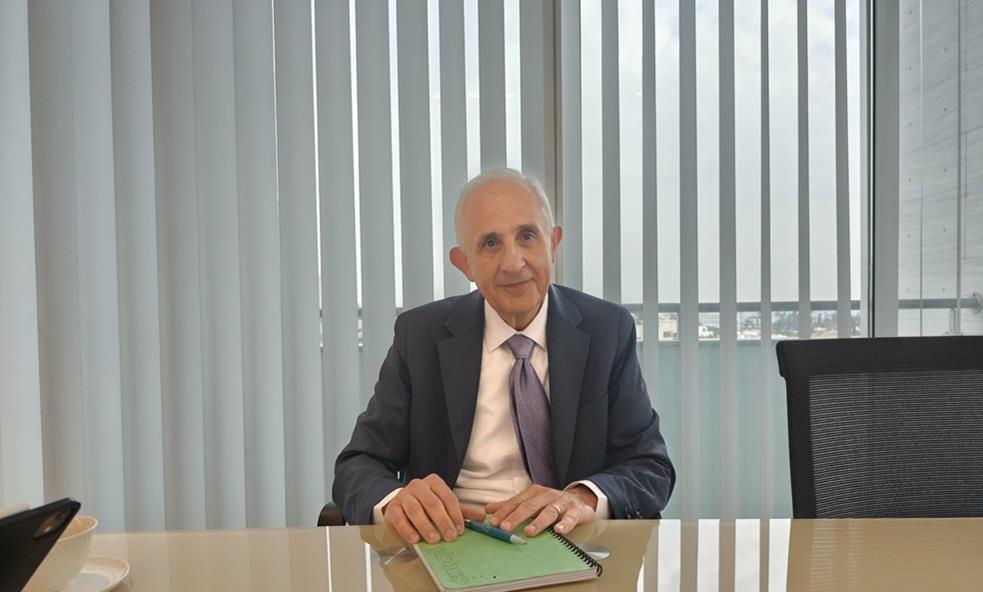
We met him at the Deputy Ministry of Research, Innovation and Digital Policy, since he has been in close collaboration for some time, both with Deputy Minister Nicodemos Damianou and with Deputy Minister to the President Irene Piki, who is leading Cyprus' efforts to become a technological hub.
In April 2025, President Christodoulides traveled to the United States with the aim of attracting American investment in Cyprus, mainly in the technology sector. From that first contact until today, how has NVIDIA's relationship with the Republic of Cyprus evolved and where are we now?
Let me first give you some context so you can understand where I’m coming from and how I view these kinds of partnerships. I’ve been at NVIDIA for about six years and currently hold the role of Global Vice President for High Performance Computing, AI, and Supercomputing. That means I’m involved in supercomputing initiatives and national AI infrastructures around the world, from very large countries to smaller states that want to “run” faster.
With Cyprus, before the meeting with the President, there was no substantial contact. From April onwards, however, in less than a year, we moved at a very high speed. We had constant contacts, meetings took place at the Presidential Palace, trainings with academics began, while the roadmap for the supercomputing infrastructure was also “set up” and is now entering the implementation phase. This did not happen “suddenly”. It is the result of a journey of months with very systematic work and frequent communication.
Before we talk about the supercomputer, tell us how important you consider this particular collaboration for Cyprus, but also for NVIDIA?
Cyprus has an advantage that is often underestimated. Because it is a small country, if there is a vision and an execution plan, you can implement things quickly, without stumbling upon dozens of obstacles that you may encounter in large states. This, especially in artificial intelligence, is crucial. The world is running. If you don't run, someone else will.
For NVIDIA, partnerships of this type have a double value. Firstly, because they show how a "national ecosystem" can develop and function properly, and secondly, because they demonstrate that a country that moves quickly and effectively can serve as a model for other similar cases internationally.
You mentioned the supercomputer that Cyprus will acquire thanks to the collaboration with NVIDIA . What exactly does this mean in practice and why is it important for a small state like Cyprus?
We are not just talking about “a machine.” We are talking about a national supercomputing (HPC) and AI infrastructure, which will be open to the ecosystem, i.e. to universities, research centers, the public sector, but also to businesses, through rules of use and governance.
In practice, it means that Cyprus is acquiring an “acceleration tool” for artificial intelligence and simulation applications that until now either could not run at all, or had to find computing power abroad. Without infrastructure, you cannot move to real, functional applications. You can have ideas, people and data, but not have a place to “run” them. With infrastructure, the way is opened for real development.
It is crucial for a small country, because it enables it to work with its own data, its own knowledge and its own pace and develop solutions that suit its needs.
Where will the supercomputer be housed? Has any preparatory work been done?
It will be housed in the space that already hosts the existing high-performance infrastructure of the Cyprus Institute and the National Competence Centre for Supercomputing. This is the space where there is already a data centre for High Performance Computing, which is being upgraded to host the new NVIDIA system. An on-site evaluation of the space was carried out using technical criteria and it was found that it can host this project.
What is required to support a supercomputer? Does Cyprus have this capability?
Supercomputers require two things: power and cooling. Beyond that, people are needed who know how to operate the system, support users, and convert computing power into real applications. It is very important to mention that the new infrastructure for Cyprus is based on the latest generation of NVIDIA technology, which offers a very large performance leap compared to older systems and is more energy efficient. In other words, our country will have multiple times the computing power in an operating framework that has been designed to be sustainable within the limits of the available facilities.
What is the state's involvement? I understand that you also have the blessings of the Council of Ministers?
The involvement of the state is essential, both at the decision level and at the implementation and governance level. The project is progressing through a financing scheme that includes state support and utilisation of available programs/tools. Most importantly, however, is that the state is participating in the design of the management framework. Who uses the infrastructure, with what rules, with what priorities, how is it ensured that the value returns to society and the economy. We want a system on which cooperation is built and solutions are produced.
What sectors is this technology aimed at? That is, where will it be utilised in Cyprus?
We have already identified areas in which Cyprus can have very substantial benefits. Indicatively:
- Climate, environment and prediction models (simulations, data analysis, risk models).
- Energy and clean tech, with optimisation applications, load analysis, and demand forecasting.
- Prevention and management of natural disasters with forecasting and early warning models.
- Health, personalised medicine / bioinformatics / biostatistics, where computing power needs are very high.
- And more broadly: digital twins and complex simulations that are currently not easy to run locally.
- In shipping in particular, great horizons can open up.
The important thing is that the infrastructure is not "locked" into a single topic. It creates a national base on which the ecosystem will be able to propose and develop new practical applications.
More specifically, how could shipping benefit?
Shipping is one of the pillars of the Cypriot economy and a sector where artificial intelligence can make a huge difference. We can create Digital Twins of entire ships, predict maintenance issues, optimise routes to save fuel and more. However, shipping companies do not want their data to leave the country. Their intellectual property, their operational data, is national wealth. That is why we need digital strategic autonomy. To process sensitive data here, with Cypriots who have a security clearance.
Before the official announcements, you held a workshop with universities and research institutions in Cyprus. What was the goal of this meeting and what conclusions did you draw?
The goal was to do something very practical. To bring the key players in the ecosystem – universities and research centres – around a table and talk specifically about practical applications, needs, readiness, but also how the governance and operation of the infrastructure will be set up. We operate in parallel, so that when the infrastructure is ready to operate, there is already a mature pool of projects and human resources.
How crucial is the role of academia to the success of a national artificial intelligence plan?
It is crucial, because the academic community is the natural "producer" of knowledge and talent. However, for a national AI plan to succeed, a bridge needs to be created from research to application, that is, to solutions that can be utilised by public bodies and the market. That is why it is important to train people who can support the ecosystem locally. The know-how must stay in Cyprus and be replicated here.
What are the tangible results that have already emerged from the collaboration with NVIDIA and what could citizens and organisations see in practice in the near future?
Training has already begun, technical discussions with universities and research centres have begun, and the first wave of applications that will run on the infrastructure has been planned. In the coming period, what will begin to look “practical” are projects in areas such as risk prediction, complex data analysis, process optimisation, and the development of AI models that have been inaccessible until now due to lack of computing power. At the same time, a great benefit will be the creation of a community of people – students, researchers, engineers – who will gain experience on real supercomputing and AI platforms.
What are NVIDIA's long-term plans for Cyprus?
The long-term plan is not to “deliver a system and leave”, but to establish a functional ecosystem, where the infrastructure becomes a hub for research, for applications, for state-academia-industry cooperation, and gradually for commercial exploitation and development of new innovative solutions. In this context, infrastructure is a very important piece of the puzzle, but not the only one. Continuity, consistency and “constructions” that show that Cyprus is serious about what it wants to do are required. That it is a place where technology is not just a narrative, but a practical ability.
The NVIDIA CEO recently introduced new technologies like driverless cars. How close are we to mass adoption of these solutions and what role does high-performance computing play in this transition?
Autonomous driving is advancing, but “mass adoption” depends on many parameters, such as technical maturity, regulatory frameworks, infrastructure and of course safety. There, the role of supercomputing is fundamental, because the models that train perception and decision-making systems need a huge amount of data and computing power. In other words, without HPC and AI infrastructure, these technologies do not “scale” safely.
Can small-sized countries, such as Cyprus, have a role in these cutting-edge technologies, or is a different strategy required to participate at such a level of developments?
They can, but it needs strategic focus. A good example is Luxembourg. A small country that invested in supercomputing, but mainly focused on specific applications that “fit” into its own economy and strengths. Why shouldn’t the same be true for Cyprus? The challenge is to find specific fields of application where the country can become truly competitive – for example around sectors where it already has activity and an international presence – and to create stability and continuity that convinces that this is a 20–30-year investment, not a short-lived project.
What is the importance of expatriates for countries like Cyprus, particularly in the field of technology and innovation, and how can they be utilised more effectively for the country?
Expatriates can act as accelerators. They bring contacts, experience, a culture of execution and access to networks that a small country has difficulty building quickly on its own. To properly utilise them, organization, initiatives, and systematic bridges between abroad and Cyprus are needed, so that the contribution is not occasional but structural.
Personally, I see it as a personal obligation. When you can help your homeland in a meaningful way, you should do it.
(Source: InBusinessNews)