









Business leaders often view environmental responsibility as a separate entity from their core operations: as compliance, PR, or solely the domain of the sustainability team. However, this siloed approach creates serious operational challenges.
Environmental responsibility has become an integral part of how businesses operate. It affects your costs, your supply chain, your competitive position, and your ability to operate within the law. It shapes decisions about manufacturing processes, facility management, product design, and supplier relationships. Ignoring it as an operational issue means failing to account for a major force impacting your business.
This article explains why this shift in perspective is necessary and outlines how to manage this integration.
The Environmental Drivers Framework
A useful lens for understanding why environmental responsibility matters operationally is the Environmental Drivers Framework. Business researcher Kit Sadgrove developed this framework, which illustrates how environmental pressure builds as companies grow. The framework indicates that larger companies face increasing pressure from multiple directions simultaneously.
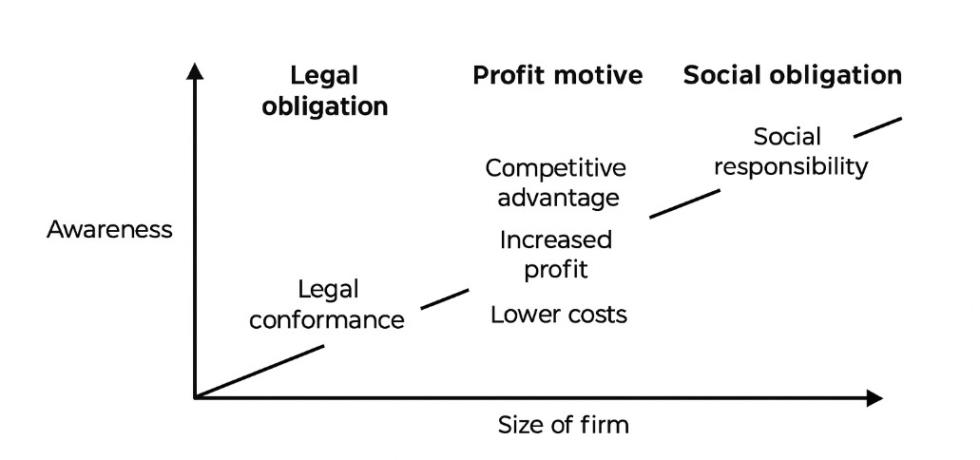
The framework illustrates four interconnected pressures that intensify as your company grows.
Legal Obligation comes first. Every company must follow environmental laws. But the larger you become, the more complex those laws get. A small manufacturer may follow basic waste disposal rules, while a large multinational manufacturer must navigate different regulations in each location. Managing this complexity demands operational handling.
Legal Conformance requires the implementation of robust systems and processes to ensure adherence to the law. Verifiable compliance cannot be achieved through mere assertion. This necessitates real operational infrastructure.
Operational Improvement occurs when managing environmental responsibility actively aids your business. When you reduce waste, you reduce costs. When you improve energy efficiency, you improve margins. When you optimise processes for environmental impact, you often do so for profitability, as well. This is not merely a theory, but a tangible operational benefit.
Social Responsibility and competitive advantage emerge as stakeholders demand it. Investors want to know about environmental risk. Customers favour companies that operate responsibly. Employees seek employment with organisations that care about impact. Good operational environmental management can become a genuine competitive advantage.
How This Shapes Real Operational Decisions
Environmental drivers do not exist in theory; they translate directly into concrete operational choices that affect how your business is run.
- Supply chain and sourcing: If your suppliers operate with weak environmental management, this creates significant regulatory and reputational risk for your firm. This is not simply the supplier’s problem. You must decide whether to work with them, help them improve, or find alternatives. These are operational decisions that impact cost, reliability, and sourcing strategy.
- Manufacturing and production processes: You face choices between methods that generate less waste and use less energy, and processes that are cheaper upfront but create more waste in the long run. The choice affects operating costs, production efficiency, facility management, and compliance with regulations. It fundamentally shapes how you design your operations.
- Product design: Whether your product can be recycled, how much material it utilises, how long it lasts, and how much energy it consumes all matter operationally. These choices affect manufacturing complexity, supply chain requirements, and customer demand.
- Facility and resource management: How you operate your buildings, the water you use, how you manage waste, and how you source energy. These are operational realities that affect costs and efficiency every single day.
- Workforce and operations culture: Employees increasingly seek employment with organisations that operate responsibly. The culture and practices built around environmental management are crucial for talent attraction and retention, as well as for overall organisational efficiency.
The Operational Cost of Ignoring This
When operations leaders fail to treat environmental responsibility as a core operational issue, problems follow: You forego the cost savings available from efficiency improvements. You fail to manage supply chain risk effectively, which often results in expensive, reactive changes when regulations shift or stakeholder pressure increases. Simultaneously, you may struggle to attract the right talent, and you face unexpected costs when compliance gaps are discovered.
More importantly, you are not making the right strategic decisions. You are not optimising your operations based on a comprehensive understanding of what drives your business. You are solving operational problems with one hand tied behind your back.
The Operational Advantage of Getting It Right
When you treat environmental management as a core operational responsibility, you find efficiency gains and cost improvements throughout your business. You optimise processes not just for throughput but for resource use, and you manage supplier risk more effectively. You make strategic decisions about manufacturing, product design, and facilities based on a fuller understanding of what matters.
You also position your business to respond more quickly when regulations change or market expectations shift, without panicking. You are already building the necessary capabilities and processes you need, and your supply chain is already resilient. Your teams are already thinking about these factors.
Finally, you compete in a new dimension. Investors, customers, and talented people increasingly favour organisations that operate responsibly. This extends beyond mere marketing; it is the foundation of a genuine competitive position built upon demonstrable operational capability.
How to Approach This
I definitely do not recommend that you become an environmental expert. You need to start thinking about environmental responsibility as an operational strategy, rather than just compliance or PR.
Here is a 5-step maturity model to guide your transition:
- Systematically Map Impact: Identify where your company creates the most environmental impact. What parts of your operations generate the most waste, use the most resources, or face the most regulatory attention? Start there. These are areas where operational improvement can create real value.
- Assign Ownership & Resources: Define who is responsible for integrating these metrics into existing operational KPIs and allocate the necessary resources.
- Anticipate the Operating Environment: What regulations actually affect you today? What are they likely to be in three to five years? What do your major customers, investors, or employees expect? It is important to understand the operating environment in which you actually work, just as you would any other operational constraint.
- Integrate into Core Strategy: Do not treat environmental responsibility as a separate initiative; instead, integrate it into your operational plan, process improvement programmes, your supply chain decisions, and your capital planning. This is how you achieve real progress.
- Measure for Strategic Rigour: You measure operational performance in many ways. Add environmental metrics that matter to your business. Track progress, identify improvements, and make decisions based on data, just as you do for any other operational challenge.
Conclusion
Environmental responsibility is now a fundamental aspect of operations. The forces pushing companies toward better ecological management are real and growing. They impact your costs, strategy, supply chain, and your competitive position.
The question is not whether these forces matter to your business. They do. The question is whether you are managing them strategically as part of your operations, or whether you are letting them happen to you. The difference between these two approaches has a significant impact on your efficiency, risk, and your competitive position.
- By Stavros Angelidis, Operations Consulting & Advisory
