





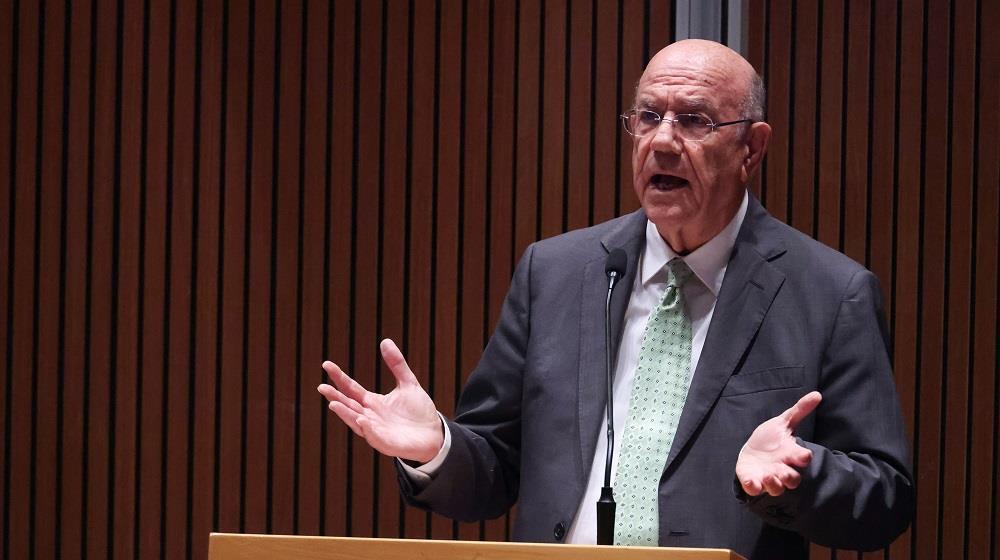
Cyprus is facing a 64.5% increase in its contribution to the European Union budget under the proposed Multiannual Financial Framework for 2028-2034, the second-largest increase among EU member states, compared with a 24.6% rise in the overall EU budget, Finance Minister Makis Keravnos has said.
Keravnos pointed out that, under the current figures, Cyprus would become a net contributor to the EU budget, stressing that the final agreement must address the disproportionate increase in the country's contribution and ensure adequate funding for Cyprus.
Speaking at a press conference on 26 November, the Minister said Cyprus was opposed to any further cuts to Cohesion Policy funding beyond those already included in the proposal put forward by the Irish Presidency of the Council of the EU.
He said the level of Cyprus's annual contribution to the EU budget would significantly limit the country's room for other public expenditure under its four-year fiscal plan.
"Financing the European budget must reflect the economic capacity of each member state, and this is our permanent and consistent position in all European Union forums and Councils," Keravnos said.
Asked whether Cyprus would be a net beneficiary or a net contributor even if there were no further cuts to Cohesion Policy funding, the Minister replied that it would be a net contributor.
Referring to discussions at the Cohesion Policy Council last Monday, Keravnos said Cyprus had advocated that Cohesion Policy funds should reach citizens and businesses easily, directly and effectively, delivering tangible results.
He said the policy was directly linked to strengthening competitiveness, productivity and social cohesion in member states, adding that reducing bureaucracy and simplifying multiple checks and regulations were necessary to ensure that its benefits reached local communities and citizens more quickly.
Keravnos stressed that Cohesion Policy should retain a strong role in the EU's next budget for 2028-2034, with adequate funding guaranteed.
"We, as a country, are opposed to any further cuts," he said, warning that additional reductions would negatively affect small and medium-sized enterprises, citizens and local communities, while further limiting Cyprus's fiscal space for development and social policies.
The Minister also referred to the different structure of the proposed EU budget, which is based on three pillars, unlike the previous framework, which provided specific allocations for the Common Agricultural Policy, Cohesion Policy and other EU policies.
He also highlighted the importance of the policy for remote regions and island member states such as Cyprus, noting that the country had already benefited substantially from its implementation.
Positive assessment of Cyprus's fiscal plan
Keravnos also referred to the European Commission's recent assessment of Cyprus's Draft Budgetary Plan, saying it had concluded that the plan complied with the fiscal policy requirements of the Stability and Growth Pact.
According to the Minister, the Commission noted that, despite the prevailing crisis conditions, the fiscal plan supported the country's strong fiscal position through the maintenance of budget surpluses.
In its assessment, the Commission forecasts economic growth of 3.3% in 2027, a fiscal surplus of 3.2% of GDP and public debt of 40.6% of GDP.
However, it also raised reservations over net expenditure growth in 2026, estimated at 8.2%, compared with the permitted ceiling of 5%.
Keravnos acknowledged the deviation, saying the Government was ready to take the necessary corrective action while continuing its responsible fiscal policy.
(Source: CNA)