




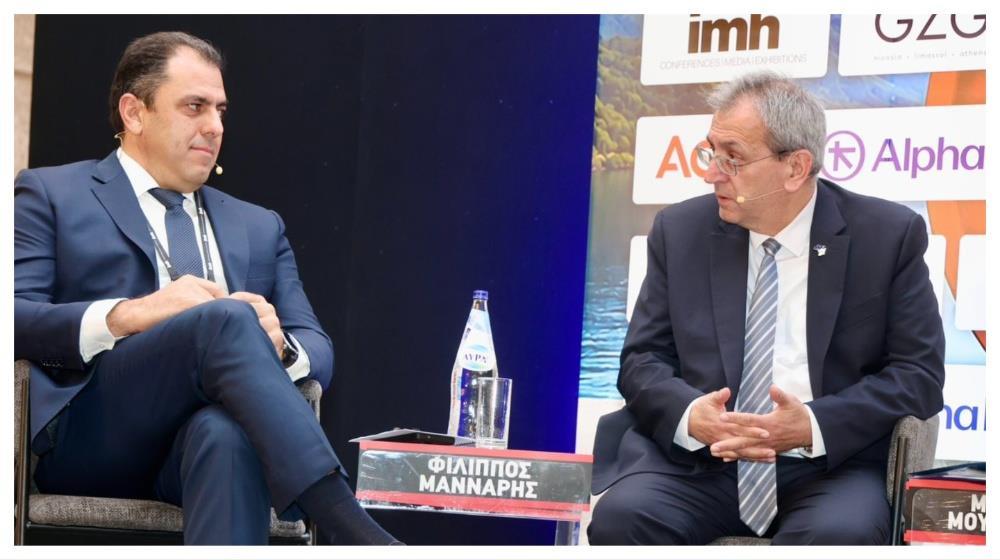
Minister of Labour and Social Insurance, Marinos Moushouttas has presented the priorities of the pension reform in Cyprus.
This was in the context of a fireside chat at the 17th Pension Forum with Philippos Mannaris, Head of Aon’s Wealth Solutions, Cyprus & Middle East, emphasising that the effort is as in the coming days, and after the legal processing by the Prosecutor's Office is completed, the bill will proceed.
The progress of the bill and the social dialogue
Moushouttas specefically mentioned that a great effort had been made to conduct an extensive dialogue with the contribution of all social partners. He acknowledged that there are differences; however, he underlined the Ministry's obligation to advance the bill, which has already been delayed.
As he stated characteristically, "The effort is, within the next few days, after the legal processing by the Prosecutor's Office is completed, to move forward with the bill. Weighing things up, we judged that we should move forward regardless of whether there is an overall agreement or not."
He explained that many of the partners' proposals were incorporated, noting that the essence of the dialogue is "to listen, to judge and to act," while emphasising that the final say on the approval or modification of the legislation will institutionally be held by the House of Representatives.
Sustainability of the Social Insurance Fund
The primary goal of the reform, as the Minister clarified, remains ensuring the sustainability of the Social Insurance Fund and public finances, which he characterised as absolutely interrelated. "We will safeguard this Fund, which belongs neither to me, nor to you, nor to any of us. It belongs to the previous, the current and the future generations," he underlined.
Actuarial reduction of 12% and support for low-income pensioners
Referring to the issue of the actuarial reduction of 12% for those who voluntarily retire at 63 years of age (a regulation introduced in 2013 to save the Fund), Moushouttas noted that the strong positions of the trade unions were taken into account. In the context of the economic parameters, the Ministry's proposal provides for a reduction of the actuarial reduction by 4.5% exclusively on the basic pension for existing pensioners, those who will retire immediately, as well as future pensioners of the next five years.
As he explained, the alternative distribution of the same fiscal cost into a basic and proportional pension (e.g. by 2.5% to each) was rejected, because "this would mean that those we want to help the most, low-income pensioners, would be helped less."
Incentives to stay in work until age 67
After the five-year period, the Ministry's philosophy aims to encourage employees to remain in the labour market. In this context, an important innovation is being introduced for the private sector: employees will be able to voluntarily continue working and paying social security contributions until the age of 67 (instead of the current 65), receiving as a reward an increase in their pension by approximately 15%. Accordingly, early retirement at the age of 63 will be accompanied by a corresponding reduction of 15%. Justifying this policy, the Minister stated: "Life expectancy is increasing. Today in Cyprus we have full employment, so we need experienced workers in the various units to work."
Supervision of the second pillar and Provident Funds
Regarding the development of the second insurance pillar, Moushouttas said that the dialogue with the social partners is continuing, however, there is a broad consensus on the need to create an independent supervisory authority. As he noted, various scenarios are being examined, such as subordination to the Cyprus Securities & Exchange Commission, the Central Bank, consolidation with insurance companies or the establishment of a body exclusively for Provident Funds, adding that "from what I have heard, without a final decision yet, most opinions converge towards a single supervisory umbrella."
Trust is key
Earlier, during his welcome address to the conference, Moushouttas analysed the philosophy of the overall redesign of the pension system, which has been in operation since 1980 and needs modernisation to respond to demographic aging, the pension gap between men and women, and modern work paths. As he stated, “The answer to these challenges could not be yet another piecemeal fix,” explaining that in collaboration with the International Labor Organization, three goals were set: adequacy, fairness and sustainability.
Presenting the changes to the first pillar, the bill of which completes the legislative review, he stressed that a revised basic pension is being introduced without an increase in contributions. The increases will range from 5% to 60% and will be paid gradually over three years (30% in the first year, 30% in the second and 40% in the third), with a guaranteed minimum increase of €30 for pensions up to €600. Double calculation will apply for fifteen years, ensuring that no one receives less.
At the same time, the state assumes for the first time the contributions for periods of child or elderly care, studies and disability, while state borrowing from the Social Insurance Fund ends and the gradual repayment of the €12 billion debt begins in 2028, transforming it into a real investment asset.
The Minister placed particular emphasis on the development of the second pillar, underlining that "the first pillar, no matter how much we strengthen it, cannot by itself ensure pensioners the standard of living they had as workers."
The goal is for every worker, beyond the 25% currently covered, to obtain a second income from a professional plan, while also addressing the fragmentation of the hundreds of funds that manage capital of over €4 billion.
In closing, he linked the reform to broader government policy on taxation and education, noting that the keyword for the success of the project is "trust."