




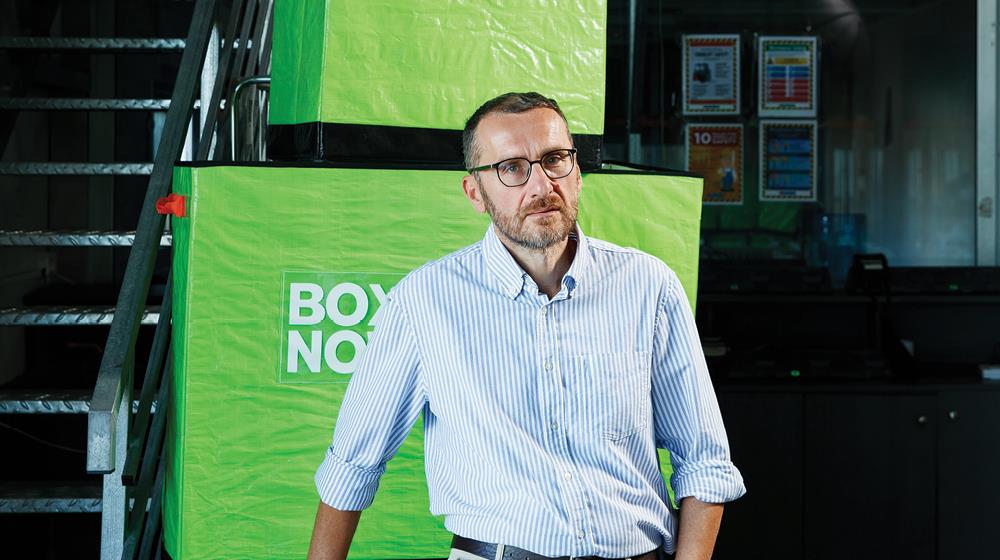
Panagiotis Pavlakis, Head of Logistics at BOX NOW Cyprus, discusses customer convenience and the latest locker delivery system innovations.
He also shares his views on BOX NOW’s strategy for optimising operations to meet today’s delivery needs.
How do you balance the density and placement of automated parcel lockers?
For us, it is a constant balance between customer convenience and operational efficiency. A locker needs to be close enough to fit naturally into a customer’s everyday routine but it also needs to be accessible to our drivers so that they can serve it safely, quickly and efficiently. When deciding where to place lockers, we look at a combination of factors: population density, road networks, walking and driving distances, accessibility, safety, local characteristics, operating costs and the area’s future development.
When we first launched in Cyprus, our priority was to establish a strong network and brand presence across rural, suburban and urban areas. Since the last quarter of 2025, our focus has increasingly shifted towards network densification – adding capacity in areas where demand is strongest. The goal is simple: we want a BOX NOW locker to be within a short driving distance for everyone.
How do you decide when a specific locker cluster has reached capacity? And what happens during peak seasonal surges?
The first clear warning signal comes when daily compartment utilisation exceeds two-thirds of available capacity. At that point, we enter what we internally consider the “red zone” and start taking action before the situation becomes a problem for customers. Demand forecasting is critical here. We continuously monitor utilisation and anticipate where additional capacity will be needed. But peak periods – especially Black Friday through Christmas and New Year – always require an extra level of operational agility. During these periods, we increase capacity and service frequency in high-demand areas by conducting additional deliveries, introducing night shifts and increasing the frequency of SMS notifications that remind customers to collect their parcels. In logistics, the challenge is not simply handling more parcels. It is making sure that a temporary surge in demand does not become a permanent customer experience problem.
How does your software handle delivery exceptions – a full locker bank, a damaged parcel, an invalid recipient PIN code, etc?
The BOX NOW information system is built around a continuous interaction between our central management system and the applications used by drivers on their handheld devices.This allows us to react quickly when something changes during the delivery process. If a shipment needs to be excluded from delivery, if its status is unclear or if recipient information is invalid, our operators can intervene directly and prevent an inappropriate delivery from taking place. A full locker is a particularly good example of why flexibility matters. When a locker reaches capacity, our operators can activate a redirection mode. The driver can then return the parcel to the warehouse or, where appropriate, redirect it to the nearest available locker, keeping the alternative as close as possible to the customer’s original choice. The objective is to solve the exception without creating a new problem for the customer.
While home delivery offers the ultimate in convenience, lockers offer flexibility. From a logistics standpoint, what is the tipping point that makes a consumer shift permanently from doorstep delivery to a locker?
Consumers ultimately choose the option that fits their lives best. Depending on the shipment, that could mean lower cost, shorter lead time, home delivery or collection from a locker. From a logistics perspective, however, the real tipping point is not distance alone – it is routine and consistency. When a locker is conveniently located on someone’s daily route, the customer no longer needs to wait at home for a delivery, rearrange their schedule because they missed the courier or worry about whether someone will be there to receive the parcel. That is when the locker becomes more than a delivery point. It becomes part of the customer’s everyday routine. And once that happens consistently, the shift away from doorstep delivery becomes a natural one.
BOX NOW lockers in Cyprus operate largely on solar energy. During intense summer heatwaves, what logistical or engineering checks are required to ensure that internal batteries and touchscreens don’t fail and cause locker downtime?
More than 90% of BOX NOW lockers in Cyprus operate using solar panels, although some locations require a stable electrical connection because of their specific conditions. Interestingly, from an operational perspective, consecutive cloudy periods can create more challenges than intense summer heat. That is why we rely on a combination of remote monitoring, preventive maintenance and a dedicated technical team. Every locker is continuously monitored remotely. Abnormal temperatures, voltage, charging levels or communication failures can trigger an alert, allowing our teams to intervene before an issue becomes a full-service disruption. We also use preventive maintenance, spare batteries and hardware components, as well as remote resets, to minimise downtime. The key is not simply reacting when a locker goes offline. It is identifying the warning signs early enough to prevent it from happening.
This Special Feature first appeared in the October edition of GOLD magazine. Click here to view it.