




The global economy has entered a period in which geopolitical crises, technological changes and demographic shifts directly affect the decisions of governments and businesses. Energy security, productivity, inflationary pressures and the development of artificial intelligence are shaping a new economic policy framework for Europe.
In these circumstances, the challenge for European institutions is to strengthen the competitiveness and resilience of economies, while maintaining the ability to adapt to a rapidly changing international environment.
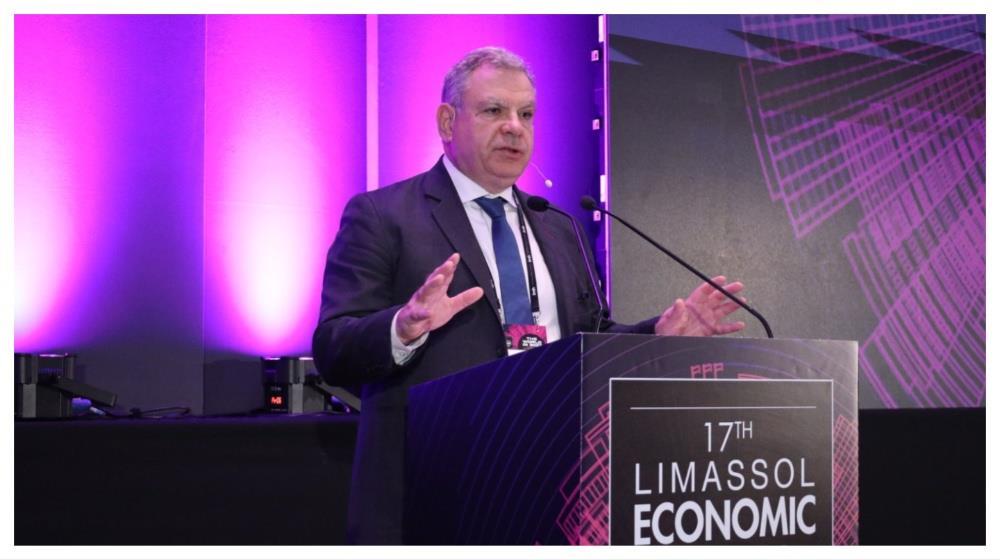
The economic and technological developments that shape Europe's priorities were analyzed by Nikos Vettas, General Director, Foundation for Economic and Industrial Research - IOBE Professor, Athens University of Economics and Business, during the 17th Limassol Economic Forum.
In his speech entitled "Global Economy Challenges and Priorities for European Policies", Vettas presented a global picture of international imbalances, focusing on the direct impacts on the European continent.
As Vettas points out, global imbalances are widening again, with China's surplus recording the largest annual increase in the last 25 years, up by about $300 billion. According to the professor's assessment, the imposition of tariffs redirects trade but changes the overall figures little, as a result of which Chinese exports are shifting towards Europe.
Vettas argues that Europe, as a net energy importer, is exposed to price shocks, a fact reflected in the European Union’s low growth rate for 2026, which is projected at 1.4% compared to 2.3% in the US. According to his analysis, Europe is facing a huge energy gap, as in October 2026 the wholesale price of natural gas in Europe reached $30 per million BTU, when in the US it was just $3. This increased cost, as the speaker explains, is hitting Europe’s energy-intensive industrial sectors hard, which are constantly losing ground to their international competitors.
At the same time, Vettas estimates that Europe is under pressure from three consecutive shocks in the energy market, which are fueling inflation again and burdening public finances. The war in the Middle East has limited the passage through the Strait of Hormuz, resulting in Brent oil exceeding $ 111 per barrel, while attacks on Russian refineries have reduced diesel supplies. As the General Director of IOBE underlines, Europe has serious vulnerabilities, such as the fullness of natural gas storage facilities, which is at 74% instead of the normal 86%, the imminent ban on Russian liquefied natural gas from January 2027 and the excessive dependence on American LNG. In his view, the winter of 2026-2027 is expected to be difficult, as a severe winter could reduce stocks to 11% by March.
According to Vettas, the productivity gap with the US is widening due to low investment and slow adoption of new technologies. As the professor reports, the US is experiencing an investment boom around artificial intelligence, with tech giants planning capital expenditures of $700 billion for 2026. In contrast, in his assessment, European reforms that require the concentration of resources or powers have stalled. Mr. Vettas argues that the Draghi report predicts the need for additional investments of 750 to 800 billion euros per year, but by mid-2026 only 30% of the agenda has been legally implemented and only 3% of the most ambitious reforms.
In Vettas' view, the way out for Europe requires the channeling of European resources to finance European public goods and the unification of the capital market.
As the professor concludes, increased defense spending must be linked to civil research and production to maintain the benefits within Europe, while education must be radically reformed, introducing digital literacy and an understanding of artificial intelligence from school, as skills are the basis for innovation and resilience.