



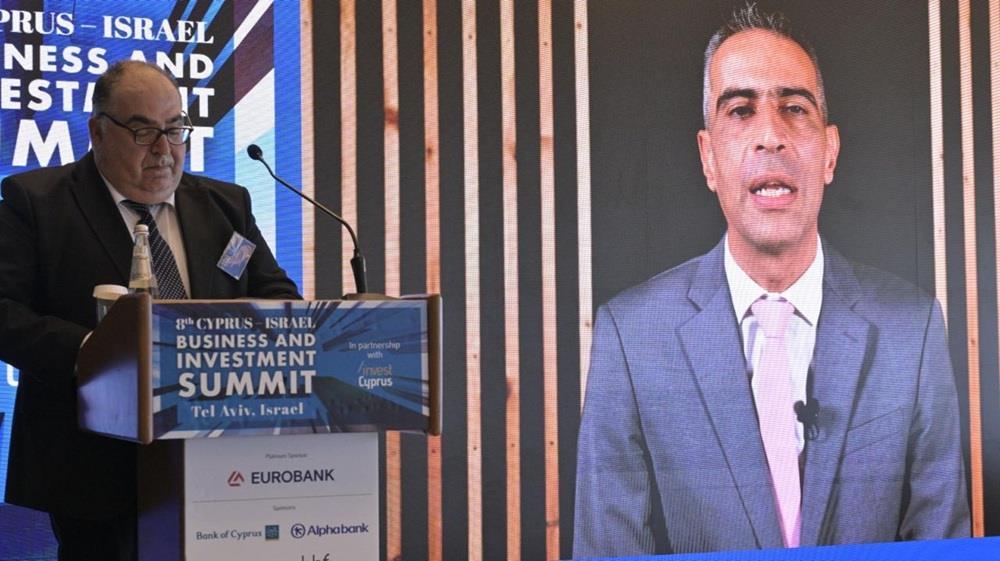
Speaking in a video message to participants at the 8th Cyprus–Israel Business and Investment Summit in Tel Aviv, the Chairman of the Cyprus Securities and Exchange Commission (CySEC), George Karatzias, highlighted the importance of international cooperation among supervisory authorities in a constantly evolving financial environment.
Karatzias said that CySEC’s cooperation with the Israel Securities Authority is based on established international and bilateral arrangements, including the IOSCO Multilateral Memorandum of Understanding, a bilateral memorandum between the two authorities, and cooperation arrangements under the EU’s Alternative Investment Fund Managers Directive.
These agreements facilitate the exchange of information, supervisory cooperation and mutual assistance, enabling the relevant authorities to address cross-border risks and safeguard the integrity of their markets.
Karatzias stressed that, at a time when financial activity, investment flows and digital services increasingly transcend national borders, close cooperation between supervisory authorities is not merely useful but essential. Effective supervision, he added, requires trust, transparency and continuous communication between the authorities concerned.
Technology and emerging risks
Turning to the changes taking place in financial services, he noted that technological innovation, artificial intelligence, digital assets and new business models are transforming the way companies operate and how investors access financial markets.
At the same time, geopolitical developments, cyber threats and the growing interconnectedness of markets are creating new risks for financial institutions, investors and supervisory authorities.
In this environment, he said, the challenge for capital market regulators is to ensure that markets remain resilient, transparent and reliable, while adapting to rapid technological and structural change.
The core mission of supervisors remains unchanged, but the conditions in which they operate are evolving rapidly. Beyond protecting investors and preserving market integrity, supervisory authorities also have a responsibility to contribute to the resilience, stability and orderly functioning of financial markets.
EU rules on crypto-assets and digital resilience
Karatzias also referred to the European regulatory and supervisory framework within which Cyprus’s capital market operates. This framework, he said, sets common standards aimed at enhancing transparency, strengthening investor protection and building confidence in Europe’s financial markets.
In recent years, he noted, significant regulatory developments have taken place. The implementation of the Markets in Crypto-Assets Regulation (MiCA) established, for the first time, a harmonised regulatory framework for crypto-asset activities across the European Union.
Meanwhile, the Digital Operational Resilience Act (DORA) introduced a comprehensive framework to strengthen the digital resilience and preparedness of financial entities against cybersecurity risks.
These two reforms, he said, reflect the EU’s broader aim of enabling innovation while ensuring appropriate investor protection, market integrity and financial stability.
Capital markets union and anti-money laundering
Karatzias also referred to the European Union’s efforts to further integrate and strengthen its capital markets through the Capital Markets Union. The objective, he explained, is to create more integrated, efficient and competitive capital markets capable of supporting investment, innovation, sustainability and long-term growth.
Developments are also taking place in the fight against money laundering and the financing of terrorism. The new EU legislative package aims to strengthen the consistency of supervision and further reinforce the integrity and resilience of the financial system across member states.
“Effective regulation is not about introducing more rules, but about ensuring that regulatory frameworks remain fit for purpose in a rapidly changing environment, while maintaining confidence in the financial system,” was the central message of his address.
Achieving this balance, he said, requires forward-looking supervision based on risk assessment and proportionality, as well as close cooperation among supervisory authorities, policymakers and market participants.
The challenge, he added, is to support innovation without compromising investor protection, encourage growth while safeguarding market integrity, and harness technological progress without undermining resilience and trust.
Trust as the foundation of the market
In closing, the CySEC Chairman stressed that trust is the foundation of every successful capital market. Investors commit capital when they believe markets operate fairly, transparently and efficiently, while businesses can access financing when markets are characterised by integrity and predictability.
At the same time, the resilience of the financial system and its ability to support productive investment contribute to economic prosperity.
Karatzias assured participants that CySEC remains committed to promoting transparent, resilient and effectively regulated markets, to playing an active role in the European supervisory framework, and to strengthening cooperation with its international counterparts, including the Israel Securities Authority.
He concluded that cooperation among supervisory authorities, market participants and policymakers can help ensure that financial markets continue to serve investors, businesses and society effectively in an increasingly complex and interconnected world.