







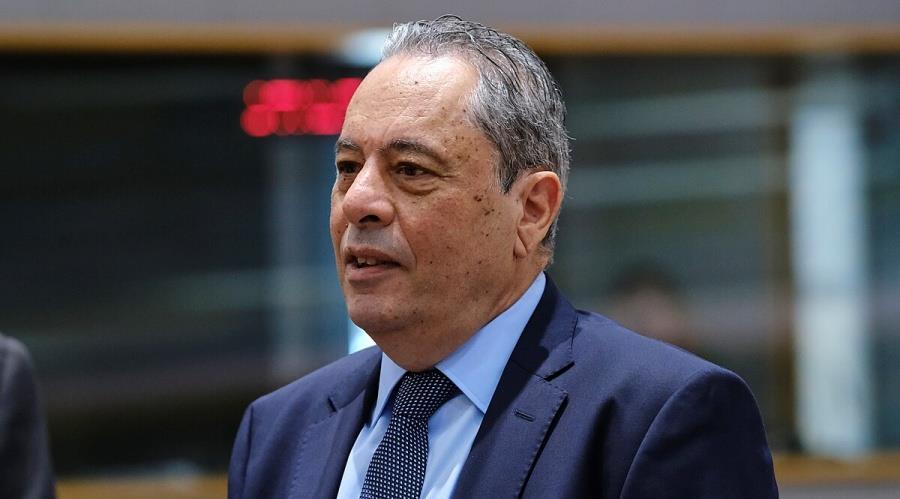
The utilisation of the EU's SAFE programme, the implementation of the multi-year defence procurement programme and the enhancement of the Republic of Cyprus’ defence capabilities were the focus of Defence Minister Vasilis Palmas on Thursday, as he addressed the final phase of the IRIS-2026 Field Exercise.
The Minister said that maintaining a high level of defence and deterrence capability was a fundamental prerequisite for the National Guard to fulfil its mission and safeguard the security of the Republic of Cyprus.
He noted that every military exercise provided an opportunity to further train personnel, while also serving as a means of assessing discipline, operational readiness, the effectiveness of procedures and coordination between different units and formations.
Palmas said that, since its establishment, the National Guard had been a key pillar in safeguarding the independence, sovereignty and territorial integrity of the Republic of Cyprus.
Referring to the international security environment, he noted that it was becoming increasingly complex, prompting the Republic of Cyprus to consistently pursue the substantial enhancement of its operational capabilities.
In this context, he said that the multi-year defence procurement programme was being implemented through the modernisation of existing systems and investment in the acquisition of advanced equipment, with the aim of strengthening operational capabilities in critical areas.
At the same time, he said that the Republic of Cyprus intended to make full use of the European Union’s SAFE financial instrument, while also seeking to ensure that its benefits extended to the domestic defence industry.
According to the Minister, efforts to strengthen defence diplomacy included establishing new defence partnerships and deepening existing cooperation with countries in the region and key international actors. Meanwhile, the upgrade of naval and air force infrastructure was progressing.
Palmas said that personnel were the Ministry of Defence’s foremost priority. He noted that investment was being made in staff training and professional development, while measures were also being taken to support career progression and advancement.
The Minister linked the strengthening of Cyprus’ defence to the circumstances facing the Republic, 52 years after the Turkish invasion and amid the ongoing Turkish occupation.
In his own address, National Guard Chief, Lieutenant General Emmanouel Theodorou said that the National Guard was entering a new era built around four key pillars: the modernisation of equipment and infrastructure, the adoption of modern, innovative practices, improved survivability through the undergrounding of infrastructure and functions and the delivery of modern, realistic training for personnel.
He noted that, in response to the political leadership’s determination to introduce modern practices into the National Guard’s operational activities, for the first time in a training exercise of this kind, incorporated unmanned aerial vehicles (UAVs) and anti-drone systems, were used, during IRIS.
These, he said, were capabilities being deployed on a large scale in conflicts unfolding around Cyprus. Some of the systems were manufactured in Cyprus by domestic companies, while others were being developed by National Guard personnel in a dedicated prototype laboratory established just a few months ago, he noted.
The National Guard Chief also referred to the combined deployment of unmanned systems alongside F-16 fighter aircraft from the Hellenic Air Force, new H145 helicopters, special forces, artillery, mortars, tanks and infantry.
He said that the use of these assets had provided an insight into the modern battlefield and the level of operations being conducted in such an environment.