




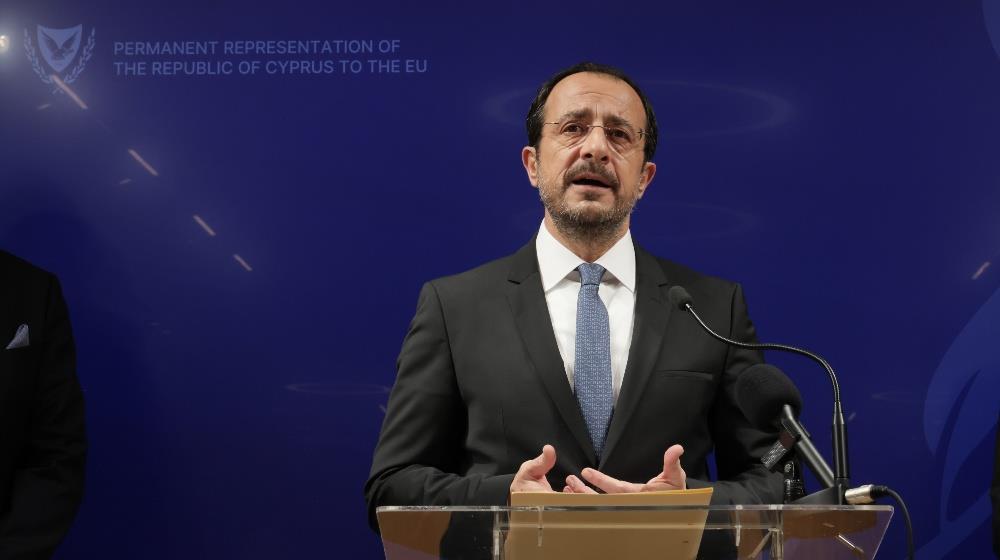
President of the Republic Nikos Christodoulides highlighted five key issues upon his arrival at Thursday’s European Council in Brussels, first among them the need for greater flexibility in taking national measures on energy costs and for suspending the implementation of the Emissions Trading System 2 (ETS 2). He also stressed the need for a political agreement on the Multiannual Financial Framework by the end of the year, while pointing to December as the month for developments regarding Cyprus’s accession to Schengen.
On energy costs, Christodoulides noted: “Our request is simple and clear: the need for the European Union to show greater flexibility in taking national measures, while at the same time further suspending the implementation of ETS 2. It is something several member states are calling for. We will support it,” he said.
Referring to Turkey’s illegal “memorandum of cooperation” with the occupied areas, he said the issue would be raised in the context of the discussion on energy and the Greece-Cyprus electricity interconnection (GSI). “We will refer to the importance of the GSI - geopolitical, energy-related and economic - and we will also refer to Turkey’s illegal efforts in relation to this matter,” he said.
On the second issue, the Multiannual Financial Framework (MFF), the President welcomed the Irish Presidency’s new proposal, which builds on the successful proposal submitted during Cyprus’s Presidency. “The first thing I want to say is that, of course, we understand and support the need to strengthen the EU’s new policies, defence and security, competitiveness, migration, but at the same time this must not come at the expense of the Common Agricultural Policy, the Cohesion Fund and Cohesion Policy, which benefit European citizens,” he said.
Christodoulides expressed hope for progress and said he expected an extraordinary summit in November. “I hope we make substantive progress today. I believe there will also be an extraordinary European Council in November. There are certain political developments, such as the elections in Spain and the result in Sweden, which may create some issues for us. We must reach a political agreement by the end of the year; otherwise, things will clearly become more difficult, and I believe we will send a negative message both to European citizens and to the world more broadly,” he said.
Asked by CNA whether the discussion on the MFF should be “unlocked” through new own resources, the President replied: “For us, the discussion on the MFF is primarily political, not an economic one. It is a political discussion which must reflect the EU’s priorities for the next period, and we know very well where we need to focus.”
He then referred to political developments in member states, saying: “The second political element of this discussion is the fact that we do not have a government in Sweden. Efforts are being made to form a government, without ruling anything out,” he said.
He added: “At the same time, there are the elections in Spain. We do not know the outcome, nor whether it will be possible to form a government. And at the same time, in 2027, there will be elections in France, Italy, Poland and possibly other member states. So it is very important that there is an agreement before the end of the year,” he said.
On the shaping of the package, the President referred to an 8% reduction by the Irish in relation to the Commission’s proposal. “It is not something we agree with, but, because at the end of the day it is a compromise, I believe this reduction will increase a little further; we will have a double-digit reduction: 10%, 11%, 12%. But the most important thing is that there is a political agreement by the end of the year,” he repeated.
He estimated, finally, that the MFF would dominate the discussions. “I believe the MFF will dominate. We are facing a new negotiating framework, and certainly the issue of energy, which concerns the European Union’s competitiveness, and the cost that families and businesses are called upon to bear as a result of a prolonged and unprecedented crisis,” he stressed.
Regarding Cyprus’s accession to the Schengen Area, he noted that, as he had already done with European Commission President Ursula von der Leyen, he would have the opportunity to discuss with his counterparts the Republic of Cyprus’s application for full accession to the Schengen Area. “The entire technical processing has already been completed, and we hope that the matter will be discussed at the competent Council in December, so that the final political decisions can also be taken,” he said.
Asked about the Strait of Hormuz, which remains closed, and the expansion of the war front to the Red Sea with the Houthis, the President said: “I expect us all to move in the same direction,” pointing to “measures with an immediate impact on citizens, primarily households, families and businesses.”
Secondly, institutional measures which cannot be implemented immediately due to preparatory work, but which “will help the European Union reduce its dependence on the region. And it is within this framework that we will refer to the GSI, to the importance of the GSI, of the interconnection of member states,” he said.
Thirdly, “which is at least the direction we are moving in in Cyprus, is strengthening citizens’ disposable income, so that they can respond, among other things, to the new challenges,” he added.
On the EU–Gulf Cooperation Council (GCC) Summit, the President said that confirmation was expected on whether it would take place. “If it takes place, Cyprus will be there. What we are seeking from the summit are specific deliverables that will bring the region, the Gulf and the European Union closer together,” he said.
He recalled that “it was one of our key priorities during our Presidency,” and that an informal meeting had been held in Cyprus with the participation of Egypt, Jordan, Lebanon, Gulf countries and Syria, where Cyprus was a “strong supporter” of closer EU engagement with the region “through specific, positive developments.” “As of this moment, we do not have a final decision,” he added.
On the EU’s role as a security provider in the Gulf, he said: “Of course, we must be a security provider in the Middle East and the Gulf. Our security, the security of the Gulf and the security of the European Union are interconnected, so we must cooperate. We must play a much more active role in security, but also in other areas.”
Asked finally whether he would welcome Britain back into the EU, Christodoulides replied: “If Britain is ready to return, we are ready to welcome it.”