






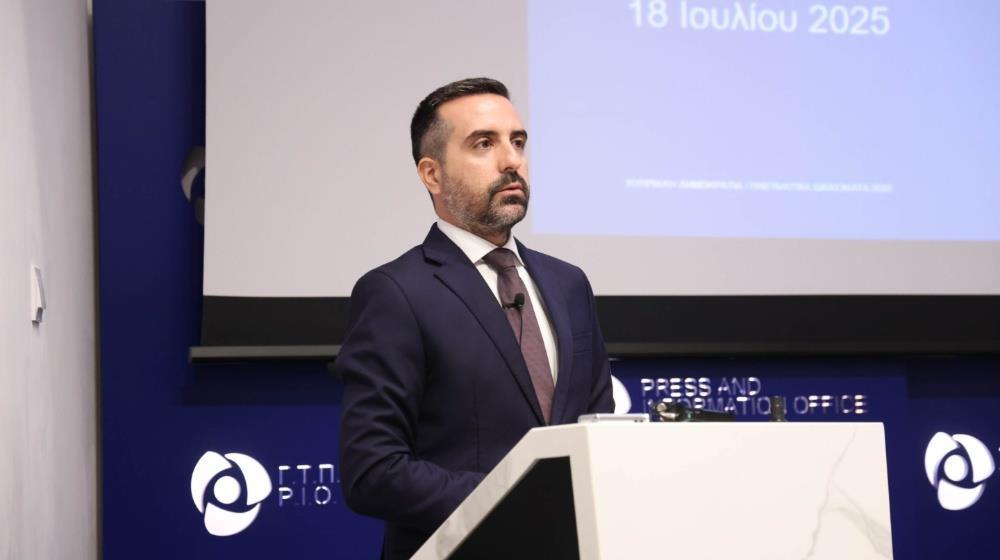
Deputy Minister of Migration and International Protection Nikolas Ioannides took part in Thursday's Justice and Home Affairs (JHA) Council in Luxembourg.
On the sidelines of the meeting, he met his Austrian, Dutch and Finnish counterparts as part of efforts to secure the Republic of Cyprus's accession to the Schengen area.
In statements before the start of the Council, the Deputy Minister said that all of the European Commission's recommendations are now considered implemented and that Cyprus is technically ready for full participation. He added that political agreement is now required and that the Republic looks to the support of its European partners in the coming months.
Referring to the recent crisis in Ceuta, he expressed Cyprus's solidarity with Spain. He stressed that any member state facing mass migratory flows must receive tangible support from the EU and the other member states, underlining the need for coordinated action to safeguard the Union's territory and the Schengen area.
During the discussion on the overall situation in the Schengen area, Ioannides said that protecting it presupposes strong management of the external borders, effective asylum procedures and credible return policies. He pointed to Cyprus's experience: despite the considerable migratory pressure it has faced, it has managed, with the support of European mechanisms, to reduce illegal and irregular arrivals and increase returns. He also noted that measures affecting the smooth functioning of the Schengen area must remain exceptional and be based on clear, well-documented evidence.
In the discussion on improving returns by strengthening readmission cooperation with third countries, the Deputy Minister stressed that the effectiveness of returns is a key indicator of the credibility of migration policy. He advocated the combined use of migration diplomacy, visa policy, strategic partnerships and financial instruments, so that the EU develops a coherent approach towards partner countries. He made clear that, where cooperation remains insufficient, the Union must be ready to make full use of the tools available to it.
He also underlined the importance of collecting and analysing reliable data on border procedures and returns, so that decisions on priority countries and on the effectiveness of readmission cooperation are based on facts. He noted that migration cannot be used as a means of political pressure or geopolitical manipulation, and that the EU must remain united in the face of attempts to instrumentalise it.
Regarding Greece's initiative to create a European emergency mechanism, the Deputy Minister supported launching a structured discussion at Council level. He noted that exceptional circumstances of instrumentalised migration and hybrid threats at the external borders may require a strong and coordinated response, stressing that any such mechanism must comply with European and international law.
On the implementation of the Pact on Migration and Asylum, Ioannides said Cyprus has made substantial progress in adapting its legislative, administrative and operational framework, including screening and border procedures, emergency planning and the operation of the "Pournara" centre. He stressed that the Pact's success will be judged by results in practice and by maintaining the balance between responsibility and solidarity. In this context, he underlined that frontline member states need continued practical, operational and technical support in order to implement the new obligations.
In an intervention on strengthening migration monitoring and early warning capabilities, the Deputy Minister stressed that information must lead to timely political and operational action. He backed more effective information exchange between member states, the Commission and European agencies, to prevent crises and mobilise the competent mechanisms more quickly. He also referred to the role of disinformation, online manipulation and smuggling networks, pointing to the need to use publicly available information within an appropriate legal framework and with full respect for personal data protection and fundamental rights.
On the sidelines of the Council, the Deputy Minister held bilateral meetings with Austrian Interior Minister Gerhard Karner, Dutch Minister for Asylum and Migration Bart van den Brink, and Finnish Interior Minister Mari Rantanen. The talks focused on efforts to secure Cyprus's accession to the Schengen area.
In addition, with his Austrian and Dutch counterparts, he discussed the possibility of establishing return hubs in third countries, in line with European and international law, as well as Cyprus's participation in related efforts. With the Finnish minister, he discussed strengthening returns and readmission through cooperation with third countries, stronger management of the EU's external borders, and new approaches to tackling illegal and irregular migration.