








Cyprus’ economy continues to present a positive picture, with growth reaching 3.8% in 2025 and expected to remain around 3% in 2026, while public finances remain in surplus and public debt has fallen to 55% of GDP.
However, geopolitical developments, energy dependence, low productivity, demographic changes and persistent weaknesses in public investment pose significant risks to the economy’s medium- and long-term prospects, the Fiscal Council has said.
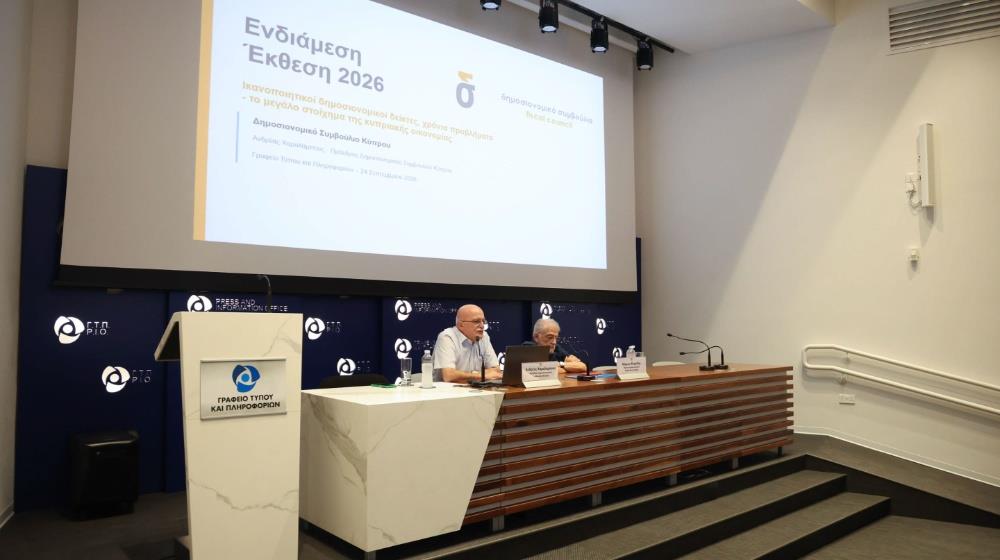
Presenting the Council’s 2026 Interim Report in Nicosia on 24 September, its President Andreas Charalambous said the country’s fiscal position remained strong, with the general government recording a surplus of around 3.4% of GDP in 2025. Public debt has declined below the 60% threshold, supported by fiscal surpluses, economic growth and favourable borrowing conditions.
Charalambous noted that economic growth has been supported by increased migration, the presence of foreign companies, rising employment, domestic consumption and exports of services. Tourism has also remained resilient despite the wider geopolitical environment.
Employment increased by 3.5% in 2025, while unemployment fell to 4.4% for the year and to 3.6% in the first half of 2026.
Structural challenges
At the same time, he pointed to structural challenges that could limit Cyprus’ growth potential. The ageing population and demographic trends mean that migration and employment can no longer be relied upon indefinitely as the main drivers of growth. Migrants already account for more than 20% of the population and the figure could approach 30%, he said.
Future growth, therefore, will increasingly have to come from higher productivity, an area in which Cyprus has underperformed in recent years, Charalambous said.
The Fiscal Council also highlighted the country’s current-account deficit, despite the strong performance of tourism and other services. This is linked, among other factors, to Cyprus’ dependence on imported energy and higher oil prices. The presence of foreign companies also affects the primary income balance, he noted.
Charalambous warned that a further escalation of geopolitical tensions could lead to higher energy prices, weaker growth in Cyprus and its trading partners, and increased government borrowing costs. "Maintaining sound public finances is therefore particularly important in such an environment", he added.
Public investment remains another major concern, according to Fiscal Council. The execution rate of the development budget stood at only 25% in the first half of 2026, reflecting, among other things, administrative capacity constraints and delays in preparing projects. The Fiscal Council also referred to low absorption of funds from the Recovery and Resilience Facility, based on an assessment by the University of Cyprus.
Strong fiscal performance
As Charalambous said, Cyprus’ strong fiscal performance has been based largely on high revenues, while expenditure remains elevated and has exceeded limits agreed at European level. Concerns therefore relate not only to the level of public spending but also to its quality, particularly the low level of investment and social expenditure that is not sufficiently targeted.
The Council identified several short- and medium-term fiscal risks, including the possibility of spending pressures during the upcoming election period and the consequences of a prolonged conflict in the Middle East, particularly through persistent energy-price pressures.
In the medium term, it also stressed the need for independent and credible studies on major infrastructure projects, including the Cyprus-Greece-Israel electricity interconnection and the Vasilikos power station. The Council does not take a position on the projects themselves, but said their viability and any potential fiscal support should be clearly assessed and compatible with other fiscal objectives.
In the longer term, Charalambous said that climate change and population ageing remain major challenges. The current ratio of approximately four workers per pensioner could fall to around two to one, underscoring the need for pension reform, he went on to say.
The Fiscal Council called for continued prudent fiscal policy, improved assessment of public investment, better targeting of social spending, a binding three-year fiscal framework, faster implementation of productivity-enhancing structural reforms and stronger fiscal governance and institutional capacity.
It also called for closer monitoring and evaluation of large state-owned and semi-government organisations, warning that unresolved structural weaknesses could eventually translate into fiscal costs and undermine the positive economic picture currently prevailing in Cyprus.
(Source: CNA)
