







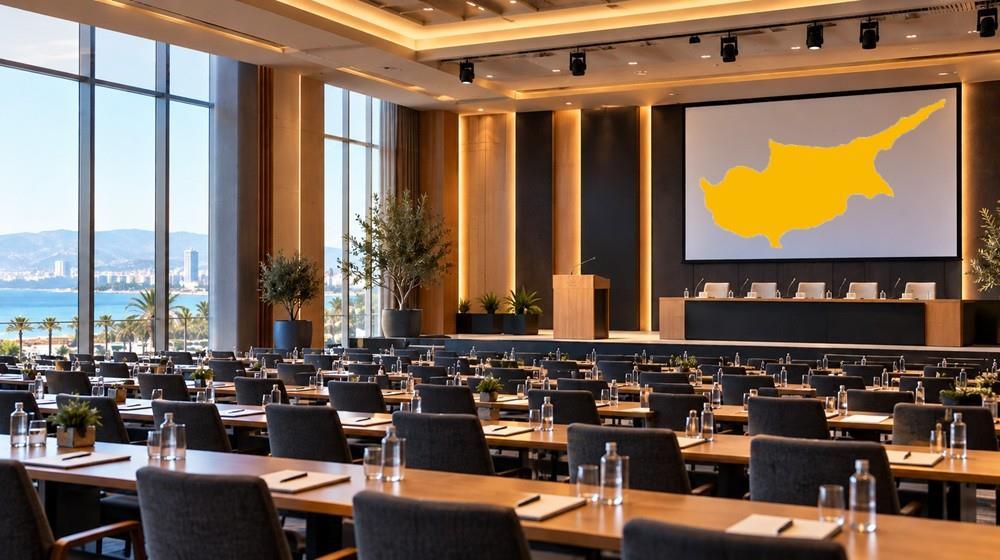
The Deputy Ministry of Tourism is focusing, among other things, on attracting more and larger international conferences, especially during the winter months, placing conference tourism among the top priority forms of tourism within the framework of the National Tourism Strategy 2035.
Indicative of the Deputy Ministry's focus on conference tourism is the recent Cabinet approval of an incentive plan for attracting conference tourism events.
As the Deputy Minister of Tourism, Kostas Koumis, has characteristically stated, "the essential feature of this specific plan is its four-year validity, which allows organisers to plan their events in Cyprus in a timely manner," noting that its annual budget amounts to €150,000.
However, based on the National Strategy for Tourism, the Deputy Ministry's targeting is not limited to traditional conferences, but covers a wider range of activities, from business meetings and incentive trips to product presentations and launches, exhibitions and other quality corporate events.
The central vision is for Cyprus to be able to successfully bid for more and larger events, even with over 600 participants, with particular emphasis on the winter season.
320 conference rooms and a capacity for 33,000 people
According to the National Tourism Strategy 2035, the government-controlled area of Cyprus has approximately 320 conference rooms and multi-purpose venues within hotel accommodations, with a total capacity of approximately 33,000 people.
Paphos has the largest total capacity, approximately 10,000 people, followed by Limassol with 8,000, free Famagusta with 6,000, Nicosia with 5,000, Larnaca with 3,000 and the mountain resorts with approximately 1,000 people. At present, the country mainly hosts small and medium-sized conferences, with a maximum capacity in a theater configuration of approximately 1,500 delegates.
However, more than 70 alternative venues outside of hotels also enter the equation, such as museums, municipal and cultural venues, amphitheaters, theaters and multi-purpose venues. These are facilities throughout Cyprus that can host events of more than 100 people.
A "weapon" against seasonality
The Deputy Ministry's interest in this specific sector, however, is directly linked to the effort to extend the tourist season. Although the total number of conference tourism arrivals remains low compared to the rest of the tourist flow, the Strategy nevertheless highlights its multiplier benefits.
As stated, "conference tourism contributes to increasing tourism revenues, reducing seasonality and strengthening winter tourism."
Furthermore, it is emphasised that conference participants are often accompanied by other people, who during their stay take excursions, gain tourist experiences and go shopping.
The Deputy Ministry even notes that in several cases, those accompanying the participants can even lead to a doubling of the number of foreign visitors associated with a conference, without the specific numbers being recorded in conference tourism statistics.
It is noted that based on the applications submitted to the relevant sponsorship plan over the last three years, the average length of stay of the conference visitor is 3.8 days.
The first city in preference was Nicosia and the second was Limassol, while in terms of time period, November comes first, followed by October, April and September. The Deputy Ministry clarifies, however, that the data of the sponsorship plan does not reflect the entire market.
Visitors with higher demands
Of particular interest is the profile of visitors that Cyprus seeks to attract. This is an audience that travels frequently, mainly outside the summer season, with a preference for four- and five-star hotels.
Conference attendees also prefer to stay in the same hotel, seek direct flights at convenient times and state-of-the-art equipment, while showing increased interest in gastronomy, healthy eating, environmental protection and sustainability.
The audience includes academics, doctors and other professionals, energy experts, representatives of professional associations, as well as managers and other business executives.
The obstacles that must be overcome
The Strategy also lists specific weaknesses that currently limit the potential for the development of conference tourism. These include the absence of direct flights from specific markets, the times and prices of air connections, the lack of large conference venues and hotels capable of accommodating all conference participants under one roof, the difficulty of finding rooms during periods of increased tourist traffic, as well as the availability of large-capacity restaurants.
At the same time, the proliferation of online and hybrid conferences after the pandemic has created additional competition, making it more difficult for destinations to attract events with a large number of participants.
Targeting Europe, the Middle East and Gulf countries
Target markets include the United Kingdom, Germany and other German-speaking countries, Poland, France, Greece, the Middle East and the Gulf countries. The strategy also includes Israel, once the situation normalises.
Already, according to available data from conferences sponsored by the Cyprus Convention Bureau, most groups come from Europe and the Middle East.
In order to claim a larger share of the international market, however, the Deputy Ministry is drawing up an extensive action plan in collaboration with its offices abroad. Among other things, participation in major international conference tourism exhibitions, such as IBTM World and IMEX, specialised workshops and pre-arranged business meetings, B2B contacts, networking events and "sales dinners", as well as familiarisation trips to Cyprus for professionals from priority markets are foreseen.
Enhanced role for the Cyprus Convention Bureau
The Cyprus Convention Bureau is taking on a key role in the planning, with the aim of claiming more conferences through academic institutions and Cypriot associations, utilising the tools of the International Congress and Convention Association (ICCA) and promoting alternative venues for organising events outside of hotels.
The Deputy Ministry of Tourism, based on the National Strategy, also recognises that there is significant scope for closer cooperation with Cypriot professional and scientific associations that participate in international networks, so that Cyprus can bid for events that are assigned on a rotating basis to member countries through competitive procedures.
Closer cooperation with ICCA is also sought for more effective utilisation of its tools and greater international networking.
Finally, the Strategy even mentions the prospect of collaborations with competitive Mediterranean destinations. Specifically, reference is made to the possibility of developing joint packages or promotional campaigns for conference tourism with countries such as Greece and Malta, following similar examples of collaborations between European conference destinations.
The direction outlined by the National Tourism Strategy 2035 is, therefore, the exploitation of conference tourism not so much as a tool for massively increasing arrivals, but as a specialised and quality product that can bring visitors with higher demands outside the peak season, boost tourism revenues and support the goal of more uniform tourist activity throughout the year.
(Source: InBusinessNews)
