






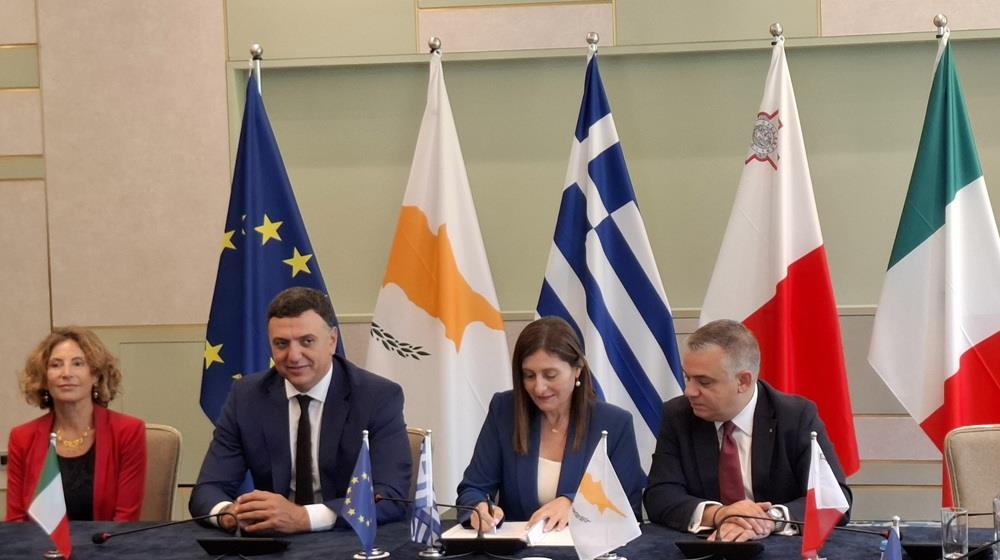
A joint declaration on protecting the competitiveness of the shipping industry was signed in Limassol on Wednesday, by Cyprus Deputy Minister of Shipping, Marina Hadjimanolis, together with Greece’s Minister of Maritime Affairs and Insular Policy, Vassilis Kikilias, Malta’s Minister for Sustainable Mobility, Chris Bonett, and Italy’s Deputy Minister for Infrastructure and Transport, Edoardo Rixi.
In statements following the signing of the Joint Declaration on 9 September, they noted that the four countries account for 75% of the EU’s shipping sector and, therefore, believe that the EU should take their positions on the competitiveness of the industry into consideration.
Deputy Minister Marina Hadjimanolis spoke of a "constructive meeting" where important issues concerning European and global shipping were discussed.
“Today, it is once again confirmed that together we can achieve even better results. Our voice becomes even stronger. Our concerns can subsequently serve as important additions towards ensuring a stronger Europe in the future on shipping-related issues,” she said.
She added that “we agreed today, by signing a Joint Declaration that we have common concerns about the future of the European shipping industry, about the competitiveness of the sector, about decarbonization.”
She also noted that 80% of global trade is transported by sea. “Issues such as energy will concern and affect shipping in the future,” she said, stressing that today’s meeting “has demonstrated that together, the four major maritime states, can lead this process rather than simply follow it.”
A joint effort to support and protect European families
On his part, the Greek Minister spoke of a "milestone" and a "very important day for all", referring to the signing of the Declaration, that reflects "joint effort to support and protect European families and our people, by strengthening the competitiveness of shipping.”
As he said, almost the entirety of global trade is carried out through shipping and, consequently, shipping directly affects the prices of energy, inflation, goods and food, and “drives the European and global economy.”
Kikilias said they would seek to explain to the EU that the challenges global shipping is facing should lead to a “prudent, realistic and meaningful policy."
“I am convinced that other EU member states will also come forward and align themselves with realism and common sense, at a time when we must protect our peoples and our economies,” he concluded.
A very fruitful discussion
On his part, Malta’s Minister said that they had a “very fruitful discussion” regarding the basic needs of people, including food, medicine and energy. “The vast majority of these reach our countries by sea,” he stressed, concluding that “whenever we meet, we are not talking only about the interests of our four countries, but also about the interests of Europe and the entire planet.”
Referring to the challenges facing the sector, Bonett noted, on the one hand, the geopolitical situation and, on the other, the issue of decarbonisation. As he noted, “decarbonisation is a choice to protect our planet for future generations, but we all agree that modernisation, decarbonisation and innovation should not come at the cost of businesses and families. That is the most important message that comes out of our joint declaration.”
He also noted that “we are working together, in close cooperation, and supporting each other, while the idea is for the EU to support our position because, at the end of the day, this will benefit the continent and its people. We all want to move in the same direction, while knowing that we are protecting everyone.”
Consequently, the Maltese Minister said that in the EU’s planning “there must be logic, it must be feasible and it must be pragmatic. The coming weeks and months will be very important to reaffirm our common position within the EU, in order to have a shipping industry that operates effectively, without creating unnecessary inflationary pressures for our citizens, and to ensure that the people working in this sector remain safe,” he noted.
As he stressed, the fundamental principle in shipping is that merchant vessels must have the right to free and safe passage wherever they are headed. He called on third countries “to allow merchant ships to carry out their work and trade to continue, because only through peaceful trade will we see Europe and the world prosper in the future, for generations to come.”
European unity
The Italian Deputy Minister participated in the meeting online. Italy’s Ambassador to Cyprus, Antonella Cavallari, who attended the meeting, noted that Italy considers its participation in this group to be extremely important.
“Together, the four countries represent 75% of the entire EU fleet,” she said, noting that “we should use our strength to promote the ideas and priorities of this group of member states within the EU.”
The Ambassador noted that it is important to maintain EU unity, but “it is also useful to convey to them the perspective of the Mediterranean countries. We share a common vision, common values and ideas. It is important to convey this message.”
The message, she continued, is that it is important to combine competitiveness and decarbonisation without jeopardising the interests of the shipping industry. She said that Deputy Minister Rixi, in his intervention during the meeting, underlined the importance of addressing the needs and priorities of the shipping industry for the benefit of the entire Union, given that the majority of goods are transported by sea.
In addition, the Italian Ambassador said that, beyond Europe, the four countries must also make their voices heard in international forums, such as the IMO.
“The decision to sign the Declaration is important, as is the decision to continue these meetings, with further meetings to follow soon. As Deputy Minister Rixi noted, we need to reach out to other partners, both within and outside Europe, as well as to other countries that may share the same views and can support our vision and interests within the international framework,” she concluded.
(Source: CNA)