







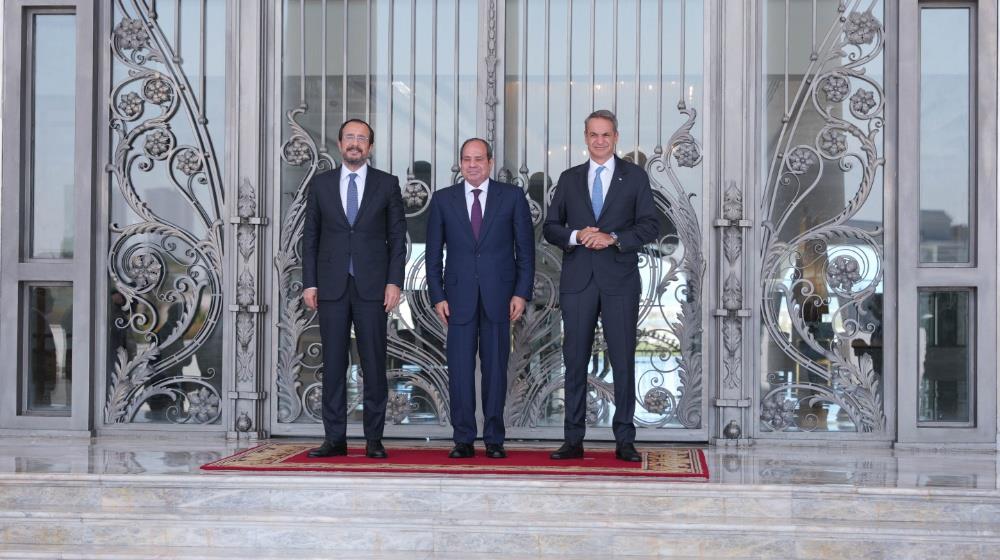
Energy, security and regional developments were at the centre of an informal trilateral meeting between Cyprus, Greece and Egypt in El Alamein, with President of Cyprus Nikos Christodoulides, Egyptian President Abdel Fattah el-Sisi and Greek Prime Minister Kyriakos Mitsotakis reaffirming the strategic importance of cooperation among the three countries for stability and security in the Eastern Mediterranean.
In statements following the trilateral meeting on 8 September, President Christodoulides described the trilateral as “informal in form but strategic in substance”, referring to the significance of the recent Final Investment Decision on the Kronos gas field, which, he said, marks Cyprus’ transition into an era of natural gas exports to Europe through Egypt’s infrastructure.
The Egyptian President placed emphasis on the Egypt-Greece electricity interconnection and on the prospect of transporting Cypriot natural gas to Egyptian infrastructure for re-export to European markets. He also highlighted the importance of defence and security cooperation in addressing regional challenges.
Meanwhile, Greek Prime Minister Kyriakos Mitsotakis reaffirmed Greece’s support for the GREGY electricity interconnection and referred to the prospects of transporting Cypriot natural gas via Egypt to Europe.
The three leaders also discussed developments in Gaza, Syria, Lebanon and Libya, reiterating their support for a two-state solution and respect for international law.
Trilateral cooperation has acquired “strategic depth”, Christodoulides said
President Christodoulides thanked President el-Sisi for the invitation and hospitality, saying that the trilateral cooperation, which has been in place for more than a decade, is based on mutual trust and common goals and has acquired “strategic depth”.
He said the four main pillars of the cooperation are stability, connectivity, security and cooperation in the wider region, noting that the sixth trilateral meeting of the Defence Ministers will take place in Cairo in less than two weeks, while the Foreign Ministers will meet in New York at the end of September. He also expressed his expectation of hosting the 11th trilateral summit in Cyprus.
Referring to the recent Final Investment Decision for the Kronos gas field in Cyprus’ EEZ, President Christodoulides said it “seals Cyprus’ transition into an era of natural gas exports to continental Europe, through Egypt’s infrastructure”.
“The Eastern Mediterranean can become a reliable alternative energy corridor to Europe,” he said, stressing the importance of trilateral cooperation in the energy sector.
On regional developments, the President said the aim is a peaceful and stable Eastern Mediterranean and wider Middle East, with an end to hostilities, de-escalation and peaceful resolution of disputes.
Regarding Gaza, he reiterated Cyprus’ support for a two-state solution and opposition to the forced displacement of Palestinians, noting that the maritime humanitarian corridor from Cyprus complements land routes through Egypt and Jordan.
He also expressed support for Lebanon’s sovereignty and territorial integrity and for Syria’s unity and good-neighbourly relations based on international law. He stressed that, as three maritime states, Cyprus, Greece and Egypt consider freedom and safety of navigation, sea routes and energy infrastructure a strategic priority.
President Christodoulides also referred to Egypt’s role as a pillar of regional and European security and stability and thanked President el-Sisi for Egypt’s long-standing support in efforts to resolve the Cyprus problem. He noted that during Cyprus’ recent Presidency of the Council of the EU, EU-Middle East relations were a “top priority”.
In a post on X, the Presidency of the Republic said energy, economy and security were high on the agenda, along with regional and international developments, while the three leaders reaffirmed the importance of the trilateral framework in promoting stability, security and development in the Eastern Mediterranean and the wider region.
Egypt-Greece electricity link a “real milestone”, says el-Sisi
President el-Sisi described Cyprus-Greece-Egypt cooperation as a model of strategic regional cooperation based on mutual respect, common benefit and international law.
Energy was at the centre of his remarks, with el-Sisi describing the Egypt-Greece electricity interconnection as a “real milestone” for regional energy integration. He also referred to plans for transporting Cypriot natural gas to Egyptian infrastructure and re-exporting it to European markets.
He highlighted the importance of coordination in defence and security in addressing regional challenges, as well as opportunities for further economic and investment cooperation.
On Gaza, el-Sisi rejected the “displacement of Palestinians” and any “change in the demographic composition of the Palestinian territories”, calling for the full implementation of the Sharm el-Sheikh ceasefire and unhindered humanitarian assistance. He reiterated support for the establishment of an independent Palestinian state on the June 4, 1967 borders, with East Jerusalem as its capital.
Regarding Libya, he supported a Libyan-led political process, elections and the withdrawal of foreign forces, fighters and mercenaries. On Syria, he stressed the importance of preserving the country’s unity and territorial integrity, while calling for de-escalation and political solutions in Sudan and the Horn of Africa.
Trilateral cooperation a model for stability, Mitsotakis said
Prime Minister Mitsotakis described the meeting as informal but substantive and as a continuation of last year’s successful 10th trilateral summit in Cairo. He said the trilateral is a “model in favour of stability and prosperity in the Eastern Mediterranean” and “is not directed against any country.”
On energy, he reaffirmed Greece’s support for the GREGY electricity interconnection. Referring to the prospects for Cypriot gas exports, he said: “Gas produced in Cyprus will be transported to Egypt, use its infrastructure to be liquefied and can return to Europe through Alexandroupolis to meet the needs of countries in southeastern and central Europe.” He described this as a “model of energy cooperation.”
On Gaza, Mitsotakis expressed support for a just peace based on a two-state solution, stressing the need for unhindered humanitarian aid and the disarmament of Hamas. He reiterated Greece’s support for Lebanon’s sovereignty and territorial integrity and for a unified Libya, with a UN-led political process and free elections.
Regarding the Cyprus problem, he reaffirmed Greece’s support for a fair and sustainable solution within the UN framework and Security Council resolutions, and for the resumption of talks.
Mitsotakis also stressed the importance of freedom of navigation and respect for international law and the Law of the Sea, saying maritime zones should be delimited through dialogue. He cited the partial maritime delimitation agreement between Greece and Egypt as an example.
“This has been, is and will be our approach overall, both in the Eastern Mediterranean and the Aegean. Greece threatens no one and seeks stability through functional good-neighbourly relations, always on the basis of international law,” he said.
Concluding, he said the strong EU-Egypt relationship is an investment in the stability and prosperity of the common neighbourhood, describing the Cyprus-Greece-Egypt trilateral as a “stable axis of prosperity and security.”
(Source: CNA)
