







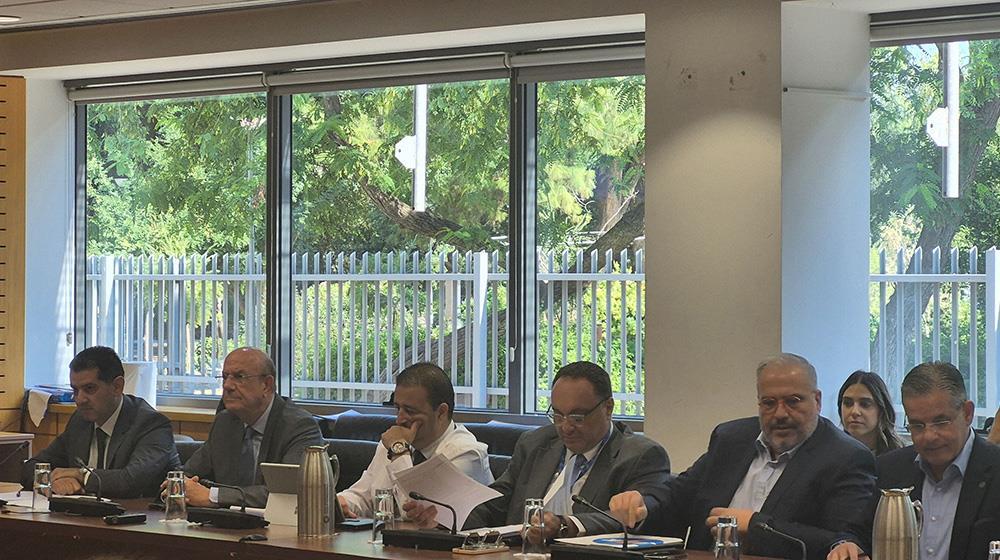
The final cost of the Cyprus–Greece electricity interconnection, the Great Sea Interconnector (GSI), is expected to be significantly higher than the current estimated capital expenditure (capex) of €1.9 billion, according to Finance Minister Makis Keravnos. Addressing the House Energy Committee, the minister stressed that the project’s financial viability and final cost remain unanswered questions.
Keravnos said that the €1.9 billion figure largely concerns the cable itself, noting that there are substantial additional construction works and other costs, including insurance cover, storage facilities and maintenance requirements. These will have to be reflected in updated studies and are expected to considerably increase the project’s overall cost.
According to the Finance Minister, the government cannot take a final decision without updated financial data and a clear picture of the investment’s viability. The state must know the real cost and how it will be financed, he said, particularly as any assumption of costs by the Republic would affect public finances and expenditure limits under the EU’s economic-governance framework.
Conversely, if the cost is passed on to consumers, it would not directly burden public finances but would create a significant issue for households and businesses in a country where electricity costs remain high. An earlier 2017 estimate by the Cyprus Energy Regulatory Authority (CERA) placed the cost to consumers at around 3.7 cents per kilowatt-hour, depending on cable utilisation and the recovery of part of the investment through its use.
The Finance Minister also referred to a viability study commissioned from a US company following a Council of Ministers decision, saying its results were not encouraging regarding the project’s sustainability. An updated study was therefore requested, and the government is awaiting its findings before deciding on the next steps.
He added that the European Investment Bank had raised concerns at an earlier stage over the project’s financial viability, while in July 2023 it suggested that energy-storage solutions should also be examined. In February 2024, the Council of Ministers acknowledged the GSI’s geopolitical significance but set conditions including the completion of due diligence, updated costings and a business plan.
The Finance Minister said Cyprus, as an EU member state, must be interconnected with the rest of the bloc so that it does not remain energy-isolated. However, he noted that the current energy crisis has prompted concern and discussion among EU finance ministers, who concluded that electricity interconnections had not provided solutions to today’s problems.
At the same time, he expressed reservations as to whether the interconnection would lower energy costs, saying: “We are not certain that the price of energy will fall,” while describing it as a particularly expensive project.
No government split
Both the Finance Minister and Energy Minister Michalis Damianou rejected the impression of conflicting messages within the government, stressing that it cannot be said that the project will proceed regardless of cost. Damianou said that, if costs prove too high, investors and other financing mechanisms will have to be found.
Damianou described the GSI primarily as a project of energy adequacy and security, rather than one aimed at reducing electricity prices. However, he said the government has a duty to ensure its technical soundness, financial viability and benefits for consumers. The entry of French company Meridiam gives the project new momentum, he added, but other investors must also participate.
Regarding the Republic’s existing commitments, it was recalled that the previous government had included the project in the Recovery and Resilience Plan with €100 million, conditional on securing EU funding for construction. In addition, a 2021 government decision provided for Cyprus’ participation in the project, a factor that must be taken into account. Whether previous commitments can be amended is, according to the Energy Minister, a “very complex legal question”.
Damianou also highlighted the project’s major geopolitical importance for Cyprus, Greece, Israel and the wider region. If costs change, he said, investor participation or other resources must be explored to cover them, so that Cypriot consumers are not unduly burdened. Regarding field surveys, he said Greece is expected to issue a NAVTEX notice in the coming weeks to allow seabed surveys to continue, with French government support for the French research vessel.
CERA questions ADMIE–Meridiam deal
CERA said that €1.9 billion is the current capex estimate, with 63% allocated to Cyprus and 37% to Greece, while the remaining costs are split equally. The regulator has also raised questions about ADMIE’s ultimate role and whether it will remain the implementing body following Meridiam’s entry.
CERA chairman Poly Lemonares said the Cyprus–Crete–Israel electricity interconnection is an EU Project of Common Interest and that the authority has a regulatory obligation arising from European legislation. He said CERA was informed of the ADMIE–Meridiam agreement on August 11 and, together with Greece’s Regulatory Authority for Waste, Energy and Water, sent a joint letter with questions on August 28. No response has yet been received.
The ownership structure and control of the cable also remain unresolved. CERA vice-chairman Alkis Filippou said that, based on current information, control and management of the cable would be entirely in non-Cypriot hands, raising the question of whether the Republic of Cyprus should participate. CERA board member Neophytos Hadjigeorgiou estimated that the project is now approaching €3 billion and would be completed after 2030.
MPs raise concerns
AKEL secretary-general Stefanos Stefanou expressed strong concern about the cost and viability of the Cyprus–Greece interconnection, saying the government has not provided clear answers on the project’s final cost or whether it will lead to cheaper or more expensive electricity for Cypriot consumers.
He also criticised the government’s approach, arguing that it continues to make commitments without a full techno-economic assessment having first been completed. He referred specifically to an agreement for the payment of €125 million over five years, as well as the increase in the project’s estimated cost from €1.2 billion to €1.9 billion, noting that there are differing accounts even of what this figure includes.
He placed particular emphasis on the project’s ownership and governance arrangements, and on who will ultimately control the electricity market. He raised questions over the participation of French company Meridiam and the terms of its investment, arguing that the government is creating communications impressions without disclosing all the details.
While acknowledging that ending Cyprus’ energy isolation is an important objective, Stefanou said a project of this scale cannot proceed without clear financial and geopolitical terms. He also raised the issue of geopolitical risk, calling for clarification over whose interests the project serves and who would bear the cost in the event of problems or non-implementation.
A series of key questions surrounding the project remain unanswered, ELAM MP Linos Papayiannis said. He stressed the political leadership’s obligation to convey the real picture of the country’s energy situation to citizens, noting that Cyprus remains Europe’s only energy-isolated country.
He also warned of the daily risk of widespread power cuts, despite current electricity adequacy, and expressed strong concern over what he described as the light treatment of the volatile geopolitical situation in the eastern Mediterranean. The MP noted publicly stated assurances that the Republic’s necessary studies would be completed before January 2027, adding that his party would closely monitor the timetable in order to assess the project’s progress and submit its own proposals.
DIKO MP Adamos Aspris referred to the need to await the results of financial-viability and technical studies on the interconnection. Responding to opposition calls for immediate decisions, he said it would be impossible for the government to take a definitive position on implementation or final cost before the studies currently under way are completed.
He also highlighted the immense geopolitical importance of the interconnection not only for Cyprus but also for strategic partners such as the United States, Israel and the European Union. In that context, he proposed greater involvement by these international parties, both financially and in assuming part of the geopolitical risk, arguing that only then would a clear basis emerge for final decisions in the public interest.
ALMA MP Irene Charalambidou accused the responsible ministers of being completely unable to provide clear and substantive answers about the GSI’s status and agreement. She said no one could burden the Cypriot state with billions of euros without securing a clear cost framework, while expressing serious concern over whether the project would ultimately reduce electricity prices or shift costs onto already burdened consumers.
She referred to the case’s “troubled past” and to ongoing investigations by the European Public Prosecutor’s Office into the transfer of shares from EuroAsia Interconnector to ADMIE. She also supported the Finance Minister against attacks he received from circles in Greece, arguing that he was defending the interests of the Republic of Cyprus.
