







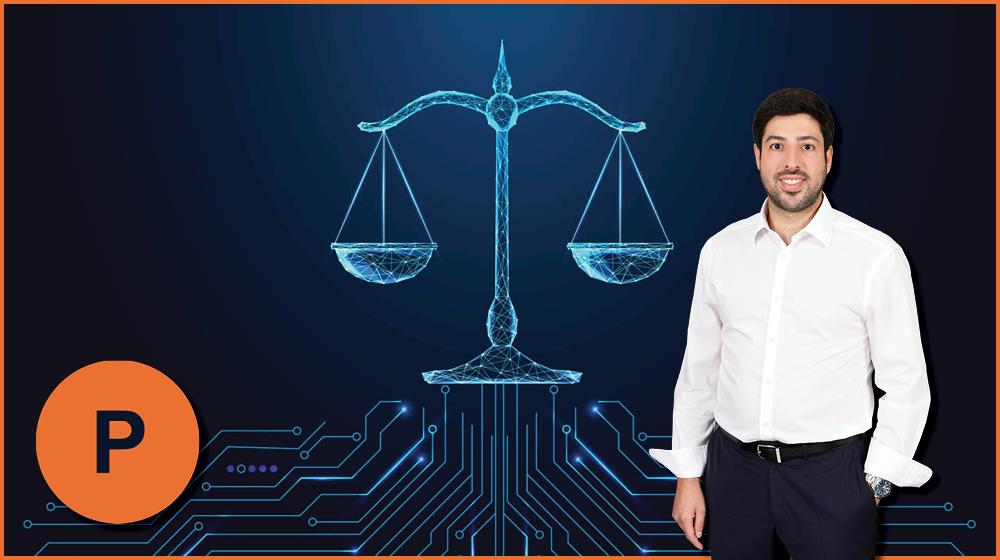
“Anyone who has tried to set up [a business] here will recognise the problem. There is no single place that gives a founder the whole picture – what needs doing, when, and where to start from. The information is scattered, a good deal of it is out of date, and someone arriving from abroad has no way of telling what is even relevant to them. Without the right advice at the outset a founder often ends up with a structure and a set of documents that are unfit for purpose and misses out on the very tax advantages that they came to Cyprus for.” Ioannis Yiasemis, Co-founder of Plato and Partner at Yiasemis LLC says.
In an interview with CBN, Yiasemis discusses how his new, recently-launched AI-powered tool, Plato, helps founders and entrepreneurs acquire all the Cyprus-specific legal information they would ever need to set up their businesses and streamline their operations.
What does Plato do, and what kind of gap does it seek to fill in the law sector?
Setting up a company in Cyprus is easy. Setting it up properly is not – and the difference between the two tends to stay invisible until an investor runs diligence on the business.
That is the gap Plato (www.plato-legal.ai) was built to close. It is the first legal AI platform built specifically for Cyprus start-ups, and it gives founders the information and the documents they need to set up and run a business here – incorporating and structuring the company, taking on employees, keeping corporate and tax affairs in order, putting commercial terms and privacy policies in place, and getting ready to raise funds. All for a fraction of what any of that normally costs.
Anyone who has tried to set up here will recognise the problem. There is no single place that gives a founder the whole picture – what needs doing, when, and where to start from. The information is scattered, a good deal of it is out of date, and someone arriving from abroad has no way of telling what is even relevant to them. Without the right advice at the outset a founder often ends up with a structure and a set of documents that are unfit for purpose and misses out on the very tax advantages that they came to Cyprus for.
Two things make Plato good at this, and set it apart from a generalist AI platform.
The first is what it is built on: a curated corpus of thousands of provisions of Cyprus legislation and official sources, rather than the open internet. That matters more than it sounds. A generalist model fills its gaps with English and US concepts, because that is what the internet is full of, and the answer comes back fluent, confident and quietly wrong under Cyprus law. A founder has no way of spotting the difference.
The second is who it is built for. Almost all legal AI being developed today points at lawyers, making firms faster at what they already do. We went the other way and put the tools in the founder’s hands. Founders already do their research with AI before they instruct anyone – as they usually confide to us. Plato is aimed at helping them do that exercise properly.
And where something does need a lawyer – and some things do – one is a click away. Plato provides information and documents, not legal advice. The difference is that by the time you reach the lawyer, the groundwork is done – which helps materially reduce the cost.
How did your experience working within the Cypriot legal ecosystem shape your decision to build Plato?
Our experience is that even though Cyprus has a rich professional services industry, accurate information – particularly for founders and start-ups – is not that easy to locate. There are also not many specialist VC-focused law firms on the island, and this has been one of the main comments we receive from founders.
This is one reason Plato was created: to pull all the relevant information founders need into one place – together with up-to-date, interactive guidance on what needs to be done and when.
How does Plato work in practice, and how does it help the people who use it on a day-to-day basis?
Plato is built around a small number of tools designed to be used daily.
The AI agent. One of the most capable agents in the market is trained to ask scoping questions that establish what you are actually building and what you actually need – before answering from the Cyprus legislation and official sources it is built on, rather than from whatever the internet says about the law somewhere else.
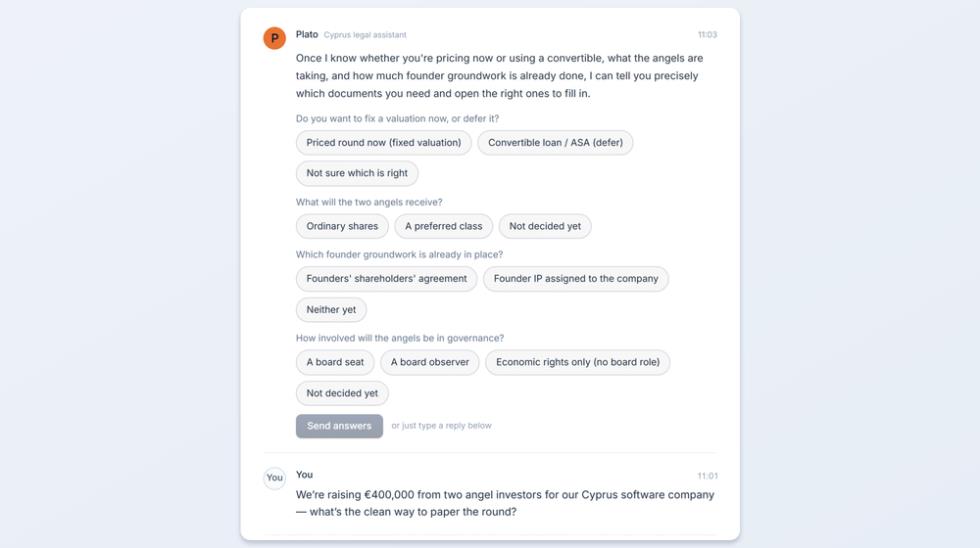
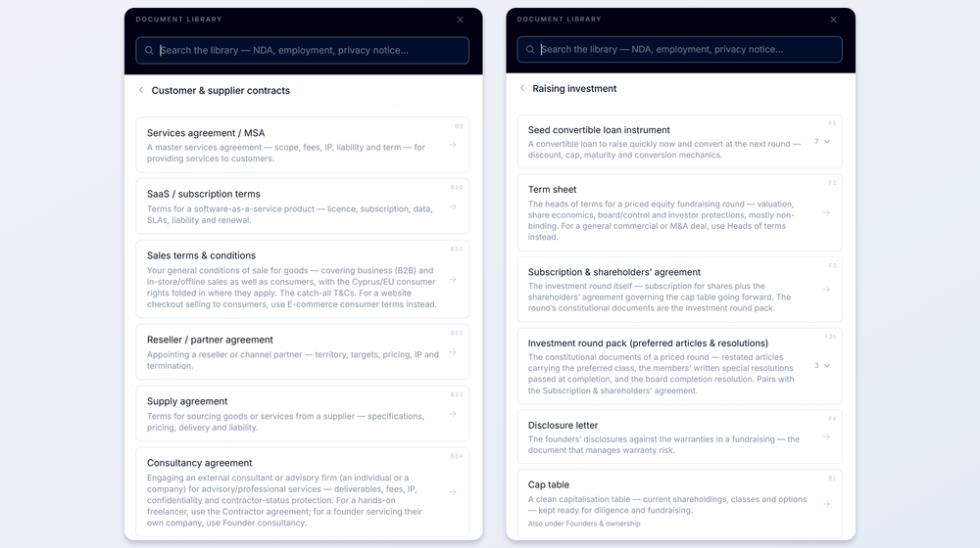
The document library. More than a hundred templates drawn from the precedent bank of a corporate and VC-focused Cyprus law firm. A user can prepare them themselves through a guided interview form.
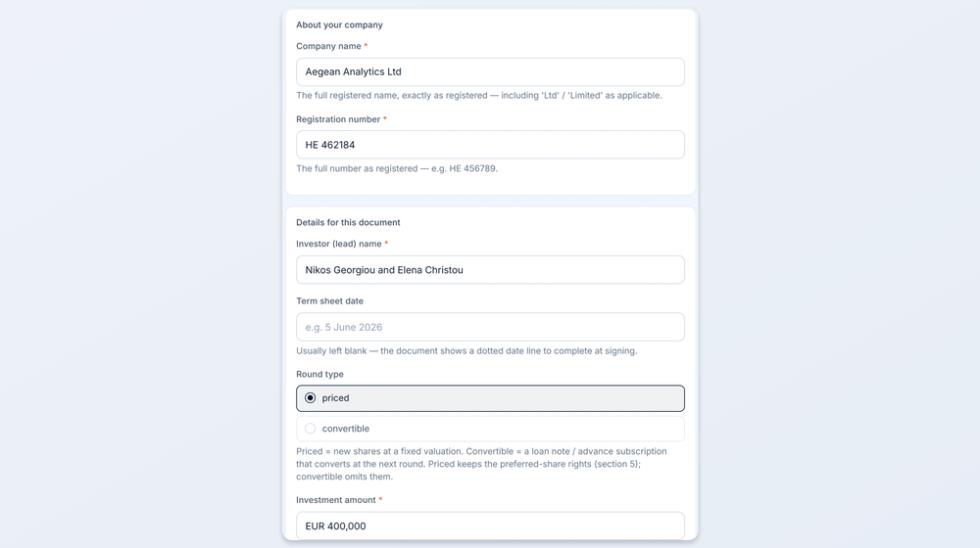
The library opens from the conversation with the agent, or a user can browse it directly.
The venture roadmap. More than fifty steps of a company’s life
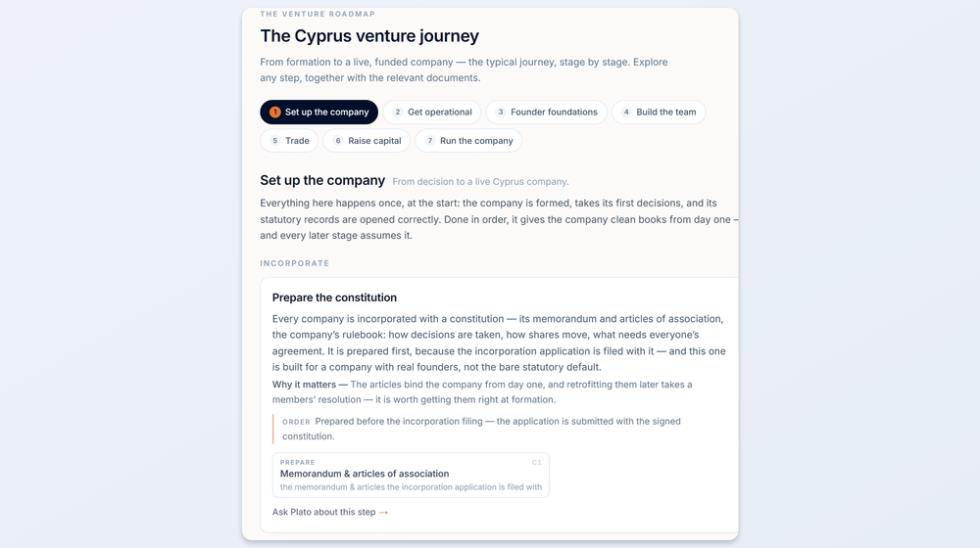
from incorporation through registrations, operations and hiring to funding rounds and exit, in the order they actually happen – with the agent alongside throughout to explain anything unclear, answer questions or amend documents as you go.
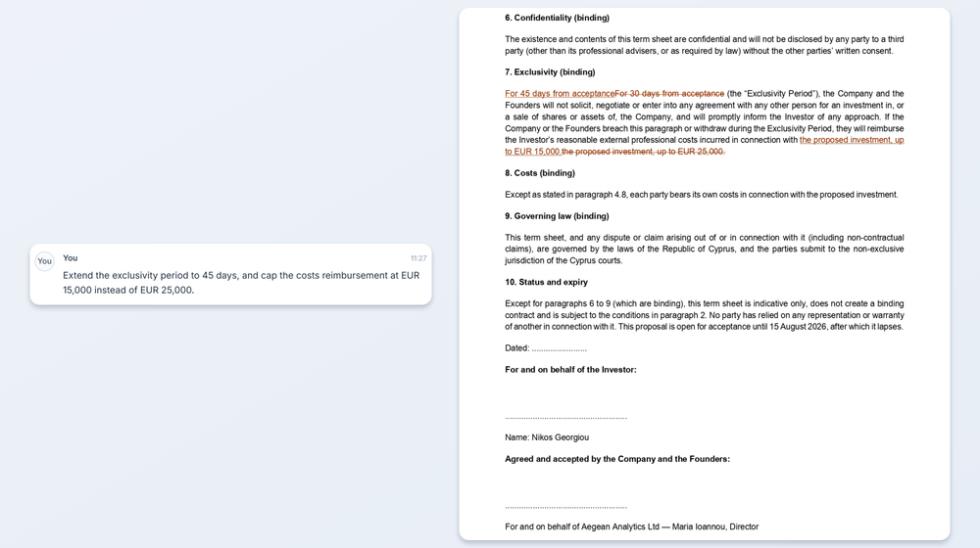
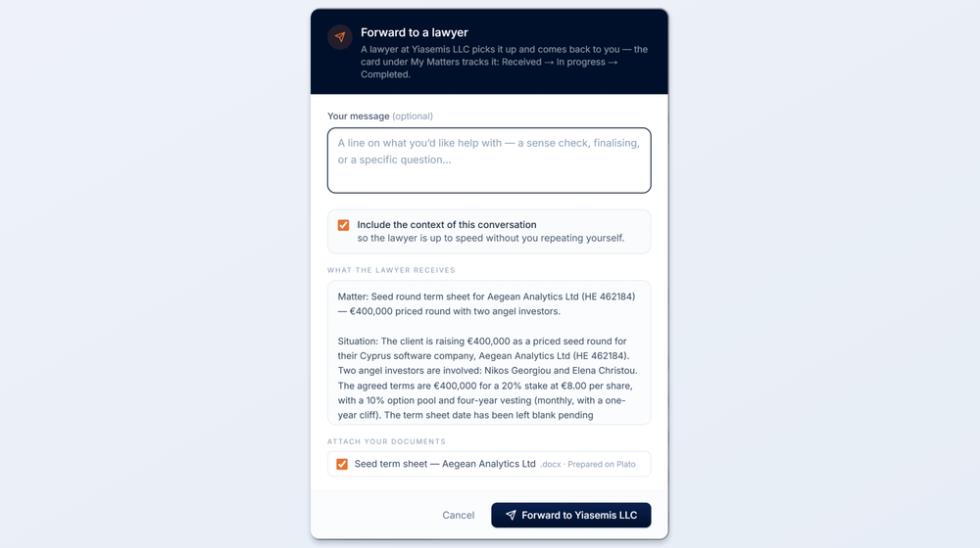
The route to a lawyer. When you want a second pair of eyes on what you have prepared, or you need something only a person can do – incorporation filings, certifications, submissions, the steps that still require a human being in Cyprus – a specialist lawyer is one click away. In other words, the work done on the platform is not a dead end. Everything you have discussed and every document you have prepared can go across to a lawyer to execute any final steps, with a summary of the matter.
Day to day, that means a founder can sit down on a Tuesday, work out what their structure should look like and why, and have the documents drafted by the end of the week. Work that would normally take weeks of back and forth can take hours, and on a single task the saving can run into thousands.
Where do you see Plato in 3 to 5 years: still a Cyprus-focused tool, or a platform that can be replicated in other jurisdictions? What other features are on your future roadmap?
Plato was created for Cyprus – for the founders, entrepreneurs and businesses who choose the island for their ventures – and that is where our focus stays for the coming years: broadening the document library, extending the venture roadmap into more scenarios, and sharpening the day-to-day tools, guided by what the founders using it ask for.
Could the model travel? Certainly. Deep specialisation in one jurisdiction, built with specialist lawyers on the ground, would work in other markets too, and we keep that in mind. But Cyprus comes first. And at the pace AI capability is moving, the platform will do considerably more in three years than anything I can describe today.
What role do you think AI should play in reshaping legal services for Cypriot businesses?
AI is already changing how professional services are delivered, and the change is not only happening inside law firms – it is happening on the client side too. As in most other industries, work is moving from the professional to the client: founders can now do a great deal of the legal research, and a good part of the drafting, themselves. The question is not whether that happens, but whether it happens accurately. For example, a founder drafting Cyprus documents through a generalist tool may very well end up with English law concepts baked in – so they are not saving money, they are deferring a cost until a lawyer has to get involved.
What was the first client problem that made you realise Plato could address a real, recurring pain point for Cypriot SMEs, instead of being merely a “nice to have” solution?
It was not one moment. It was the same issue coming up again and again.
A founder comes in ready to raise funds: the company exists, there are employees, the product is live. Then an investor starts looking into the business and the issues start appearing: the constitution does not work as prepared, the structure misses tax benefits that the business was aiming for, the corporate records were never properly kept, and the IP was never assigned to the company the investors are about to buy into. All of it is fixable, but it is fixed with money and time that a company in the middle of a raise cannot afford.
Plato exists so that founders never have to reach that point – it is built to close the knowledge and experience gap of the earliest stages before that gap does damage. The sharpest version of the problem shows up in start-ups, but it applies just as much to SMEs: foundations are far cheaper to get right early than to repair late.
