








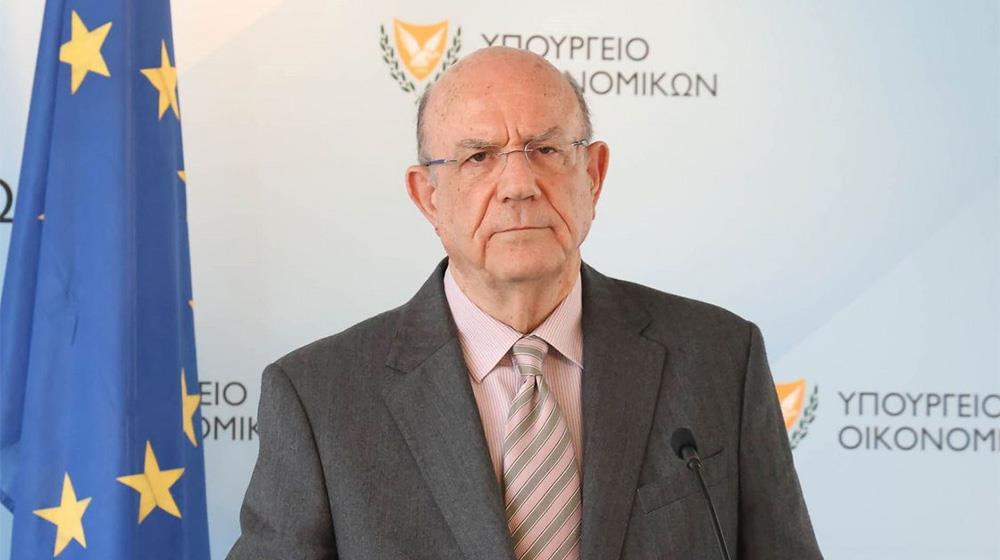
The semi-annual Fiscal Policy report of the Ministry of Finance points to a resilient economy growing at a satisfactory pace, according to Finance Minister Makis Keravnos, who presented the report at Tuesday morning's Cabinet meeting.
Alongside the positive indicators, the report records rising inflationary trends, with the Minister noting that inflation rose from 0.5% in January to 3.1% in June, and is expected to hover around 4% by the end of the year.
Social policy to tackle the cost of living continues
The Finance Minister expressed confidence that the surplus fiscal balance will allow the government to continue its social policy, noting that it is through this policy that inflationary pressures and the cost of living are being addressed. Responding to a journalist's question, Mr. Keravnos explained that the Commission's guidelines on the measures applied to tackle the cost of living stipulate that they must be targeted and short-lived.
"According to the contents of the report, the Cypriot economy continues to grow at a satisfactory pace, despite heightened geopolitical uncertainty and the ongoing energy crisis driven by the rise in international oil prices," the Minister said, announcing the key figures of the Fiscal Policy report.
Goal to maintain growth rates
He explained that "our economy is showing resilience and, although our forecasts were somewhat conservative, precisely because of the data, our economy nonetheless grew at a rate of 3.3% in the first half of the year — three times the average growth rate of European countries." He added that the government's goal is to maintain these growth rates.
Labour market resilient
On the labour market, he said it "continues to show resilience and to operate under conditions of full employment," adding that in the first quarter of 2026 it stood at 4%, compared with 5% in the corresponding period of the previous year.
Measures to curb inflationary pressures
Inflation figures for the first half of 2026 showed it averaged 1.7%, the Finance Minister said, explaining that it rose from 0.5% in January to 3.1% in June. "The forecast is that by the end of the year it will remain at higher levels, around 4%," Mr. Keravnos said, adding that the government is taking measures to curb this trajectory.
Fiscal surplus estimated at €900 million
"The fiscal position remains in surplus," the Minister continued, noting that "in the first half of 2026, the government's fiscal balance recorded a surplus of 1.1% of GDP."
He further said that for the whole of 2026, the fiscal surplus is estimated to reach €900 million. "This contributes decisively to the continuation of the social policy the government implements, which exceeds €1 billion — nearly 33% of the budget," he continued, noting that "it is through this policy that inflationary pressures and the cost of living are being addressed."
Measures worth €200 million in force
Referring to the measures being implemented and currently in force, he said they amount to €200 million, adding that the fiscal surplus is also of decisive importance for reducing public debt. "We are not complacent, because the challenges continue to exist; the crises, the wars continue, with unpredictable developments. So we will continue to implement this prudent economic policy," the Minister concluded.
Responding to a question on whether the measure for a reduced fuel tax could be extended, the Minister said the measures "are constantly being evaluated in line with developments, and specific decisions will be taken at the appropriate time."
He recalled, however, "the European Commission's guidelines on taking these measures — that they must be targeted and of short duration." He added, nonetheless, that "the data are being weighed, because just as developments change the data for us, they also change them for the entire European Union."
"Surpluses exist to serve our needs"
Asked whether the reduction of the surplus concerns him, the Minister answered in the negative, explaining that "the goal is not to create surpluses for their own sake; surpluses exist to serve our needs and, above all, to repay the €1 billion a year of our debt." He added that "with the start of repayment, you understand that the needs may well change."
Discussion on pension reform cost premature
Asked about the cost of the pension reform, Mr. Keravnos replied that the discussion is continuing between the Labour Minister and the social partners, and that "it would be premature to start talking about what the cost is at this point."
He noted, however, that the reform bill "contains various provisions and also various scenarios; therefore, once the positions of the social partners have been received, it will be determined which scenario could be followed, and only then will we be able to speak more specifically."
(Source: InbusinessNews)
