







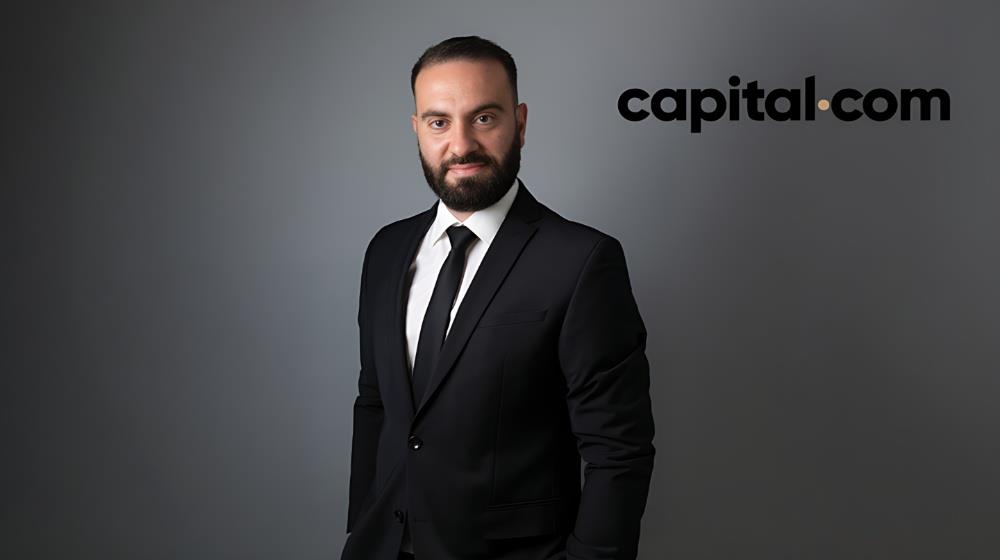
Christoforos Soutzis, CEO Europe of Capital.com, offers an in-depth look into the ever-evolving finance sector, shares his insights into running a successful business operation and suggests how potential future finance sector leaders need to prepare well if they are to achieve their ambitions.
Among other things, he shares how the past 10 years have shaped his approach as CEO Europe and weighs in on how the investment landscape is developing in today’s environment of geopolitical uncertainty.
He also talks about the imprtance of trust in the financil sector and discusses Europe's competitiveness compared to US, Middle East and Asia.
Among other things, Soutzis, in additon, talks about how technology including AI has impacted the sector and shares the advice he would give to young professionals looking to enter the fintech sector.
You have been with Capital.com almost since its inception. What lessons from the past 10 years have shaped your approach as CEO Europe?
I joined Capital.com in 2016 as Head of Risk. Watching a business develop from a startup – with clear ambition but no proven track record – into a regulated global financial services firm, teaches you things you can’t learn any other way.
The most important lesson is that you can never stand still. Our sector moves faster than almost any other. Regulations like MiCA and DORA are reshaping what compliance and operational resilience mean in practice. Geopolitical events – whether the conflict in Iran’s region or sustained monetary policy divergence across major economies – reach our clients within seconds and demand an immediate response from our risk and operations teams. AI is rewriting how financial services firms are built, how clients are served and how risk is managed. Any organisation that treats its current model as the destination rather than a waypoint is already falling behind.
The second lesson is that sustainable growth and strong governance reinforce each other. When risk discipline is built into how you operate from day one, it makes you better commercially as well as regulatorily. Clients who trust the firm stay longer, engage more thoughtfully and refer others. That’s not a compliance argument; it’s a business one.
My leadership approach has been shaped by clear ownership, genuine accountability and an obsession with staying ahead of where the environment is heading rather than reacting to where it’s already arrived.
How is the investment landscape developing in today’s environment of geopolitical uncertainty?
The macro backdrop across Europe has genuinely changed in character, not just degree. We're navigating ECB monetary policy decisions that are playing out against divergent fiscal conditions across member states, energy price volatility and the ongoing economic consequences of the conflict in Ukraine. Meanwhile, the European retail client base is more informed and more responsive than at any previous time. When the ECB moves on rates or a significant data print lands, retail clients are responding faster than anytime before. The gap between institutional and retail market engagement has narrowed considerably.
A more important shift is in client behaviour. Clients who engage most sustainably are those who approach markets with structure and prior thought, who have considered their exposure before conditions change rather than reacting to every headline. That shift in the quality of engagement is more significant than any change in volume and it reflects a broader maturation in how retail participants relate to financial markets.
The industry has a genuine obligation not to amplify the noise. In periods of high volatility, the temptation for financial services firms is to frame market movement as something that clients must respond to immediately. The more responsible position is the opposite: helping clients understand that volatility increases complexity and risk, that considered inaction is often the most defensible choice, and that the quality of a decision matters more than the speed of it. That’s a harder message to deliver but it’s also the right one.
Trust remains one of the most valuable currencies in finance. How do you build and maintain that trust? What are the biggest compliance challenges facing online investment firms today?
Trust in financial services is slow to build and fast to lose. The firms that maintain it long-term are the ones where compliance isn’t a function that sits separately from product and commercial decisions; it’s embedded in how choices get made from the start.
Regulatory oversight matters enormously here. Operating under recognised regulatory frameworks is not simply a licensing formality. It means that firms are required to comply with applicable client money and safeguarding requirements, that practices are under active supervision, and that a real complaints mechanism exists. Transparency is particularly important when clients are choosing between a regulated firm and offshore alternatives operating with fewer constraints. But formal regulation is only part of what builds trust today. Clients increasingly consult public review platforms and independent assessors before they open an account. Client sentiment expressed at scale, and recognition from independent industry bodies, have become genuine indicators of how a firm actually operates. The firms that take those signals seriously tend to perform better over time than those that treat reputation as a separate function from service quality.
As for compliance challenges, digital operational resilience is at the front of many minds right now. DORA has materially raised the bar for regulated firms across incident response, third-party risk management and ICT governance. The second area is AI governance. As the industry embeds AI more deeply in client-facing services, analytics and operational processes, the obligation to ensure that those tools are accurate, explainable and do not introduce new biases becomes a compliance matter, not just a product one. The regulators are watching this space carefully – and they should be.
How competitive is Europe as a destination for fintech investment compared to the US, Middle East and Asia? What strengths does Cyprus offer international financial services companies?
Europe has genuine advantages that don’t get talked about enough. Regulatory credibility under MiFID II is one. Operating under CySEC supervision, or holding an FCA authorisation, carries real weight with institutional counterparties and sophisticated clients globally. It’s a quality signal that lightly regulated offshore licences simply cannot replicate. The Middle East has moved fast. The UAE, in particular, has built serious infrastructure at ADGM and DFSA, and client sophistication in that region has grown significantly. That’s reflected in our own business – MENA has become our largest region by trading activity. Asia remains important, with Singapore and Hong Kong maintaining strong regulatory frameworks. The US is a different conversation; the regulatory framework for retail investment and trading firms in that market is prohibitive, which means that European and MENA markets represent the primary operating environment for firms like ours.
Cyprus’ position deserves an accurate explanation rather than a generic one. The island has built a genuine concentration of regulated investment firms, professional services expertise, and compliance and technology talent with specific knowledge of the online trading sector. When hiring a Head of Compliance or a Trading manager, the talent exists here in depth that most European cities can’t match. That took fifteen years to develop and it’s a real structural advantage for the jurisdiction.
The question for Cyprus, and for Capital.com as a business, is what comes next. A single-product focus is not the ceiling. We have already started expanding multi-asset capabilities: equities and digital assets, and longer-horizon investment products are all in scope. Broadening from a single-product model to a more comprehensive investment offering is both a strategic evolution and a jurisdictional opportunity for Cyprus to remain relevant as the regulatory landscape around digital assets, particularly under MiCA, takes shape.
Capital.com was founded by tech entrepreneur Viktor Prokopenya, who wanted to build a technology-focused financial services company. To what extent has his vision been achieved and how are new technologies like AI helping the company evolve?
Viktor’s original thesis was that financial markets were unnecessarily inaccessible – too complicated to understand, poorly designed for actual humans to use, and structured in ways that served the firm rather than the client. That thesis hasn’t changed. What’s changed is how much technology is available to act on it.
The design principle that guides our product decisions is straightforward: help people make better decisions. Not faster ones. Not more of them. Better ones. That means giving clients more clarity about their own behaviour, how they’ve been acting, what patterns emerge, whether that aligns with their stated objectives, before they take their next step. Most financial services firms give clients market data. The more meaningful commitment is to give clients data about themselves. That’s a different and more honest kind of transparency.
On AI more broadly, we’re past the phase of thinking about AI as a chatbot or a productivity tool. The more consequential application is AI running systems autonomously, automating processes, monitoring risk in real time and flagging anomalies before they become incidents. That shift from AI-as-assistant to AI-as-agent operating inside regulated infrastructure is where the real operational change is happening. It also raises the stakes on governance. An AI agent making decisions inside a regulated financial firm needs the same accountability framework as a human process. We’re building that in, not adding it afterwards.
How do you see technology reshaping the relationship between investors and financial advisers?
The disintermediation conversation has been running for twenty years and it remains more complicated than either side argues! Technology has unquestionably put institutional-grade data, analytics and market access into retail clients’ hands. That’s real and it’s permanent. But what to do with that information – how to interpret a macro event in the context of your specific financial position, how to size exposure appropriately, when to hold through volatility and when to act – such judgements benefit enormously from human expertise applied to a specific client’s situation. Technology, however well designed, doesn’t replace that. What changes is the baseline. A financial adviser in 2030 won’t spend time explaining basic market mechanics or walking through instrument definitions. Technology addresses that. The value they add sits higher: behavioural coaching, tax efficiency, genuine strategic planning built around a client’s actual life circumstances. That’s a more substantive professional role, not a diminished one. The advisers who lean into that shift will be well-placed. Those who resist it will find the gap between what they charge and what they deliver increasingly difficult to justify.
What has been the most important leadership lesson of your career so far and how does it guide you today?
Hire people who are better than you at the things that matter, and then genuinely get out of their way. That sounds obvious but it requires a specific kind of confidence to act on consistently. Earlier in my career, I watched leaders hold onto decisions they should have delegated, not because the team couldn’t handle them but because letting go felt like losing control. The result was slower decisions, lower quality outcomes and demoralised teams.
For me, leadership clarity is about owning your mandate completely and creating conditions where the people around you can do the same. That means being clear about what you expect, being honest when things aren’t working, and not confusing your presence in a decision with your contribution to it.
The other thing I’d add, especially in a regulated industry, is this: accountability without integrity is just risk. You have to actually mean what you say to your regulator, your clients and your team. The firms that treat compliance as a performance eventually run into that wall. The ones that treat it as a genuine expression of how they operate don’t.
What advice would you give to young professionals looking to enter the fintech sector? What types of skills will they need if they are to grow further in their careers?
There’s real depth to this sector right now but I’d push back slightly on the framing of “what skills do you need.” The people who do well here aren’t the ones who picked the right technical stack in advance, they’re the ones who stay curious and keep updating their model of how the industry actually works. That said, a few things are becoming non-negotiable. Data literacy isn’t the same as data science; you don’t need to build models but you do need to interrogate them and understand what they’re actually telling you. Regulatory awareness is genuinely valuable early in a career: understanding why rules exist, not just what they say, separates people who get blocked at the compliance gate from those who can work constructively through it.
AI competency is now a baseline, not a differentiator. But I’d push further; the professionals who will have the greatest impact are those who understand how AI functions as an operational agent, not just as a tool they use. Knowing how to design, supervise and govern AI-driven processes is a skill that barely exists in the workforce today and will be in high demand within five years.
Softer skills matter more than people expect. The ability to explain a complex risk or technical decision to a non-specialist audience is scarce and highly valued. So is sitting with genuine uncertainty rather than forcing a premature conclusion.
My specific advice: spend time early in your career inside a regulated firm. The discipline it builds is worth more than any certification, and the understanding of how governance actually works, not how it looks on paper, will follow you for decades.
This interview first appeared in the 2026 edition of The Cyprus Journal of Wealth Management. Click here to view it.
