







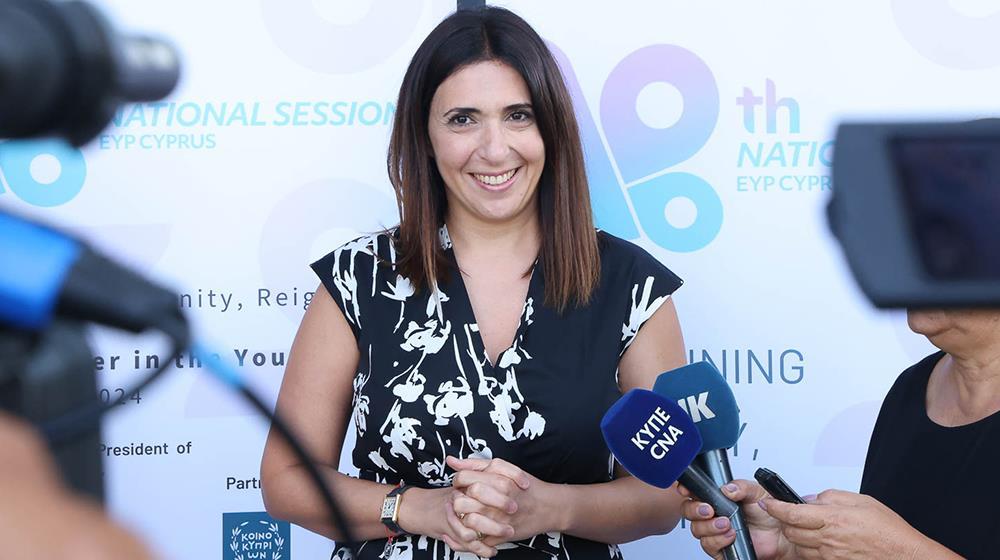
The acquis of the Cyprus Presidency of the Council of the EU must not be lost, as this does not concern any particular government or individual, but has been a national mission, Deputy Minister for European Affairs, Marilena Raouna, said shortly before the end of her term on July 31. She further stressed the need for Cyprus to establish a coordinating structure that would include all departments within Ministries and Deputy Ministries dealing with EU affairs.
“We must build on the lessons we have learned from the Cypriot Presidency, drawing on best practices from other Member States, with a view to ensuring institutional continuity. We must not lose this acquis and this legacy of the Cypriot Presidency, and we are here to continue the dialogue. Let us build on the achievements of the Cypriot Presidency and make a coordinating structure, which does not currently exist, so that it can effectively advance Cyprus’ interests,” Raouna told the Cyprus News Agency.
She pointed out that EU issues, beyond their sheer volume, which has increased significantly, and their complexity, are now cross-cutting and require a cross-cutting coordination structure. “And very often, it is also necessary to bridge differences in positions at the political level, because frequently one Ministry may hold one position while another Ministry may hold a very different position on the same issue,” she noted.
Regarding the results of Cyprus’ EU Presidency, Raouna said that “it is recognised that we were a particularly effective Presidency, and this is evident from the numbers. We negotiated 32 dossiers at the trilogue level- that is negotiations involving the Council, the European Parliament, and the European Commission. We successfully concluded 85% of them (27 dossiers), which is a very high percentage,” she said. This has been publicly acknowledged by the heads of the EU institutions as well, and “it is something we continue to see even after the end of our Presidency,” as was the case, for example, at the most recent General Affairs Council meeting in which she participated, she said.
"Establishing a Deputy Ministry of Europen Affairs is necessary 20 years after Cyprus joined the EU"
Asked about the House of Representatives’ decision to reject a six-month extension of her term and whether she considers the establishment of a Deputy Ministry of European Affairs necessary 20 years after Cyprus joined the EU, Raοuna said that the decision of the House of Representatives is fully respected, noting that “there must be, and there is, respect for all institutions and for all the people behind those institutions, and this applies to everyone.”
She said that throughout the preparations for the Cyprus Presidency and during the six-month term they had “a particularly productive, smooth, and flawless cooperation” with the parliament as there was also a significant parliamentary dimension to the Cyprus Presidency.
She also noted that the Cypriot EU Presidency was not politicized. “One of my first actions as Deputy Minister to the President for European Affairs was to seek out and hold meetings with all the political forces in the country. I believe there has been political maturity on the part of all political forces regarding the Cypriot Presidency, and this is also a lesson: that when a national mission is not politicized, we achieve these significant results for Cyprus, because the Presidency did not concern any particular government or individual," she noted.
"Now, this decision has been made as regards the extension of the existing legislation for six months to ensure institutional continuity and to allow for the continuation of certain important negotiations that are currently underway,” she said.
These issues require a horizontal coordination structure and do not concern just one Ministry, she noted. “Negotiations are now moving at such a rapid pace because the roadmaps have set very strict timelines, requiring a political decision to be reached within a very short timeframe to bridge the differences,” she pointed out. Raouna added that it was therefore deemed beneficial to have an extension of her term to allow time to present a more comprehensive proposal, taking into account best practices in member states.”
As she said, approximately twenty of the 27 member states have this permanent structure; they have established the position of a Deputy Minister for European Affairs because the scope, volume, and complexity of horizontal issues in the European Union have increased significantly, she added.
