







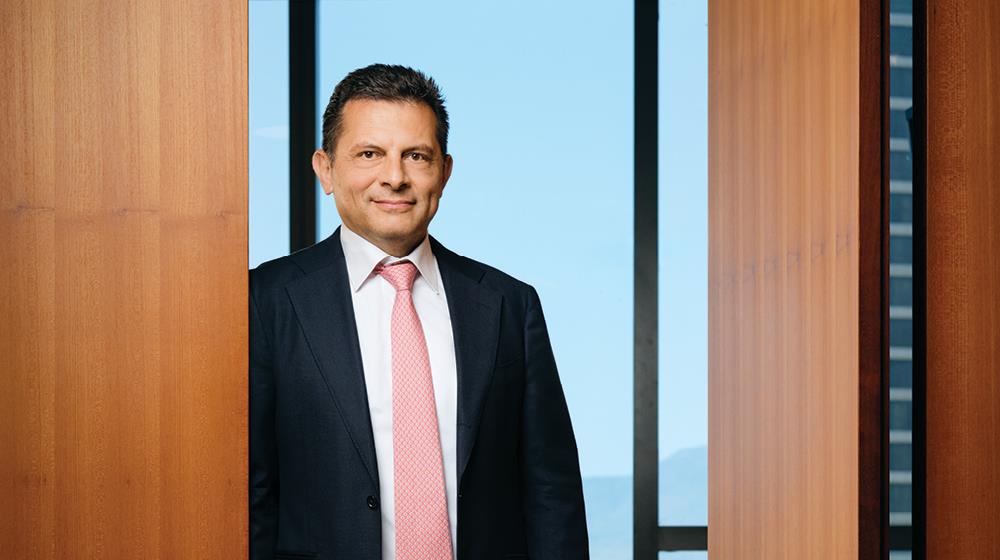
Wealth management has moved beyond a traditional advisory role to become a key enabler of long-term financial resilience, says Haris Hambakis, Deputy CEO, Eurobank Limited, who explains how banking is undergoing a transformation that goes beyond integrating new technology: it is about building institutions that are more responsive, more intelligent and better equipped to create lasting value for customers, businesses and the wider economy.
The 2025 merger that established Eurobank Limited as the largest financial institution in Cyprus, with assets exceeding €28 billion, was a significant milestone for the country’s banking sector. From a client’s perspective, what new capabilities, opportunities or advantages has the combined institution brought to the market?
The establishment of Eurobank Limited in 2025 represented more than a corporate merger; it brought together two successful banking institutions – Eurobank Cyprus and Hellenic Bank – each with a strong legacy and a longstanding presence in the market. Building on this combined heritage, the new entity benefits from greater scale, broader capabilities and deeper expertise. For clients, however, the significance of the merger lies not in size alone but in what that scale enables: a more comprehensive proposition, faster execution, increased innovation and a greater ability to support evolving financial needs across segments.
By combining strong local market knowledge with the wider Eurobank Group’s expertise, product capabilities and international network, the new bank is better positioned to deliver solutions that are both more sophisticated and more relevant to the Cypriot market. Crucially, this positioning is shaped by our clients themselves, whose evolving needs, expectations and behaviours increasingly guide our strategic priorities. This creates the opportunity to bring proven products, practices and service models to Cyprus, while adapting them in a targeted and disciplined way to reflect real client demands and prevailing market conditions. For retail customers, it means an improved digital experience, greater convenience, more personalised service and access to a wider set of products and capabilities. For corporate and SME clients, this translates into broader financing capabilities, faster response times, stronger advisory support and access to a more complete range of banking solutions.
Ultimately, the combined bank is better equipped to deliver the qualities that matter most to clients: strength, reliability, agility, responsiveness and innovation. Our ambition is to combine the capacity and sophistication of a leading regional banking group with the proximity and service culture expected from a trusted local bank.
Cyprus has demonstrated remarkable economic resilience in recent years. Looking ahead, what structural reforms do you believe are most critical to enhancing competitiveness, attracting investment and sustaining long-term growth?
Cyprus has indeed demonstrated remarkable resilience in recent years, providing a solid foundation for future growth. To sustain this momentum and further strengthen competitiveness, however, continued commitment to structural reforms remains essential. Accelerating digital transformation across both the public and private sectors is a key priority. Streamlining administrative procedures and reducing bureaucracy would significantly improve the ease of doing business and enhance Cyprus’ attractiveness as an investment destination. Equally important is the continued strengthening of the legal and judicial framework, particularly in terms of efficiency and the timely resolution of disputes. Investor confidence is closely linked to predictability, transparency and institutional effectiveness. Investment in human capital is another critical area. Aligning education and workforce skills with the evolving needs of the economy, particularly in technology, financial services and innovation-driven sectors, will support sustainable and inclusive growth.
Finally, maintaining fiscal discipline while promoting targeted investments in infrastructure, innovation and productivity-enhancing initiatives will help ensure that economic growth remains balanced and resilient over the long term. Cyprus has already made significant progress. The challenge now is to maintain reform momentum and policy consistency, reinforcing the country’s position as a competitive and attractive business and investment hub in the region.
At the ICPAC Mediterranean Finance Summit 2026, you highlighted the transformation taking place across the banking industry. What are the most significant shifts shaping the sector today and how are they influencing the way banks serve their customers?
The banking sector is undergoing a period of profound transformation, shaped by both structural strength and evolving expectations. Particularly in Cyprus, the sector is significantly more resilient. Capital adequacy has strengthened, asset quality has improved, with non-performing loans declining to historically low levels, and liquidity remains robust. Even though profitability is gradually normalising, banks are entering this new phase from a position of strength. This stronger foundation allows banks to focus increasingly on innovation, growth and long-term value creation.
One of the most significant shifts is the growing use of data and analytics, which is transforming how banks understand customer needs, manage risk and design solutions. Decision-making is becoming more informed, proactive and personalised, enabling institutions to deliver greater value while operating more efficiently. Another important development is the evolution of the banking model itself. Everyday transactions are increasingly migrating to digital channels, while physical branches are evolving into advisory and relationship centres focused on more complex financial needs. As a result, the role of the banker is becoming more consultative and specialised. At the same time, customers increasingly expect simplicity, speed and transparency in every interaction. Meeting these expectations requires banks to become more agile, continuously adapt their operating models and embrace innovation in a purposeful way.
The transformation taking place across banking is not solely about technology. It is about building institutions that are more responsive, more intelligent and better equipped to create lasting value for customers, businesses and the wider economy.
In an environment characterised by geopolitical uncertainty, market volatility and evolving investor expectations, what role does wealth management play in helping clients preserve and grow their wealth over the long term?
In such an environment, wealth management has moved beyond a traditional advisory role to become a key enabler of long-term financial resilience. Clients today are seeking more than pure investment performance; their focus has shifted towards resilience, preservation of capital and sustainable long-term outcomes. Delivering these objectives requires a disciplined approach anchored in robust portfolio construction, prudent risk management and continuous oversight. Within this context, the role of the bank extends beyond product provision to that of a trusted advisor, supporting clients in navigating complexity, assessing trade-offs and making informed decisions with confidence. This includes providing access to diversified investment opportunities across geographies and asset classes, while dynamically adjusting strategies in line with evolving market conditions. Equally critical is the foundation of trust. Enduring relationships are built on a deep understanding of clients’ priorities, clarity and transparency in communication, and consistency in delivery.
Ultimately, effective wealth management combines expertise, personalised advice and a long-term perspective. At its core, however, it is also built on strong personal relationships, giving clients the confidence to engage with clarity and discipline, and supporting both the preservation and sustainable growth of their wealth across market cycles.
As digital capabilities and AI continue to reshape financial services, how does Eurobank ensure that innovation enhances rather than replaces the personal relationships and trusted advice that your clients value?
At Eurobank, we view technology and human interaction as inherently complementary. Nowhere is this more important than in wealth management, where trusted relationships and personalised advice remain central to the client experience. Technology is not a substitute for this human dimension; it is an enabler that allows it to operate more effectively and at greater depth. Advanced digital capabilities and AI strengthen our ability to understand clients in a more holistic way, capturing patterns, anticipating needs and supporting more informed, timely decision-making. This allows us to deliver advice that is not only more precise but also more relevant and forward-looking. At the same time, our investment in digital infrastructure is focused on improving the overall client journey. By simplifying routine interactions and making everyday banking faster, more secure and more intuitive, we reduce friction where it does not add value. Our approach is explicitly “customer journey first”: technology must enhance the experience, not complicate it. Importantly, as routine processes become more automated and transactional activities shift to digital channels, relationship managers are able to dedicate more time to what matters most: meaningful contact, strategic advice and long-term client engagement.
Ultimately, technology should make banking more human, not less. Our objective is to combine agility, efficiency and convenience with trust, expertise and personal connection, delivering a model that remains deeply client-centric, responsive and sustainable over the long term.
This interview first appeared in the 2026 edition of The Cyprus Journal of Wealth Management. Click here to view it.
