







Digital assets are increasingly playing a role in the real economy, as blockchain technologies are integrated into cross-border payments, trade transactions and everyday financial services. Collaboration between banks, e-money institutions and businesses in the digital ecosystem is now creating the conditions for secure, fast and fully regulated solutions.
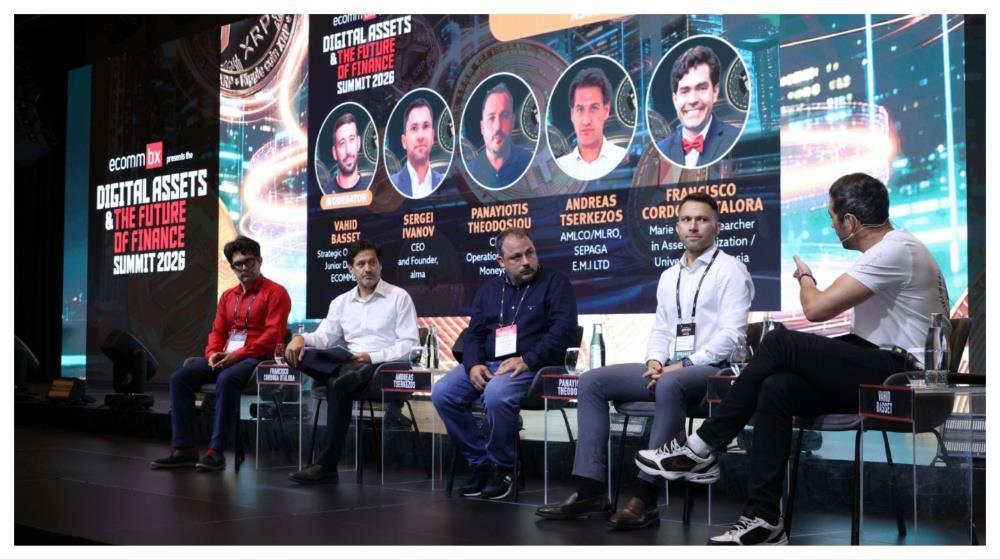
These developments were discussed at 'The Mainstream Banking System, EMIs, Payment Institutions and Digital Assets in the Real Economy' panel discussion which took place as part of the recent Digital Assets and the Future of Finance Summit 2026, presented by ECOMMBX.
The discussion was moderated by Vahid Basset, Strategic Operations Junior Director, ECOMMBX.
The panel included Sergei Ivanov, CEO and Founder of alma; Panayiotis Theodosiou, Chief Operations Officer, Moneygate; Andreas Tserkezos, AMLCO/MLRO, SEPAGA E.M.I LTD, as well as Francisco Cordoba Otalora, Marie Curie Researcher in Asset Tokenization / University of Nicosia.
Sergei Ivanov said that the value of blockchain technology is already being proven in practice, especially in cross-border payments. As he explained, transactions via stablecoins are completed almost instantly and with minimal costs, unlike traditional bank transfers that still require more time and higher fees. According to him, the widespread use of digital assets shows that the technology has already passed the stage of real-world implementation.
Panayiotis Theodosiou noted that the key factor driving developments is the customer himself. As he stated, businesses and consumers are looking for faster, cheaper and fully digital services, which is pushing the entire financial industry to adapt. At the same time, he underlined that the regulatory framework follows this transition, enhancing transparency and trust in the market.
On his part, Andreas Tserkezos pointed out that the relationship between banks and payment institutions and digital asset companies has changed significantly. As he explained, today's discussion mainly concerns risk management processes, transaction monitoring and compliance with regulatory requirements. He added that the MiCA framework and the new obligations that accompany it have created greater trust, allowing each company to be assessed based on the true risk picture and not just its activity in the crypto space.
Francisco Cordoba Otalora noted that in many markets, such as Latin America and Africa, the adoption of stablecoins preceded regulation, as real user needs led to the search for faster and more cost-effective solutions for cross-border transactions. As he said, this experience proves that innovation often precedes legislation, while regulation comes later to allow the market to evolve to the next stage. At the same time, he noted that local stablecoins are now being developed in various countries, which creates new digital ecosystems and highlights the increasing role of digital assets beyond simple payments.
The participants shared the view that digital assets are now becoming a functional part of the real economy. The demand for faster payments, technological advancements and the maturation of the regulatory framework are creating the conditions for banks, payment institutions and businesses in the digital ecosystem to collaborate in a common, more secure and transparent financial environment.
(Source: InBusinessNews)
