





The digital asset market is entering a new phase of maturation, as institutional participation strengthens, technology evolves, and blockchain applications expand beyond investment activity, touching payments, capital markets, and real asset management.
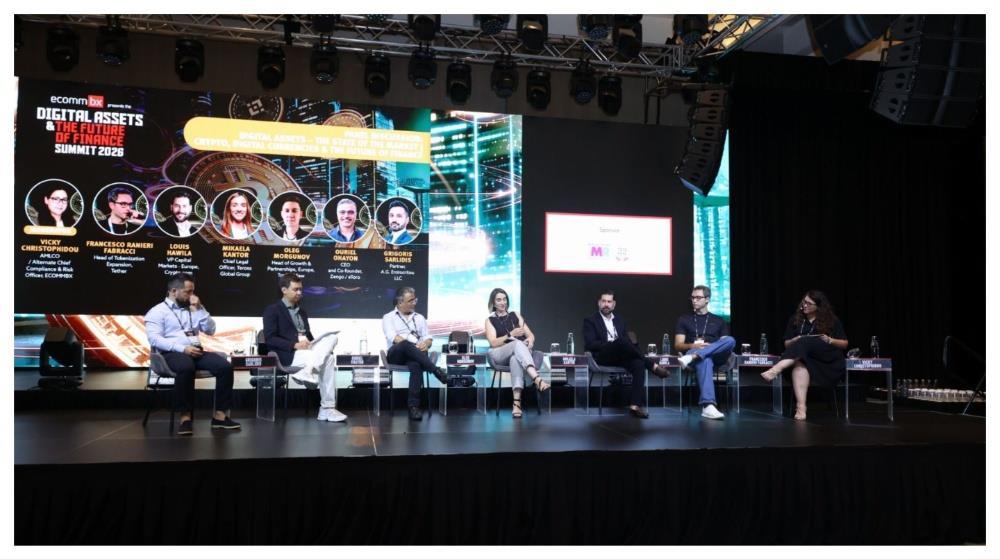
These developments were at the center of the discussion on 'Digital Assets – The State of the Market | Crypto, Digital Currencies & The Future of Finance,' which took place as part of the Digital Assets and the Future of Finance Summit 2026, presented by EXOMMBX.
The discussion was moderated by Vicky Christophidou, AMLCO / Alternate Chief Compliance & Risk Officer, ECOMMBX, who in her introductory remarks noted that the financial ecosystem is facing a historic convergence, where both the concept of money and the very infrastructures that support it are being redefined. As she stated, digital forms of money now allow the transfer of value in real time, while the institutional adoption and maturation of the European regulatory framework create the conditions for digital assets to be gradually integrated into everyday economic activity.
Participating in the discussion were Francesco Ranieri Fabracci, Head of Tokenization Expansion, Tether; Louis Hawila, VP Capital Markets - Europe, Crypto.com; Mikaela Kantor, Chief Legal Officer, Teroxx Global Group; Oleg Morgunov, Head of Growth & Partnerships, Europe, TradingView; Ouriel Ohayon, CEO and Co-founder, Zengo / eToro and Grigoris Sarlidi, Partner, A.G. Erotocritou LLC.
Francesco Ranieri Fabracci, said that the market is now in the phase of institutional adoption of tokenisation, with more and more organisations in the traditional financial sector seeking to transfer financial products to the blockchain. As he explained, Tether has already proceeded with the tokenisation of various asset classes, such as stocks, bonds and money market funds, estimating that the market has not yet become fully mainstream, but is at a pivotal point of development.
He also noted that different markets move at different speeds, noting that the United Arab Emirates is moving particularly quickly in the use of tokenisation, especially in the real estate sector. He stressed, however, that for a tokenised asset to gain value, it must be accompanied by real investment returns and sufficient liquidity.
Ouriel Ohayon argued that the market has already entered a phase of widespread adoption, noting that tokenisation is no longer limited to digital currencies. He cited prediction markets as a typical example, where – as he said – blockchain technology is used to access new types of investment products that are more easily understood and usable by the general public.
At the same time, he stated that a similar dynamic is also present in access to private investments, where through blockchain more investors can gain exposure to assets that until recently were only available to a limited number of participants.
Oleg Morgunov focused on how investor behavior is changing, noting that access to markets is becoming increasingly direct and transparent through digital platforms. He said that technology is helping to broaden market participation, while the quality of information and analytical tools is becoming increasingly important for making investment decisions.
Grigoris Sarlidi noted that the market has now left the experimental stage behind. As he explained, clients are no longer wondering whether they should participate in the digital asset space, but are looking for the right way to do so within a mature and regulated environment.
At the same time, he emphasised that the regulatory framework has evolved significantly in recent years, contributing to the gradual removal of the market from the logic of speculation and creating more stable foundations for long-term growth.
Louis Hawila said that a key prerequisite for wider institutional adoption remains trust. As he noted, large organisations are primarily looking for clear operating rules and a clear legal framework, as only in this way can they develop their activity safely and strengthen their participation in the market.
Regarding the role of artificial intelligence, he noted that its use is now an integral part of daily operations, with applications supporting different parts of the company, including compliance. As he mentioned, the development of AI is great and in the coming years it is estimated that each employee will have their own personal AI agent, significantly enhancing productivity and reducing operating costs. “Every company that seeks to remain competitive and operate at a high level should integrate artificial intelligence into its services and processes,” he emphasised.
Mikaela Kantor, with a legal approach to the interesting topic, underlined that regulation acts as a catalyst for market development, as it strengthens investor protection, creates common operating standards and increases public trust. She stressed, however, that balance is crucial, as excessive regulation can limit innovation. As she stated, the goal is for the regulatory framework to act as a lever for development and not as an obstacle to the evolution of the ecosystem.
(Source: InBusinessNews)