








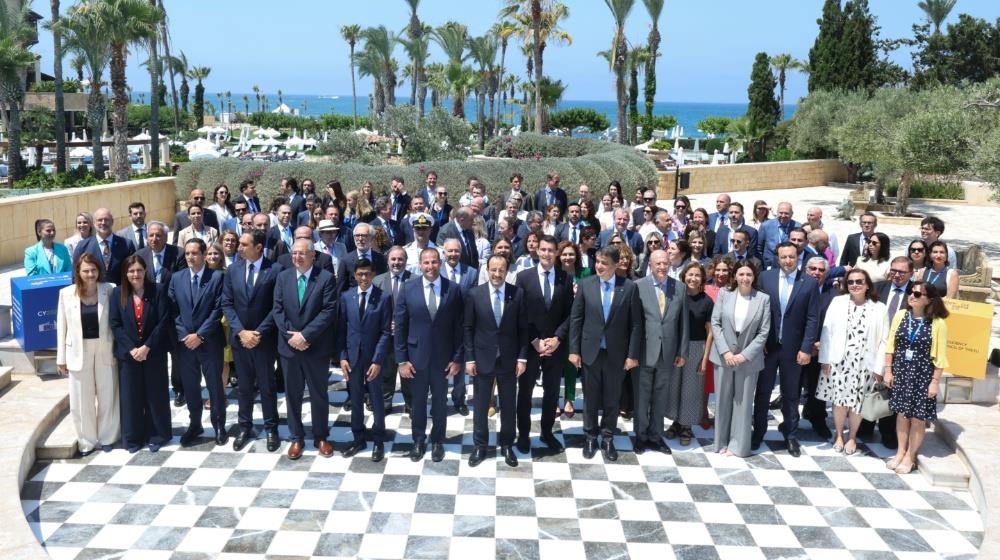
"Geography should never become a ceiling on people's ambition, on economic opportunity, or on Europe's commitment to fairness," said the Prime Minister of Malta, Robert Abela, in his address at the High-Level Conference 'Strengthening EU Islands and Coastal Communities', taking place in Paphos.
On his part, the Vice-President of the European Parliament, Younous Omarjee, described the occasion as a "historic moment," referring to the adoption of the Strategy for Islands and the the Strategy for Coastal Communities.
Speaking of a "rare moment" in which islands are not at the margins of Europe's debate, but very much in the center, Prime Minister Abela said that islands' circumstances are diverse, but many of the pressures they face are similar, referring to distance, higher costs, exposure to external shocks, and dependence on reliable connections.
For island member states in particular, he continued, these pressures are structural realities. "They are felt more immediately, because there is no mainland to fall back on when disruption occurs", he said, noting that geography shapes how we live and work, it affects how people move, how businesses trade, how services are delivered, and how quickly external shocks are transmitted into daily life.
"For an island, connectivity is not a luxury. It is basic infrastructure. When connectivity is weak, everything else becomes harder. Transport costs rise. Supply chains become less reliable. Access to markets becomes less certain. Families and businesses have fewer options and less room for error," he highlighted, adding that these pressures also reinforce each other, since island economies are often small and open. "That openness has served us well. It has also made us outward-looking, adaptable, and resilient. But it also means that shocks in energy transport, tourism, or trade are felt quickly and directly."
Clean transition
Giving clean transition as an example, he said that ambition has to be delivered in real economies, with real costs, and with a clear understanding of the different starting points. "Islands often face higher transition costs. They may depend more heavily on imported fuels. They may have fewer technological options available at scale. These are practical constraints" that affect what can be delivered, how quickly, and at what cost, he said.
In smaller economies, he continued, sustaining economic activity increasingly depends on attracting skills from outside. This brings, then, its own pressures, particularly on infrastructure, housing, and the careful use of limited space. In smaller labor markets, these dynamics are felt earlier and more directly, Abela noted, pointing that over time, this becomes a question of whether communities remain viable, whether services remain accessible, and whether our younger generation, our young people, believe that they can build a future at home.
"That is the challenge, but it is not the whole story. Islands should not be spoken about only through the language of constraint. They are also places of innovation, resilience, and strategic value," he argued. As he said, in energy, in maritime activity, in digital policy and tourism, islands often become testing grounds for new approaches precisely because they have to adapt quickly, use resources carefully, and think beyond their size.
According to Malta's Prime Minister, islands also understand interdependence. "We rely on routes, partners, markets, and neighbors. That gives island communities a very clear sense of why European cooperation matters, not as an abstract idea, but as something practical and necessary," he said.
"If islands are to contribute fully, policy has to start from our realities. Equal treatment does not always mean identical treatment. Where and when circumstances are structurally different, policy needs to reflect that. That is why the treaties recognize the specific challenges faced by island regions. It is also why these realities need to be reflected more consistently when European policies are designed, not corrected afterwards," he underlined.
These strategies must be more than a recognition of challenges, he stated, noting that they must make a difference in how policy is shaped, how rules are applied, and how European ambition is translated into real conditions. "The real test is whether that understanding is reflected from the outset, when policies are designed, when funding is allocated, and when rules are implemented, not after they have been proposed or agreed upon."
Concluding, Prime Minister Abela said that geography will always shape island life as it shapes many coastal communities. "But it should never become a ceiling on people's ambition, on economic opportunity, or on Europe's commitment to fairness. Our task is to make sure that island citizens are not asked to carry European ambition with fewer tools than other people. That is the measure by which this strategy should be judged."
Historic significance
On his part, the Vice-President of the European Parliament, Younous Omarjee, speaking in French through an interpreter, said that "the moment we are experiencing here is one of historic significance."
He said that the strategy marks the culmination of a long political process, rooted in the resolution adopted almost unanimously by the European Parliament, which explicitly called on the European Commission to develop a European strategy for islands.
Omarjee stressed that the challenges of insularity deserve coherent, ambitious and comprehensive responses. "The European Union's recognition of insularity is now a reality. This is a historic moment because, for far too long, Europe's islands were the forgotten territories of the European project," he said.
The Vice-President of the European Parliament called for Europe to be viewed as an archipelago. "We often forget that Europe is, above all, a peninsula of the Eurasian continent, open to seas and oceans," he said, referring to the Mediterranean, the Baltic Sea, the North Sea, the Atlantic Ocean, the Arctic Ocean and the Black Sea.
Tremendous opportunities
He further noted that islands operate in areas offering tremendous opportunities, particularly in the blue economy. At the same time, he highlighted the challenges posed by climate change, energy pressures, connectivity, mobility, access to public services and housing.
"This is the reality of island regions. They face challenges that are fundamentally different from those encountered in continental Europe, which means they require different solutions, tailored to their specific circumstances. That is precisely what this strategy recognises," he said.
He added that insularity "is not simply a matter of identity; it is an everyday reality," arguing that in the coming years the EU should assess "the cost of insularity" so that it can be more effectively taken into account when shaping European policies.
Omarjee also underlined the importance of enabling young people to remain on their islands. "At a time when Europe is facing serious demographic challenges, it is vital that talented young people are able to stay on their islands and build their future there," he said, in conditions of peace and prosperity.
He also described the timing as ideal, as Ireland, another island Member State, is about to assume the Presidency of the Council of the European Union. "I know that the Irish Presidency will continue these efforts so that we can move from strategy to implementation," he said.
(Source: CNA)
