







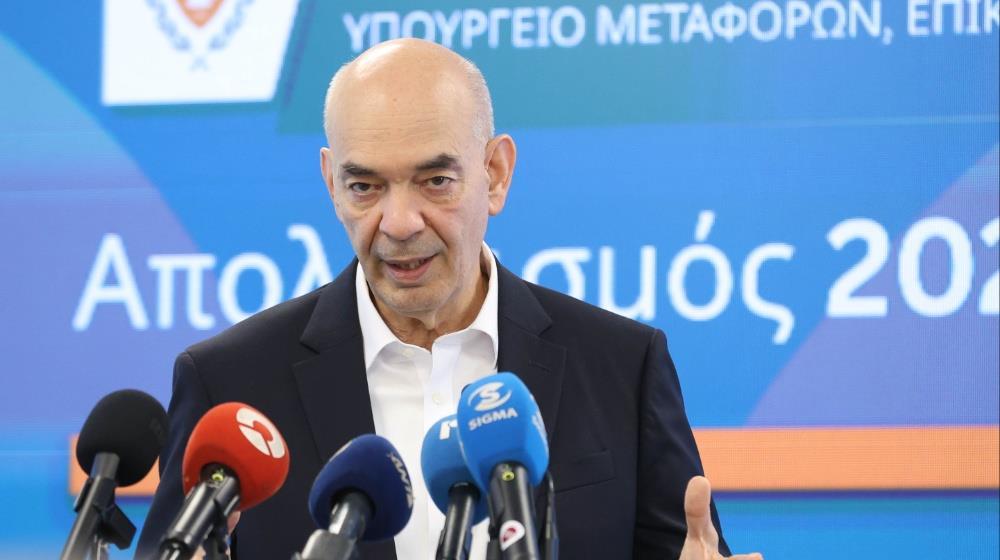
The green transition must be accompanied by innovation, investment and policies that strengthen, rather than weaken, Europe's position in international aviation, said Minister of Transport, Alexis Vafeades, in his address, at the European Aviation Strategy Summit in Nicosia, organised on Monday by the Cyprus Presidency of the Council of the European Union.
He added that Europe must continue to ensure that islands, peripheral regions and remote communities remain connected to opportunities, markets and services, and, in this context, regional aviation plays an essential role.
In his address, read by the Ministry’s Permanent Secretary, Marina Ioannou Hasapi, the Minister said that aviation is perhaps the clearest expression of the Cyprus Presidency’s vision for “An Autonomous Union – Open to the World’, as it connects citizens, supports the economy, strengthens tourism and trade, and keeps Europe connected with its neighbours and global partners.
“Aviation is not simply a mode of transport; it is a public good and a strategic enabler of Europe's openness and prosperity. We meet at a defining moment for European aviation. The sector is facing geopolitical instability, airspace restrictions, supply-chain pressures, rising operational costs and the challenge of decarbonisation. At the same time, Europe is preparing a new Aviation Strategy that will shape the future of the sector for years to come”, he continued.
He added that as we look ahead, competitiveness must remain at the centre of discussions, particularly in an increasingly challenging global environment.
“While we remain fully committed to sustainability, safety and high, but also clear and simplified, regulatory standards, we must ensure that European airlines, airports, manufacturers and service providers continue to compete successfully on the global stage. The green transition must be accompanied by innovation, investment and policies that strengthen, rather than weaken, Europe's position in international aviation”, he further noted.
Another priority is connectivity, continued Vafeades, adding that as an island Member State located at the crossroads of Europe, the Middle East and North Africa, Cyprus understands that connectivity is not a luxury, but an economic necessity, a social lifeline and a prerequisite for growth.
“Europe must continue to ensure that islands, peripheral regions and remote communities remain connected to opportunities, markets and services. In this context, regional aviation plays an essential role. Across Europe, regional airlines, smaller airports and Public Service Obligation routes, provide vital links for citizens and businesses, particularly in remote, island and sparsely populated regions”, he explained.
He added that as we shape the future EU Aviation Strategy, we must ensure that these services remain viable and sustainable, noting in that regard that territorial cohesion is a fundamental European objective, and aviation is often the only practical means of guaranteeing equal access and connectivity for all regions.
“While maintaining strong internal connectivity across all regions of the Union, we must also look beyond our borders. Europe's prosperity, security and global influence increasingly depend on strong aviation links with neighbouring countries. Strengthening connectivity with the Middle East, North Africa and the Western Balkans can support trade, tourism, investment and people-to-people contacts, while reinforcing Europe's role as a global hub”, he stressed.
A third area that deserves particular attention is the emergence of new generation long-haul aircraft, continued the Minister.
“These highly efficient aircrafts are transforming global aviation. They are making it possible to operate direct routes over longer distances, while reducing fuel consumption and environmental impact. They are also creating new opportunities for airports and regions that previously relied on major hub airports for international connectivity”, he added.
“This technological evolution has the potential to bring Europe closer to new markets and to strengthen both connectivity and competitiveness. At the same time, these developments complement -rather than replace- regional aviation, which will remain indispensable for territorial cohesion and balanced economic development across Europe”, he said on the issue.
“Today's Summit brings together policymakers, regulators, airlines, airports, manufacturers, air navigation service providers and international organisations. Your expertise and experience will help shape the debate on the future EU Aviation Strategy. I encourage you to engage openly, exchange ideas and focus on practical solutions. The conclusions emerging from this Summit can make an important contribution to building a European aviation sector that is competitive, connected, sustainable and resilient”, he concluded.
