





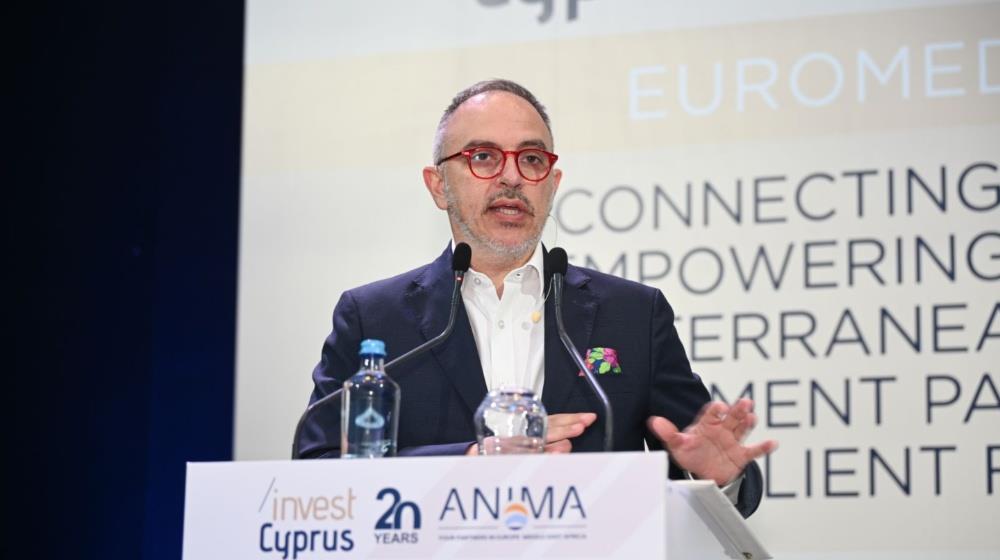
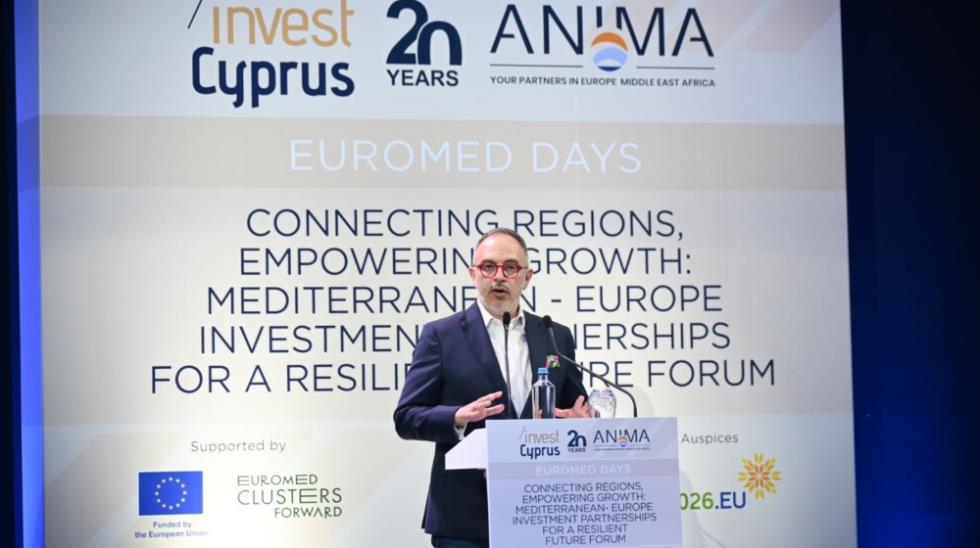
Nicosia Mayor Charalambos Prountzos shared a realistic and deep business perspective on regional cooperation in a speech entitled 'Building Resilient, Innovative and Connected Cities: Strengthening the Mediterranean –Europe Partnership,' within the framework of the EUROMED DAYS 2026 conference.
Putting aside classic political rhetoric for a while, Prountzos chose to "wear the hat of the private sector," approaching the challenges of the Mediterranean through the prism of the market, security and applicable business plans.
In his analysis, the Mayor of Nicosia developed six key points that highlight the strategic importance of cities, while simultaneously dispelling the stereotype that a single policy can be applied everywhere in the same way.
The fallacy of "one size fits all" and the role of cities as "testbeds"
The Euro-Mediterranean market presents an extremely interesting peculiarity: it combines very small markets with huge states, and large metropolises with smaller provincial towns. As Prountzos pointed out, economic analyses often fall into the error of levelling, but it is impossible to approach a market like Cairo, for example, in the same way as Nicosia. Cyprus, with a population of one million, cannot be compared to Turkey, with a population of 85 million.
But why are cities at the centre of this debate? The answer is simple: because that is where the heart of the economy beats. In the European Union, 70% of the population lives in urban centres, while 17.6% reside in European Mediterranean countries. Consequently, the vast majority of Foreign Direct Investment (FDI) is directed and implemented in cities.
At the same time, smaller cities offer a unique advantage: they act as the perfect commercial testbeds. When a company wants to develop and test a product in critical sectors such as energy, water management, data or retail, it doesn’t start the test in a huge, chaotic business environment. It pilots it in a smaller, controlled city, and then scales the solution to larger markets. Cities, therefore, form the basis for an entire ecosystem of investments and infrastructure.
The challenge of small investment "tickets" and the bureaucratic gap
One of the biggest distortions in the infrastructure market is the focus of large institutional investors and sovereign wealth funds exclusively on mega-projects. These funds refuse to even discuss projects whose budget is below the threshold of half a million euros. However, in the European Union, the average size of a city is around 300,000 inhabitants.
Prountzos underlined the urgent need to find ways to mobilize investment capital for smaller investment "tickets," as the majority of the population does not live in large cities, and the financing needs of these cities are significantly lower but also vital.
Furthermore, the business world is called upon to bridge two completely different institutional environments. On the one hand, the European Union has an extremely strict and often bureaucratic framework for the public sector, which is designed with transparency and equality in mind, but lacks flexibility – with the only exceptions being in the areas of defence, security and transnational GovTech (G2G) agreements.
On the other hand, North African countries are showing great flexibility, offering direct concessions and creating special economic zones at speed. This is why we see huge investment capital from China flowing to Africa, while Europe remains trapped in its own processes.
Values, risk and the need for meaningful innovation
The European Union began as a purely economic community, but has evolved into a union of values, where democracy and the rule of law determine legistlation. This creates an inevitable divergence with neighbouring Mediterranean countries. From an economic point of view, European companies are often hesitant to invest in North Africa or the Middle East, as they weigh the risk of political instability and the so-called reputational risk based on European criteria.
At the same time, in the points he presented, Prountzos also found that the issue of financing within Europe needs a radical revision. The funds are there, but the way they are used is suffering. A typical example is the Horizon programme, which, despite the huge amounts it channels, has not managed to produce substantial, commercially exploitable innovation. In his assessment, Horizon has turned into a bureaucratic exercise in compliance and box-ticking instead of a creative process. This is why Europe is unable to produce entrepreneurial "unicorns" compared to the US or China.
The historic opportunity of the European South
Concluding his speech, Charalambos Prountzos sent a resounding message on the future of the region. Historically, the economic and political power of the European Union has always been concentrated in Central and Northern Europe. The European South has never been treated as the productive or economic engine of the Union. Now, however, for the first time, the conditions are changing. If we manage to create substantial synergies between European cities and the large markets of North Africa, we can unlock huge investment funds. The tools are there, and the needs in areas such as green energy and addressing water scarcity are common. It is the historic opportunity for the South and the Mediterranean to come forward, transforming challenges into commercial and economic power for the whole of Europe.
The EUROMED DAYS – Connecting Regions, Empowering Growth: Mediterranean-Europe Investment Partnerships for a Resilient Future Forum, was organised by Invest Cyprus and the ANIMA Investment Network.
(Source: InBusinessNews)