







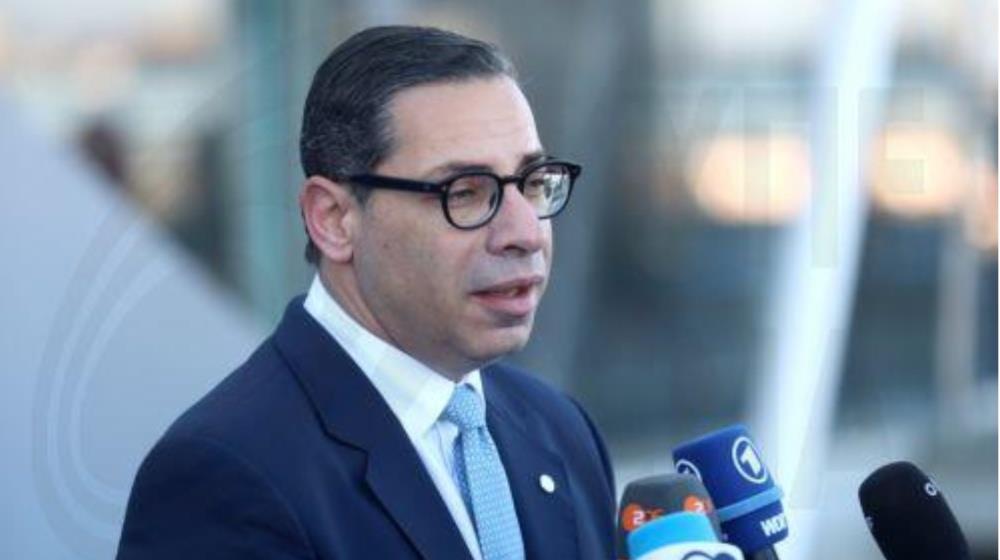
Cyprus and Kyrgyzstan signed a Memorandum of Understanding on political cooperation on Monday, with Foreign Minister Constantinos Kombos describing the development as a "pivotal moment" that could create new momentum in trade, investment and broader bilateral relations.
Speaking after talks with his Kyrgyz counterpart Zheenbek Kulubaev in Bishkek, Kombos welcomed the signing of the MoU and highlighted the signing of an agreement on the avoidance of double taxation between the two countries.
"This, I believe, is a pivotal moment. It's an opportunity to create a momentum in terms of investment and trade, and it's an extremely important development in the history of our bilateral relations," Kombos said.
The Cypriot Minister added that the agreements would contribute to establishing a more predictable, transparent legal and fiscal framework for businesses and investors and could act as the accelerator for economic growth.
Kombos is visiting Kyrgyzstan as part of a regional tour of Central Asia that also included Tajikistan and Uzbekistan. According to the Foreign Ministry, the visits aim to promote and further upgrade Cyprus' relations with countries in the region.
Describing Kyrgyzstan as the final stop of his Central Asian tour, Kombos said the visit demonstrated Cyprus' commitment to strengthening political dialogue and cooperation with Bishkek.
"It is the first time I am visiting your country, and this is just the second ever official visit of a Minister of Foreign Affairs from Cyprus in 34 years of diplomatic relations," he noted.
The Minister also congratulated Kyrgyzstan on its recent election as a non-permanent member of the United Nations Security Council for the 2027-2028 term, describing it as "a great diplomatic and political achievement" and "a recognition of commitment to international law and to the principles underpinning the UN Charter."
He said Cyprus looked forward to close cooperation with Kyrgyzstan at the Security Council, particularly in promoting respect for the UN Charter and international law.
The two Ministers reviewed the state of bilateral relations and discussed ways to expand cooperation in areas of mutual interest, with particular emphasis on strengthening institutional contacts and maintaining regular political dialogue at both technical and political levels.
Kombos said he had invited his counterpart to visit Cyprus as part of efforts to increase high-level exchanges between the two countries.
The Cypriot Foreign Minister also noted that Cyprus has offered 46 scholarships to Kyrgyz citizens over the past three years and intends to continue creating opportunities for students from Kyrgyzstan to study in Cyprus.
A significant part of the talks focused on relations between the European Union and Kyrgyzstan. Kombos reiterated Cyprus' support for deeper engagement between the EU and Central Asia, a region he described as having growing strategic importance in areas such as connectivity, trade, transport diversification and energy security.
He added that they exchanged views on the prospects for further cooperation under the EU-Kyrgyzstan framework, including the enhanced partnership and cooperation agreement and also cooperation under the Generalised Scheme of Preferences Plus (GSP+).
"The EU is looking towards this region and its members. So does the Republic of Cyprus, with openness in dialogue, transparency in facilitative conditionality and active engagement," he said.
He added that cooperation should remain firmly grounded in the principles agreed between the EU and Central Asian states, including full respect for international law, sovereignty and territorial integrity.
During the meeting, Kombos also briefed his Kyrgyz counterpart on recent developments in the Cyprus issue.
In concluding remarks, Kombos said the discussions reaffirmed the importance of maintaining open channels of communication and advancing practical cooperation, stressing that Cyprus remains committed to constructive engagement with Kyrgyzstan both bilaterally and within the wider framework of EU-Central Asia relations.
Bishkek express concerns over EU sanctions
According to the Kyrgyz Foreign Ministry, discussions between the two Ministers focused significantly on relations between the Kyrgyz Republic and the European Union, including cooperation during Cyprus' Presidency of the Council of the European Union in the first half of 2026.
The Kyrgyz side expressed appreciation for the European Union's support in implementing socio-economic reforms, strengthening democratic institutions, developing human capital and advancing sustainable development initiatives in the country.
At the same time, Kulubaev raised concerns over the intensification of the EU's sanctions policy, warning of the potential adverse effects that unilateral restrictive measures could have on Kyrgyzstan's trade, economic and financial development. According to the Kyrgyz Foreign Ministry, Kulubaev stressed that Kyrgyzstan opposes the politicisation of international economic and commercial relations while remaining committed to constructive dialogue aimed at identifying mutually beneficial solutions.
The Kyrgyz Foreign Minister reaffirmed Bishkek's readiness to further expand cooperation with Cyprus in the fields of trade, investment, education, culture and humanitarian affairs. The two sides also highlighted the tourism potential of both countries and expressed interest in exchanging expertise and promoting joint initiatives in the sector.
According to the announcement, the Ministers also reaffirmed their commitment to maintaining political dialogue and enhancing practical cooperation both bilaterally and within the framework of Kyrgyzstan's partnership with the European Union.
Following the talks, the two sides signed a Cooperation Programme between the Ministries of Foreign Affairs of the Republic of Cyprus and the Kyrgyz Republic for the period 2027-2028, further strengthening the institutional framework for bilateral cooperation.
