







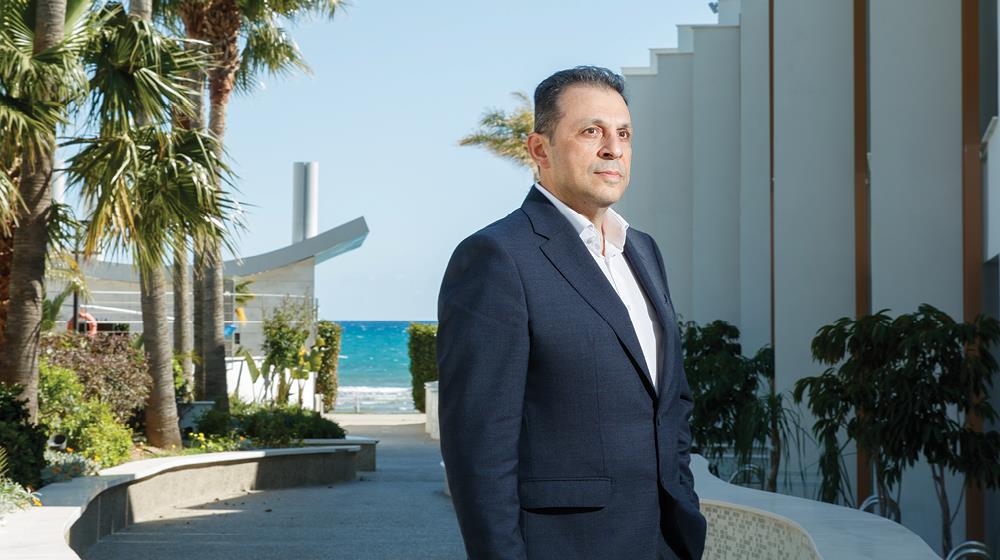
When Marios Polyviou founded Sunnyseeker Hotels in 2012, Larnaca accounted for just 7% of overnight stays in Cyprus. Today that figure stands at 14%.
As President of the Larnaca Hotels Association and CEO of the company that brought Radisson, IHG and Best Western to the city, Polyviou has had a front row seat and a direct hand in that transformation. Here, he reflects on what international brands have meant for Larnaca beyond the hotels themselves and why he considers the city a year-round destination for tourism.
Sunnyseeker Hotels has been central to bringing international hotel brands to Larnaca – Radisson, IHG, Best Western, etc. What differences does a recognised brand make to a city like Larnaca, beyond the hotel itself?
Sunnyseeker Hotels identified the absence of international brands in the local hotel industry and responded to that need. It took considerable effort but Larnaca has benefited immensely. International brands promote not only their hotels but the location, so Larnaca has been put on the map. The city itself is being promoted, which, in turn increases the number of visitors. The hotels in Larnaca are doing extremely well and I believe that they have contributed to the wider tourism industry in Cyprus as well as to the city specifically.
Year-round tourism has been cited as an industry ambition in Cyprus for decades but is it truly achievable?
Cyprus is still not yet a year-round tourism destination but Larnaca is! There are certain areas, such as the Famagusta district, where there is a significant drop-off in the number of visitors during the winter period and some hotels have to close. But this is not happening in Larnaca. There is certainly a reduction in occupancy from the heights of the summer season but, even so, most hotels in Larnaca remain open during the winter. Therefore, we consider Larnaca a year-round destination.
For the rest of the island, is it about connectivity, the product offering or something else entirely?
It’s both a product and a connectivity issue. For example, certain areas have a very sharp focus on summer leisure so it’s almost impossible for them to remain open during the winter. But as we’ve seen with Limassol, Larnaca, Nicosia and the mountainous regions, developments in the agrotourism sector have shown visitors that they are worthwhile destinations during the winter period. This is the main reason for the increasing number of visitors during the ‘quiet’ period for Cyprus. In a way it’s cyclical, as airports are also impacted by seasonality. But one thing leads to another: when airlines see that there is increased demand from visitors to travel to Cyprus during the winter, they will increase the number of scheduled flights. Somebody has to take the lead. So, yes, Cyprus is primarily known as a summer destination but we certainly have a lot to offer during the winter as well.
Each city has its own distinct identity in the local market – business, luxury tourism, leisure and so on. Where does Larnaca position itself?
Larnaca has two distinct leisure options: one is the city itself – offering everything from gastronomy to archaeological sites and museums. And of course, during the summer, there are its fantastic beaches. Over the last ten years, many boutique hotels have arrived on the scene. This is especially true inside the city, a move that has created its own market, leading to visitors arriving all year round. We also have a growing number of business travellers attending conferences in Larnaca. So, the city is evolving across many different segments of the tourism industry, including business and leisure.
Larnaca has always attracted significant tourism, not only from the UK and the EU but also from Israel and Russia. However, the last few years have shown how quickly source markets can change and even disappear due to geopolitical events, so is there a need to diversify at a strategic level?
Definitely. The tourism industry is very sensitive to geopolitical events and there tends to be a lot of activity in our neighbouring region but this has been true for decades and Cyprus has always managed to stay away from the problems. Indeed, it has played a role as a pillar of stability in the Eastern Mediterranean and it is precisely because it has always been considered a safe hub by everyone that we have often seen an increase in the number of visitors when events are occurring in neighbouring countries.
In the last couple of weeks, developments have impacted the flow of tourism, not just to Cyprus but across the wider region, as the industry is very sensitive when it comes to security. But the message is clear: all the hotels and other facilities of the sector – airports, transport, restaurants – in Cyprus are extremely safe. Regarding the source markets for Cyprus, we have already diversified. We have the major markets, at the moment led by the UK, while the second is Israel, where activity has slowed down because its airports are closed. Consider, however, that in 2022, when the Russian market was impacted – it was the second biggest market at the time – the tourism sector reacted quickly and managed to recover. So, we do have the necessary adaptability.
If you look back at the state of Larnaca’s hospitality/tourism industry in 2012, when you started Sunnyseeker Hotels, and compare it to where it stands today, what is the development you’re most proud of? And is there one thing that you wish had moved faster?
Larnaca has changed considerably over the past 15 years, not only in the hospitality sector but as a city overall. In 2012, Larnaca accounted for 7% of overnight stays in Cyprus but we have doubled it to 14% and, last year, it ranked third in terms of regional numbers of overnight stays. Of these major changes, such as the number of hotels that have been added to the market and the infrastructure which has been upgraded significantly, I’m certainly very proud of the hotels that we have opened and are managing: Radisson Blu, Radisson Beach Resort, Hotel Indigo and Mikes Kanarium City Hotel. I wish we had moved faster on adapting to new technology but this is where working with major international brands makes a key difference, as they have the means to keep pace with technological developments. The speed of technological change in the hospitality sector is astounding.
This interview first appeared in the April edition of GOLD magazine. Click here to view it.
