







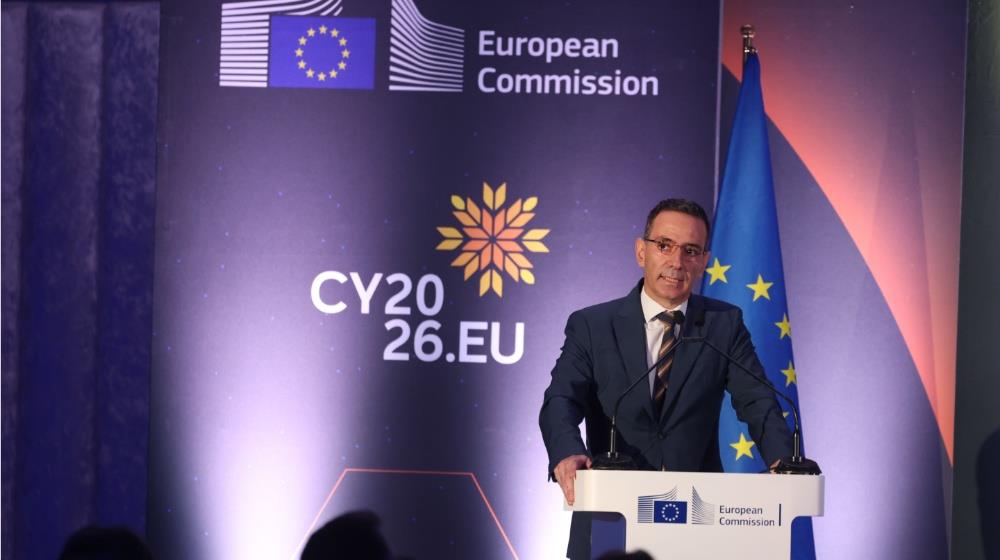
“Europe needs a modern space regulatory framework that gives confidence to operators, investors and citizens”, Deputy Minister of Research, Innovation and Digital Policy Nicodemos Damianou said on Tuesday at the opening of the high-level European conference “EU Space Days 2026” in Nicosia, where officials warned that space is rapidly becoming a central arena for economic competition, technological sovereignty and security.
The annual EU Space Days 2026 brings together representatives from the European Commission, the European Space Agency (ESA), the EU Agency for the Space Programme (EUSPA), industry leaders and researchers to discuss the future direction of Europe’s space policy and industrial strategy.
Speaking during the morning opening session of the two-day conference, held under the Cyprus Presidency of the Council of the European Union, Damianou said Europe must accelerate efforts to strengthen its strategic autonomy in space through investment, regulatory clarity and closer coordination between Member States.
“Space is at the center of everything that matters for Europe: competitiveness, security, resilience, and strategic autonomy”, he said, describing the sector as critical infrastructure underpinning navigation, telecommunications, disaster response, financial systems and digital connectivity across the continent.
He stressed that the space sector has evolved far beyond scientific exploration and now forms part of Europe’s geopolitical and economic architecture.
“The global space economy has already surpassed €500 billion and is expected to exceed one and a half trillion within the next decade”, he said. “Europe must strengthen its technological sovereignty and build a true Single Market for Space”.
Referring to the Draghi and Letta reports on European competitiveness, the Deputy Minister warned that Europe risks falling behind global competitors unless it moves faster to translate innovation into industrial and strategic capacity.
A key focus of Damianou’s intervention was the ongoing work under the Cyprus Presidency on the proposed EU Space Act and the future structure of the space pillar of the European Competitiveness Fund under the EU’s next Multiannual Financial Framework for 2028–2034.
He said Cyprus has worked intensively with Member States and stakeholders to support “a clearer, more balanced and more operational framework for space activities in Europe”, balancing safety, resilience and environmental sustainability with innovation and competitiveness.
Damianou added that the Presidency had already tabled a compromise text on the EU Space Act in March, while discussions continue on ensuring long-term funding and flexibility for Europe’s future space programmes.
“Europe’s ambitions in space require not only clarity, but also the financial, industrial and technological capacity to deliver”, he said.
He also positioned Cyprus as an emerging regional hub for advanced technologies and space-enabled services, highlighting its geographic location at the crossroads of Europe, Asia and Africa.
“Our country hosts gateway facilities and satellite ground stations for leading European operators, as well as four operational satellites using Cypriot assets”, he said.
Damianou added that Cyprus is advancing plans for an optical gateway linked to EU secure connectivity systems and quantum communications infrastructure, while also hosting part of the Galileo Search and Rescue network and future EGNOS monitoring stations selected by EUSPA.
“These are not symbolic projects”, he said. “They are strategic capabilities that directly support resilience, connectivity, safety and security across our wider region”.
He also pointed to Cyprus’ transition to Associate Membership of the European Space Agency as a major milestone for the country’s research and innovation ecosystem, opening the door for greater participation by Cypriot universities, startups and companies in European programmes.
“For Cyprus, space is not an abstract discussion. It is the next technology frontier”, he said.
Alongside the economic and industrial dimension, the conference also focused on security concerns and the increasing militarisation of space.
Addressing delegates during the opening session, Cypriot Member of the European Parliament (S&D) Costas Mavrides warned that space had become “a critical arena of competition, opportunities and vulnerabilities”.
“We see Russia advancing anti-satellite capabilities, conducting electromagnetic warfare and even considering the placement of nuclear weapons in space”, Mavrides said. “We see China deploying manoeuvrable dual-use satellites capable of approaching and potentially disabling other spacecraft”.
He said these developments underline the need for a stronger and more coherent European defence and security strategy in space.
Mavrides argued that the European Union must adopt a “360-degree” approach to security, addressing threats ranging from the war in Ukraine and instability in the Middle East to tensions in the Eastern Mediterranean.
He also highlighted the importance of dual-use technologies, noting that many advanced space systems serve both civilian and military purposes.
“The same satellite that enables precision agriculture or maritime monitoring can also deliver secure communications and early warning for military missions”, he said.
Mavrides further called for increased European investment in space infrastructure and defence capabilities, warning that EU spending still lags significantly behind global competitors such as the United States and China.
The conference continues on 27 May with discussions on the future of the EU Space Programme, space for defence, quantum communications and Earth observation, as well as Europe’s broader strategic autonomy ambitions in space.
