






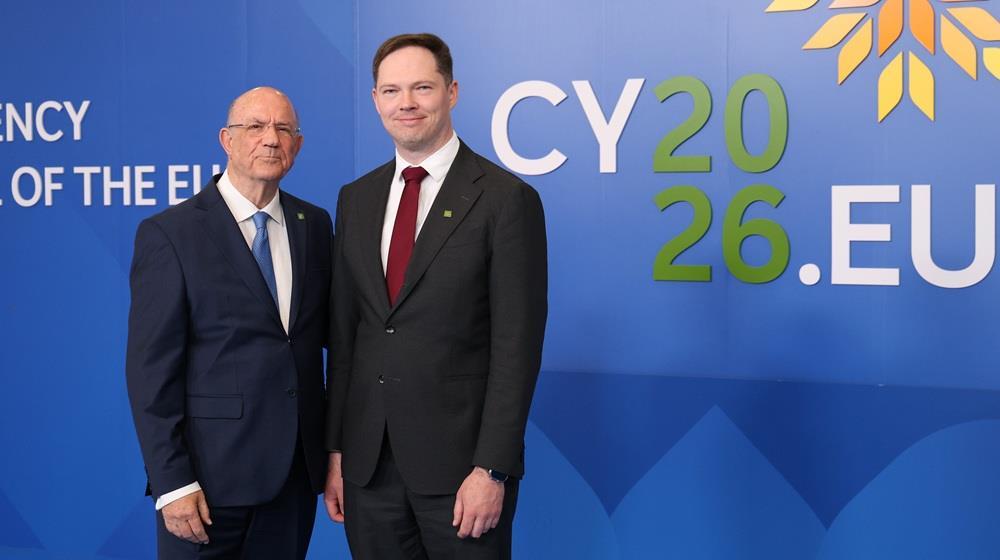
Cyprus and Lithuania have a lot in common and can find more ways to cooperate, especially on tourism and defence, Lithuanian Minister of Finance, Kristupas Vaitiekūnas, has told the Cyprus news Agency (CNA), in view of his participation in the informal meeting of Economic and Financial Affairs Ministers (ECOFIN) taking place on Friday and Saturday in Nicosia.
He also expressed optimism about the next Multiannual Financial Framework, as well as hope for a quick resolution of the crisis in Iran, while reiterating his country’s support to Ukraine and its EU accession path.
Asked about the informal ECOFIN’s meeting agenda, Vaitiekūnas said that economic topics will be at the forefront, namely the global economic situation, the oil crisis, the fiscal stability of European countries, and measures on how to move forward with the increased fuel prices and the crisis which might come if the situation in the Middle East is not resolved.
Another topic, according to the Lithuanian Minister, will be housing affordability, a very important topic, as he said, for all Western countries, but for Lithuania in particular, where a rapid growth of housing prices has been observed, especially in its major cities and the capital, Vilnius.
Asked what Lithuania expects the EU can do on energy prices in the framework of a concerted effort, he said that there could be a united mechanism for all European countries.
“The EU can provide expertise, they can share the best ideas that countries have come up with to cope with that. Of course, we already have recommendations from the European Commission to apply more targeted and temporary measures instead of very broad and very expensive measures that have little effect on prices. We also expect to get more details about these recommendations. There are also talks about windfall revenue tax on refineries, while there might even be some measures that provide an escape clause for some expenses,” he further explained.
Asked whether this topic is connected to the general discussion about alternative energy sources, Vaitiekūnas replied in the affirmative, adding that Lithuania has been reshuffling its investment programmes, directing more investments into energy independence, renewable energy sources, and energy storage capacity.
“We are redirecting these investments from EU funds, from other sectors. It is a long-term investment that can increase our energy independence. We have a plan to produce more electricity that we consume by 2028,” he noted.
Asked about the current situation in Ukraine, the Lithuanian Finance Minister said that the war Russia is fighting in Ukraine is a war against all Western countries, “against our way of life, against our freedom and against who we are.”
“We, of course, continue to support Ukraine, we would like to see a more rapid accession to the EU. I think that Ukraine has made a tremendous job on reforms. Of course, we have to demand that reforms continue, but on the other hand, we have to provide some clear horizon for EU accession. Maybe it can be a little bit different procedure, the country is fighting, and I think it is a mutual interest to have Ukraine in the EU. For Ukraine, it is economic prosperity, for us it is security and defence and warfare know-how. Lithuania will use all the means it has to help Ukraine to succeed in joining the EU,” he stressed.
Referring to security and defence, and asked about the EU SAFE programme and whether Lithuania has any particular projects in this area, Vaitiekūnas said that Lithuania welcomes this programme.
“It is very beneficial in our point of view. We calculated that we are getting about 6.4 billion euros from it, but we have to understand that this is a loan mechanism. We are happy with it, it has a lower interest rate, and we calculated that in a 10-year period, we can save around 250 million in interest payment if we use this mechanism,” he continued.
Regarding the programmes and projects that could be financed through it, he said that the biggest part will be used for the development of the Lithuanian armed forces, while a smaller part of resources will be used for military support to Ukraine.
He also said that the defence industry is starting to develop in Lithuania, with the country’s national development bank helping companies in the sector to start their business. “It is a high value-added sector, so there is an opportunity. Whether we use it or not will depend on how actively we will work,, he commented.
Referring next to the discussion about the next Multiannual Financial Framework, the Lithuanian Minister said he is cautiously optimistic as to the current state of the MFF.
“Of course, we are worried that it might be downgraded and the threat is real, but at first glance, as we see it now, it looks quite optimistic. We see that one of the priorities of the next MFF is defence-related, security-related. At this stage, we managed to calculate that around 10% to 12% of all funds are directly or not directly linked to the security and defence, so that is optimistic for us,” he further said.
He added that there are also worrying elements, such as the cohesion funds and agriculture, while although there has been a major improvement in nominal value compared to the last programme, in terms of purchasing power, the new framework is the same.
“And if it is cut, it will become smaller than it was. So, it is worrying, because that means that the European Union as an entity does not get more united and stronger than it was,” he noted.
Asked about relations between Cyprus and Lithuania, Vaitiekūnas said that the two countries have a lot more in common than can be seen from a first glance.
“We are both border regions, we both face drone threats in our territory, and we have a similar economy because the financial sector is very important for Cyprus, but it is very important for Lithuania as well. I think our businesses and our people can find more ways to cooperate, for example on tourism and defence, so it would be interesting for both nations to visit each other and to know more about one another. I think businesses could always find a way so that they can cooperate,” he underlined.
Asked whether Lithuania monitors development in the Middle East, the Lithuanian Minister said they are monitoring the region very closely.
“We always wanted to see it stable and prosperous. Lithuania, Israel and the Jewish community in Lithuania, we have a long and difficult history, and we want both nations to prosper and find the best way to look into the future and work together,” he continued.
“Most of our attention goes now to Iran and the Hormuz crisis. It has a negative effect on the economy, that is another thing that we have in common with Cyprus. We have a rapidly growing economy, but it slows down and puts a stagflational pressure, which is the worst situation in the economy. So it is really worrying and it would be great to see some resolution of that conflict and, of course, to move forward,” he added.
Asked about the Lithuanian Presidency of the Council of the EU in the first half of 2027, right after the end of the current EU trio, Vaitiekūnas said that as a political goal and as a political agenda Ukraine will be the priority for the Lithuanian presidency.
“We have to help them with EU accession, we have to help them with the reforms, we have to help them with the rebuilding and the fighting, and of course to learn from them. These people went through very difficult times, but we have to learn from them, and we have to provide them hope too. They are not fighting for nothing, they are fighting for freedom, for prosperity and for all European values which we share with them,” he concluded.
