








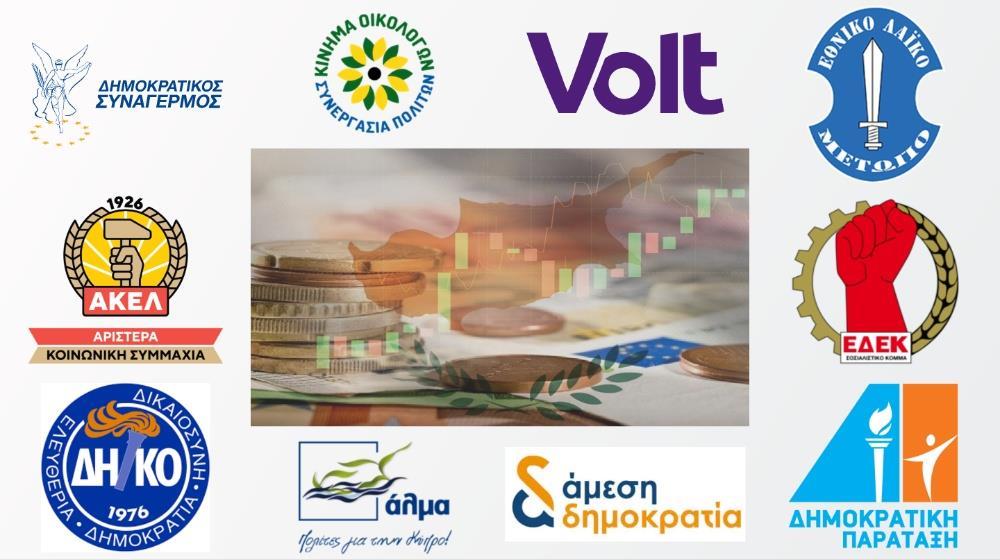
With parliamentary elections set to take place this Sunday, the political landscape in Cyprus is entering its final stretch, as parties intensify their focus on key issues shaping voters’ decisions. At the heart of the pre-election debate lies the economy, with rising prices, the ongoing housing crisis, and increasing energy costs dominating public concern. The new Parliament, once formed, will be tasked with addressing these pressing challenges through a series of critical policy decisions in the months ahead.
Ahead of the Parliamentary Elections, InBusinessNews reviewed the official websites of the political parties to record their main positions on the economy.
DISY: "Responsibly Forward"
DISY, under the slogan "Responsibly Forward," presented 31 policy directions, key priorities, and goals for the next decade ahead of the Parliamentary Elections.
Regarding economic stability, the party emphasizes the need for an annual surplus to strengthen Cyprus's resilience to external crises, stressing the importance of reducing public debt below 40% before 2031.
DISY also calls for controlling inelastic expenditures through a strict public sector employment policy, while investing more in digitization and simplifying administrative procedures.
The party also states it will not accept any new taxation and will maintain a favorable regime for high-quality foreign investments through incentives. On housing, DISY believes the problem can be effectively addressed through collaboration with the private sector, assigning more projects to the Cyprus Organization for the Development of Housing (KOAG), immediately revising local plans, providing more urban planning incentives, and launching urban land consolidation to release enclosed plots.
AKEL: 12 Policy Pillars
AKEL has submitted proposals covering 12 pillars: secured rights for every worker, dignity pensions for better living conditions, the right to housing for all, restricting property purchases by foreign investors, blocking arbitrary foreclosures, supporting efforts to re-establish the Cooperative movement, cheap electricity for households, taxing excess profits of renewable energy companies and banks, abolishing double taxation on fuels, establishing a network of nurseries and childcare centers, and supporting families and new parents.
According to AKEL:
"Cyprus is at a critical junction. High prices, rents, loans, low wages, and pensions are suffocatingly pressuring the vast majority of Cypriots. The new generation cannot move forward with their lives. The middle class is disappearing, and low-income groups are being pushed into poverty."
The party continues:
"Banks and large corporations are accumulating record profits and excess earnings. State revenues are increasing significantly due to higher taxes paid by consumers. The Government, without caring about what people are going through, is giving away hundreds of millions of euros to banks and large enterprises."
DIKO: High Prices and Economic Pressure
DIKO primarily highlights the issue of high prices and the economic pressure on citizens. The party has already prepared a comprehensive package of proposals aimed at immediately and substantially addressing the problems caused by inflation and economic difficulties.
"With a sense of responsibility toward citizens and their real needs, the Democratic Party is submitting specific, costed, and actionable proposals aimed at the immediate relief of households and the creation of conditions for economic stability and social justice," the party states.
These proposals, organized into six specific chapters, address both the pressing everyday needs and the structural weaknesses of the economy, placing the citizen and quality of life at the center.
ELAM: What Is Proposed
Although ELAM has not officially submitted its positions, the main axes of its economic program include:
- Tax Reductions and Inflation: Proposes reducing taxes on fuels, essential goods, and electricity to protect households and small and medium enterprises from high prices.
- Protection of Borrowers: Prioritizes the interests of citizens and borrowers over banks, supporting relief measures for "red loans" and interventions in interest rates.
- Energy: Supports accelerating the arrival of natural gas in Cyprus, with the ultimate goal of reducing electricity costs, which are harming the economy's competitiveness.
- Change of Economic Model: Promotes developing new sectors, emphasizing the primary sector (agriculture and livestock), the secondary production sector, and supporting startups.
- Social Policy: Seeks to create a strong social state supporting vulnerable groups, large families, and low-income pensioners.
EDEK: Strong, Fair, and Sustainable Economy
EDEK, with human-centric politics and action since its founding, ranks the economy as one of the most important sectors of politics, "since the economy should serve society, not the unchecked and purely profit-driven business activities of the few."
The party proposes a Strategic Framework for Cyprus's New Economy for 2026–2030, with the substantive slogan: "STRONG – FAIR – SUSTAINABLE ECONOMY," with the necessary precondition of no exclusions and equal opportunities for all.
Within this framework, EDEK sets three key macroeconomic goals:
- Stable growth of 3–4% annually with emphasis on productivity, innovation, and gradually diversifying the economy from over-reliant sectors to new, sustainable ones, while maintaining social cohesion.
- Maintaining public debt below 65% of GDP by 2030, with investment grade in all major ratings.
- Tackling inflation and high prices through targeted subsidies, increased domestic production, and reduced energy costs.
DIPA: Transformation of the Production Model
DIPA believes it is time to transform Cyprus's production model into a more developmental one with a human-centric orientation.
The party suggests:
- Providing incentives to promote large developmental projects.
- Accelerating urban planning permits, focusing on immediately advancing projects that will boost new sectors with strong growth prospects (innovation, technology, environment, new forms of tourism, film studios, etc.).
- Accelerating the issuance of property titles, approval of which has been pending for many years.
- Activating and strengthening the €20 million investment fund with participation from the banking sector and the private sector.
- Introducing a state guarantee scheme for investments that will quickly positively impact employment.
- Utilizing EU funds and channeling them into agriculture, agritourism, and female and youth entrepreneurship.
- Leveraging e-Governance so that services like the Cadastre, Urban Planning, and Municipalities continue operating smoothly, ensuring the construction and land development sector is not harmed and can compensate for damages to the Cypriot economy.
- Accelerating the processing of cases where the state owes money to citizens (e.g., VAT, income tax refunds) to improve liquidity for businesses and the real economy.
Movement of Ecologists: Economic Reconstruction
The Movement of Ecologists – Citizens' Cooperation promotes economic reconstruction and fair wealth distribution, emphasizing that "the only answer to avoiding future economic crises is a full transition to a green economy."
"Instead of socially indifferent and environmentally blind austerity, as a Movement we have specific proposals for sustainability," the party explains, emphasizing its pursuit of an innovative green transformation through ecological design rules, green public procurement, rules for state aid, private investments, small enterprises and cooperatives, better financing for research, development, and education, promoting entrepreneurship (especially social entrepreneurship), good labor relations, democracy in workplaces, and combating unchecked corporate interests.
The goal will be achieved through a shift toward:
- The Green New Deal
- Economic reconstruction and fair wealth distribution
- Institutionalizing a national minimum wage/pension and strengthening workers' rights
- Sustainable tourism development
ALMA (The Leap Movement)
The Leap Movement has set as its central goal the radical reconstruction of Cyprus to build an economically prosperous, fair, and decent society with an effective state, strategic targeting, and credible institutions.
"We want a state based on public-spirited rationalism that practically promotes human-centric and sustainable development, ensuring that everyone—today and tomorrow—lives with dignity, prosperity, equality, and respect for rights and expectations."
Among other things, ALMA has set the following goals:
- A stable, predictable macroeconomic framework characterized by long-term fiscal strength that favors investment
- A productivity leap through innovation, digitization, and data utilization, with skills upgrading
- Green and competitive economic transformation with supply security and a fair transition (see Energy section)
- Transparent market rules: rule of law, anti-corruption, quality regulation, and fast licensing
- Resilient value chains and outward orientation: shipping, logistics, and trade adapted to new European frameworks
- A modern financial ecosystem: transparency, instant payments, and SME access to financing
- Tax justice and social cohesion – fair distribution of growth with targeted social spending
Direct Democracy
Although Direct Democracy has not compiled a specific program of positions, among other things it proposes:
- Increasing the minimum pension to €1,088, matching the minimum wage
- Granting financial assistance for having children:
- €5,000 one-time payment for the first child
- €10,000 for two children
- €15,000 for three or more children
To address the housing problem, the party suggests constructing 10,000 homes on buildable land through public-private partnership. For students, it proposes providing a €100 card to cover part of the rent cost.
Volt: The Suggestions
Volt has submitted a series of positions and proposals for the economy covering five key areas: tax reform, housing policy, innovation, digitization, and labor rights.
Regarding the tax system, the party's basic goals are fairer burden distribution, strengthening equality and transparency, and supporting development at both social and business levels.
For housing policy, Volt suggests increasing the availability of residential units at affordable purchase and rental prices, planning and implementing social housing programs, and developing a medium-term plan to maintain supply at levels meeting estimated demand and housing needs.
Regarding labor rights, Volt's policies aim to create an extremely productive, fair, and safe working environment for all citizens.
