







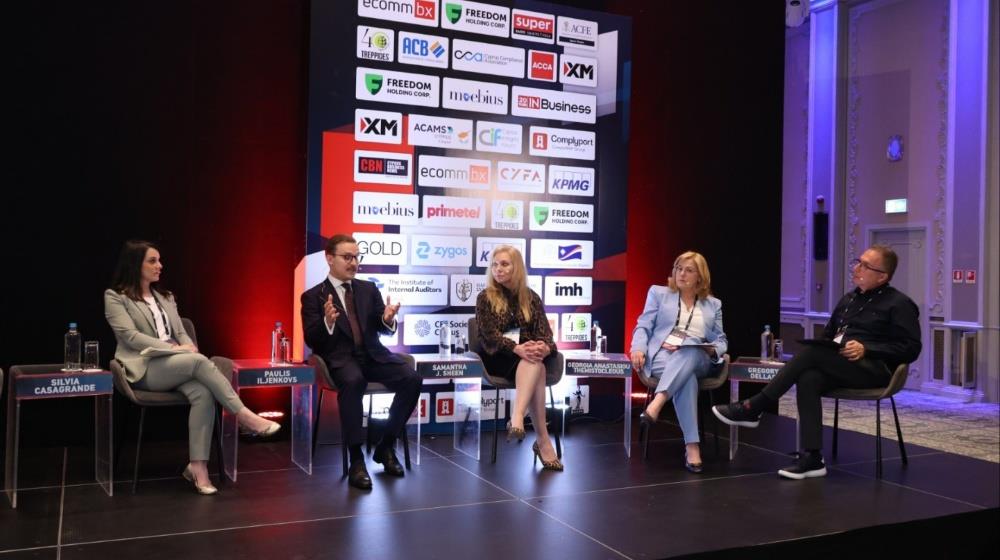
A panel discussion entitled ‘From Lists to Leverage: Why Sanctions Compliance still Fails and what can we do about it’ saw experts at the 2th International Compliance Forum, presented by ECOMMBX weigh in on why firms still misjudge exposure, where banks vs regulators disagree and what enforcement cases actually show.
The panel was made up of Silvia Casagrande, Head of Engagement, Office of Financial Sanctions Implementation (OFSI), Paulis Iljenkovs, Deputy Director, Financial Intelligence Unit (FIU) of Latvia, Samantha J. Sheen speaking in her capacity as a subject matter expert, and Georgia Anastasiou Themistocleous, Deputy Economic Director, Head of National Sanctions Implementation Unit, Ministry of Finance. The discussion was moderated by Gregory Dellas, Group Chief Compliance & Risk Officer, ECOMMBX, Chair, ACAMS Cyprus Chapter and the Chair of the conference.
The panel highlighted that sanctions compliance is becoming more complex, not because of a lack of guidance, but because of the speed, volume, and sophistication of global sanctions developments.
The experts agreed that many institutions still struggle with basic sanctions fundamentals, such as understanding jurisdictional reach, maintaining adequate screening, and recognising that liability remains with the institution even when using third‑party tools. Authorities emphasised that firms should communicate more openly with regulators, including when breaches occur.
Sanctions evasion typologies have become increasingly sophisticated, driven by the expanding scope of sanctions, especially those targeting Russia. However, identifying evasion does not mean sanctions are failing; rather, it reflects active enforcement. Coordinated international action — such as widespread designations of shadow‑fleet vessels — demonstrates growing global alignment.
A recurring theme was that technology alone is not enough. While screening tools and AI are essential, over‑reliance creates “zombie behaviour,” where staff stop thinking critically. Human judgment, contextual understanding, and the ability to interpret unusual patterns remain irreplaceable.
Smaller firms face particular challenges due to limited resources, making them more vulnerable to exploitation by sanctions evaders. Regulatory arbitrage persists, with some jurisdictions chosen specifically because they rarely enforce sanctions.
Finally, the discussion underscored that sanctions implementation is not merely a regulatory obligation but a national security function. New national sanctions units — such as the one recently established in Cyprus — are being shaped by international best practice and cross‑border cooperation, signalling a more coordinated and intelligence‑driven future for sanctions enforcement.
Diamond Sponsor: ECOMMBX
Platinum Sponsor: Freedom Holding Corp.
Gold Sponsors: Treppides, XM
Silver Sponsors: Complyport, KPMG, Moebius, Zygos
Supporters: ACAMS Cyprus Chapter, ACCA, ACEMPI, CCA, ICAEW, Primetel, The Marshall Islands Registry
With the support of: ACB, ACFE, Cyprus Bar Association, CIF, CFA Society, CYFA, Institute of Internal Auditors
Communication Sponsors: CBN News, GOLD, IN Business