








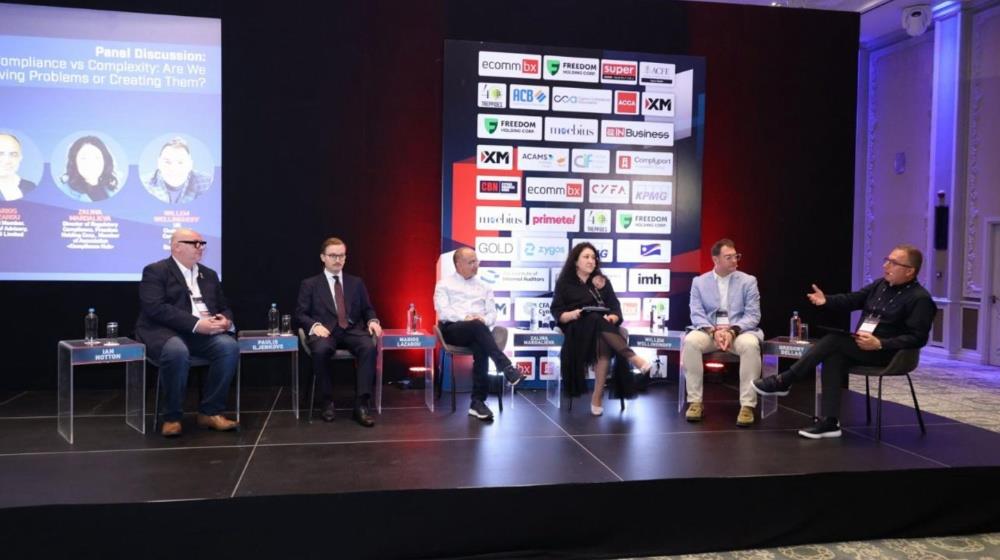
Local and international experts shared their opinions in a panel discussion entitled ‘Compliance vs Complexity: Are We Solving Problems or Creating Them?’ at the 12th International Compliance Forum, presented by ECOMMBX.
The experts talked about whether regulation is becoming unmanageable, whether the compliance sector is measuring the right things and if compliance should ‘own culture.’ They also weighed in on whether or not AI is a cure or a new risk and whether or not AMLA will create harmony or bureaucracy.
The panel was made up of Ian Hotton, Head of Compliance and Risk, Asset Reality, Paulis Iljenkovs, Deputy Director, Financial Intelligence Unit (FIU) of Latvia, Marios Lazarou, Board Member, Head of Advisory, KPMG Limited, Zalina Mardalieva, Director of Regulatory Compliance, Freedom Holding Corp., Member of Association ‘Compliance Hub,’ and Willem Wellinghoff, UK Chair, Chief Compliance Officer, Ecommpay. The discussion was moderated by Gregory Dellas, Group Chief Compliance & Risk Officer, ECOMMBX, Chair, ACAMS Cyprus Chapter and the Chairman of the conference.
The panel’s main takeaway was that compliance is becoming significantly more complex, but also more strategically important. The discussion repeatedly returned to three central themes: risk understanding, human judgment, and the need for compliance to evolve from a control function into a strategic business partner.
Key conclusions included that institutions are generally becoming better at understanding financial crime risk, particularly compared with a decade ago, but the process remains uneven across jurisdictions and sectors. Better-quality KYC, transaction monitoring and suspicious transaction reporting (STRs) were described as essential for effective financial intelligence work.
They also talked about how documentation and reporting are not simply “box-ticking” exercises. From the FIU perspective, high-quality and timely STRs remain one of the most valuable tools for identifying and investigating money laundering and other financial crimes.
Another takeaway was that compliance functions are under increasing pressure due to expanding regulation, operational complexity, ESG obligations, cyber risk, sanctions, crypto, AI and digital finance. However, panelists generally rejected the idea that compliance has become “unmanageable.” Instead, they described it as an evolving and continuously moving target.
Several speakers warned that compliance departments are being overloaded with responsibilities that should belong to the wider business. Compliance should provide oversight, guidance and challenge — not own every operational or strategic decision.
A strong consensus emerged that compliance must become embedded within business decision-making rather than operating as a separate “sign-off” department. Multiple speakers described “compliance by design” as the future model, where compliance is integrated early into product development, governance and strategic planning.
The panel stressed repeatedly that risk ownership belongs to the business itself, not solely to compliance teams. Effective risk management requires coordination between compliance, operations, technology, boards and front-line teams.
Technology and AI were viewed as essential tools for handling growing complexity, but not as replacements for human judgment. Speakers agreed that AI can improve efficiency, investigation support and monitoring processes, but current systems are still immature and potentially risky if relied upon without human oversight.
Several panelists warned that excessive reliance on AI could create new unmanaged risks, particularly if organisations begin trusting automated outputs without sufficient expertise, governance or accountability.There was broad concern that regulation may be becoming too prescriptive, potentially undermining the risk-based thinking that regulators have spent years encouraging. Speakers warned that excessive prescription risks creating a “checklist mentality” focused on satisfying supervisors rather than genuinely understanding and managing risk.
The discussion on the EU’s new anti-money laundering authority, Anti-Money Laundering Authority (AMLA), reflected cautious optimism. Panelists believed AMLA could improve consistency and harmonisation across EU supervision, particularly for cross-border firms. However, concerns were raised that AMLA could also become overly bureaucratic or insufficiently risk-based, depending on how direct supervision is ultimately implemented.
Another major conclusion was that effectiveness should not be measured solely through internal compliance metrics or regulatory reporting. Speakers argued that the ultimate measure of success is whether criminal activity is actually disrupted, criminals prosecuted and illicit assets recovered.
Panelists also emphasised that private-sector investment in compliance must be matched by sufficiently resourced public-sector institutions, including FIUs, law enforcement and prosecutors, otherwise the overall AML system cannot achieve meaningful outcomes.
The importance of trust, integrity and organisational culture emerged throughout the discussion. Compliance was described not merely as a regulatory necessity but as a strategic enabler of sustainable growth and institutional credibility.
The final practical recommendation from the panel was that institutions should focus on three priorities: embedding compliance strategically into the business, maintaining a genuinely risk-based approach, and using technology intelligently while preserving human judgment and accountability.
Overall, the panel concluded that compliance is no longer simply about satisfying regulators. It is increasingly about enabling organisations to operate safely, sustainably and credibly in a highly interconnected, technology-driven and rapidly evolving financial system.
Diamond Sponsor: ECOMMBX
Platinum Sponsor: Freedom Holding Corp.
Gold Sponsors: Treppides, XM
Silver Sponsors: Complyport, KPMG, Moebius, Zygos
Supporters: ACAMS Cyprus Chapter, ACCA, ACEMPI, CCA, ICAEW, Primetel, The Marshall Islands Registry
With the support of: ACB, ACFE, Cyprus Bar Association, CIF, CFA Society, CYFA, Institute of Internal Auditors
Communication Sponsors: CBN News, GOLD, IN Business
