








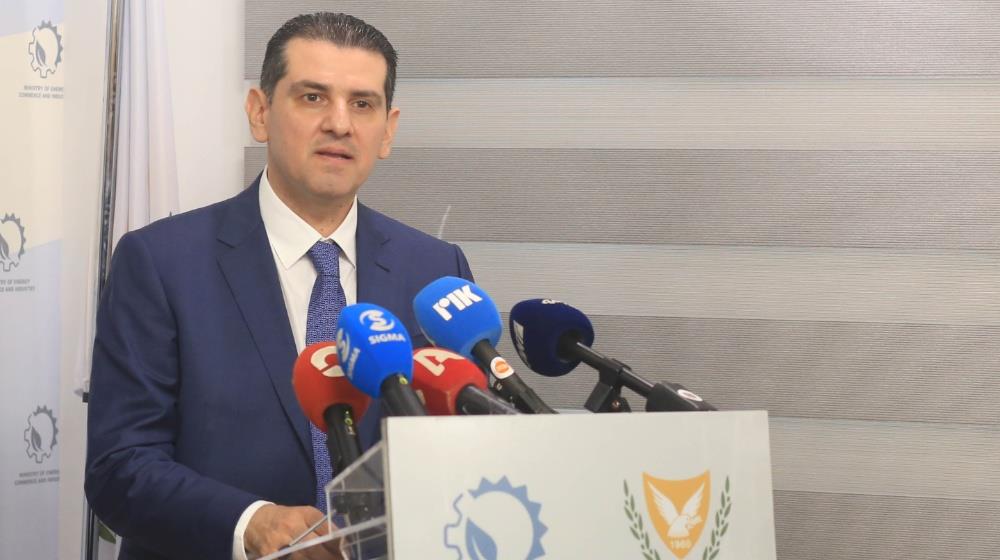
The informal Meeting of Energy Ministers, that met in Nicosia under the Cyprus' Presidency of the Council of the EU, discussed, among other things, how the development of indigenous gas resources, such as those of Romania, Greece, Cyprus, and Poland, can strategically complement EU’s security and diversification goals, according to Minister of Energy, Commerce and Industry, Michael Damianos.
Τhe Minister who presided over the 13 May meeting stressed that, looking beyond 2030, this infrastructure must be assessed through the lens of EU’s climate and clean energy goals.
On his part, Energy and Housing Commissioner, Dan Jørgensen, stressed that we are faced with a fossil fuel energy crisis, noting that we need to speed up and double down on efforts to transition away from fossil fuels.
Asked about the expressed desire of many member states to start drilling at greater scale for the gas beneath the Mediterranean and whether the Commission is prepared to facilitate this massive gas drilling, the Commissioner avoided to answer.
Asked about the progress of the country’s gas exporting efforts, the Cypriot Minister said that with respect to Aphrodite field, which is the oldest and biggest discovery, “things proceed as planned.” Specifically, he said that Chevron is proceeding with FEED by January 2027, and FID is going to be within six months of that. “We're looking at first gas at 2030, 2031 and this is according to plan,” he said, with the gas going, by pipeline, to Egypt.
As regards to Cronos discovery, which is awarded to the consortium of ENI and Total, he said that we are in the final negotiation stages to try and agree commercial, legal and technical terms, in order for this gas to go through Zohr to Egypt and then on sale to the European market. “If we reach an agreement in the next week or two, then we're looking at first gas by the end of 2027 or the first six months of 2028 for the European market,” he estimated, adding that this is very good for Cyprus, for the two big European companies, for Europe and for Egypt as well.
With respect to the Exxon discoveries, the Minister said that they are proceeding according to plan and timeline. “We're looking at first gas at 2033 at the earliest, because there's a lot to do technically, in terms of construction mainly.”
The Minister noted that Cyprus has resources. “If we close on Cronos, we'll be able to supply Europe with LNG in two years' time, more or less, which is important,” he said, reiterating that Europe needs to rely on gas as the fossil fuel like a bridge and needs to stay on course with hydrogen transition pathway and reduce greenhouse emissions by 90% by 2040. “We need to stay within those timelines. But of course, having fossil fuels within the EU helps in our ability to be more prepared with respect to external shocks in energy prices or fossil fuel prices.”
Ensuring Europe’s long-term energy security
Referring to the outcomes achieved during the meeting Damianos said, today’s dialogue remained firmly rooted in the Cyprus Presidency’s overarching ambition: fostering a European Union that is economically competitive, highly resilient, and strategically autonomous.
He pointed that coordinated action and accelerated electrification are essential to mitigating the risks arising from EU’s reliance on imported fossil fuels and ensuring Europe’s long-term energy security.
To achieve the long-term sustainability and security the Council held an extensive discussion on the Commission’s AccelerateEU initiative. “In light of the current geopolitical developments, Europe’s dependence on imported fossil fuels poses a significant economic and security risk, as demonstrated by the rapid price shocks affecting households and industries,” he said.
He added that the Ministers discussed the implementation of the five strategic pillars aimed at strengthening coordination, protecting consumers, and accelerating electrification. “It is now paramount that the Member States implement these measures swiftly and in a coordinated manner to avoid fragmented responses and build long-term resilience,” he noted.
The Energy Minister added that enhancing electricity storage capacity is a critical tool for ensuring grid stability and providing the non-fossil flexibility required to reduce and stabilise energy prices for all Europeans.
Ministers also addressed the pivotal role of electricity storage in unlocking a cleaner and more resilient energy future. “The transition to a climate-neutral economy by 2050 requires a massive increase in the scale of deployment,” Damianos noted, adding that they explored ways to remove existing barriers, such as complex administrative requirements, while strengthening cross-border coordination to build a resilient EU supply chain for strategic components.
“By better synchronising variable renewables with stable low-carbon baseloads and diverse storage solutions, from lithium-ion batteries to pumped hydro and thermal sand storage, we can create a more flexible and truly integrated Energy Union. One that delivers affordable energy to our people, businesses and industry, forming a cornerstone of our competitiveness agenda and underpinning an energy system that is resilient and capable of withstanding external shocks,” he said.
The Minister stressed that securing a predictable energy trajectory requires EU to strike the right balance between the development of indigenous resources and a firm commitment to a hydrogen-ready transition that fully aligns with its decarbonisation goals.
The Minister also said that, during their working lunch, the Ministers examined the role of natural gas beyond 2030 and the importance of maintaining a predictable energy trajectory. “Europe is now called upon to address the additional challenge of managing fluctuations in the global LNG market, as well as volatility driven by instability in the Middle East. We discussed how the development of indigenous gas resources, such as the Neptun Deep project in Romania, offshore explorations in Greece and Cyprus, and discoveries in the Polish Baltic coast, can strategically complement our security and diversification goals," he noted.
"However, looking beyond 2030, this infrastructure must be assessed through the lens of our climate and clean energy goals,” he recalled.
Damianos pointed out that by aligning short-term crisis responses with long-term structural goals, “we are ensuring that the European energy landscape remains stable, resilient and affordable for people, businesses and industry,” stressing that EU’s success will depend on the speed with which it translates these high-level policy debates into concrete cross-border projects and enhanced operational cooperation.
“As the Cyprus Presidency continues its work, we remain focused on mobilising the necessary investments in storage and infrastructure to bridge the gap between our current capabilities and our long-term climate and energy goals. Together, we are building a resilient energy system that is not only capable of weathering the geopolitical shocks of today, but is also enhancing our competitiveness,” he concluded.
We need to speed up and double down says Jørgensen
European Commissioner for Energy and HousingDan Jørgensen said that since the conflict in the Middle East began, EU has paid €35 billion more for its energy than normally, with zero more energy.
“This is not an energy crisis; this is a fossil fuel crisis. It shows us what happens when you are dependent on fossil fuels,” he said. Noting that this time Europe is better prepared than 2022, since there are more renewables deployed in the system, there are diversified suppliers and it is more energy efficient, the Commissioner said that “we are still too vulnerable. So, when prices on the global market rise as they have now, we are hit hard.”
He stressed that “we need to speed up and double down on our efforts to transition away from fossil fuels. We need to speed up and double down on our efforts to become more energy efficient. And we need to work together in making sure that whatever we do now to support the industries that are suffering or the citizens that are challenged, that these efforts are targeted and temporary, so as to not undermine our long-term strategy.”
The Commissioner added that during the Council’s next meeting in June, “there will be important decisions on the table. “The grid package that I proposed some months back is now more necessary than ever. We need better possibilities of planning our grid infrastructure in Europe. We need better interconnections so that we are indeed a true European Energy Union in the future. We need this to be able to deploy the renewables that we need as fast as we need them and in the scale that we need.”
He also added that EU also needs permitting rules to be changed fundamentally. “Today it takes easily five years, sometimes even a decade, to get a permission for a new project, either production of renewables or degrade infrastructure. This is obviously way too long. That needs to be slashed fundamentally. And we need better rules for cost sharing, better rules for how to involve local communities so that we will prevent opposition.”
Asked about whether there is cause to stop the clock on the methane regulation from gas-importing countries, Commissioner Jørgensen said that the Commission is “very committed to the methane regulation. This is one of the most ambitious instruments that we have to bring down emissions fast,” noting that high fuel prices, supply issues etc will eventually go away, but climate crisis will be here for long. “We need to stay on course, and we will stay on course with the methane regulation, although we are also committed to making sure that the implementation will be as pragmatic as possible.”
The Commissioner was also asked whether EU’s fight against the Russian shadow fleet is also causing a rise on fuel prices. He noted that this fight continues. “We have, since the start of this conflict, made sanctions and implemented regulation that has really taken up this fight, and we will continue to do so,” he said.
No short-term security of supply issues for jet fuels
Invited to give the Commission’s assessment whether the EU has enough jet fuel supply to cover demand this month, Commissioner Jørgensen said that EU has set up an observatory to make sure that it has the overview of how much jet fuel is there, how much is imported, how much is exported, who are the actors, and how to deal with possible security of supply issues.
“We're not there yet. We don't expect a very serious security of supply issue on a very short term. But we cannot exclude that there will be security of supply issues on a longer term," he said.
He explained that "this all depends, of course, on the situation in the Middle East. It also depends on how the market are reacting, how the airline companies are reacting."
"We've already seen airline companies canceling flights, many flights even. But we continue to monitor the situation and if we end up in a situation where there is security of supply, of course we will then be prepared to take the talks with the Member States on how to best address that situation,” he concluded.
(Source: CNA)
