








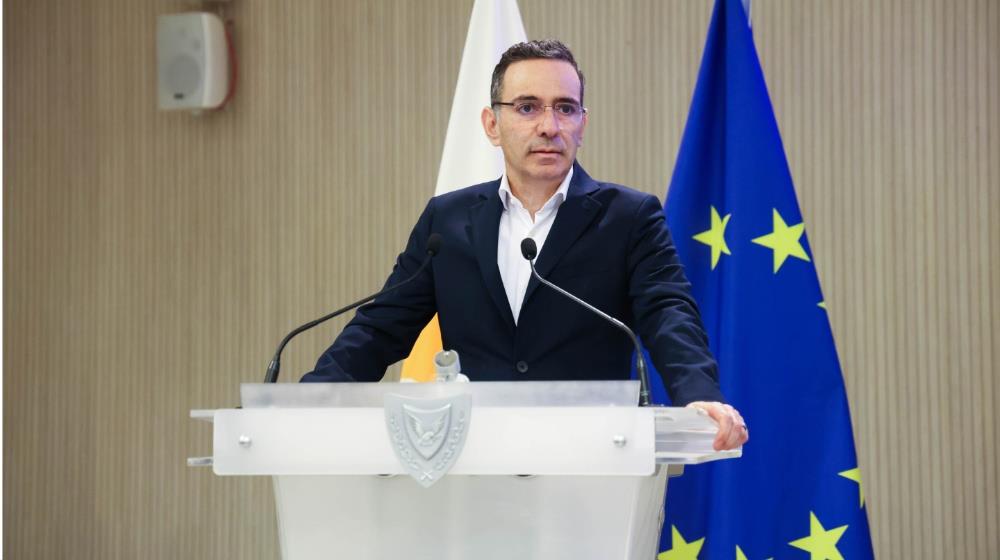
Promoting the use of AI by businesses, children’s online protection and the protection of critical infrastructure are on the agenda of the informal meeting of Telecommunication and Digital Policy Ministers, being held in Nicosia under Cyprus’ EU Presidency.
“We feel these are three of the main persistent dimensions of our shared digital agenda, items that we have not exhausted and where further exchange of practical views is still needed to collectively move forward and also keep the momentum of the discussion,” Cyprus’ Deputy Minister for Research, Innovation and Digital Policy, Nicodemos Damianou, said, opening the meeting on 30 April.
Today's agenda, he said, aims to tackle critical issues “that shape our shared capacity to act, to innovate, and to protect from as practical an angle as possible.”
He said they would begin with a discussion on accelerating the widespread adoption of trustworthy AI across the European Union, focusing in particular on moving from policy frameworks and pilot projects to implementation, and how this can be done at scale. In this context, he said, they would have the opportunity to explore how national and EU-level initiatives can be better aligned to accelerate uptake, while safeguarding trust and ensuring that AI delivers tangible benefits for citizens, businesses, and public services.
“Europe should really focus purposefully on the application of AI in parallel to building capacity, which is something we are doing,” he said.
The second session concerns strengthening the protection of minors online, “an issue of particular importance in today's rapidly evolving digital environment, and this is a matter that has raised growing concern and growing momentum across Europe,” Damianou said. “How do we assure consistent protection and effective safeguards across the digital single market is essential as digital risks continue to evolve and become more prominent,” he added, noting that a growing number of Member States are announcing practical steps.
The EU Ministers were to also discuss during an informal lunch the protection of Europe's critical infrastructures and the reinforcement of collective resilience.
“Our goal today is to move beyond merely discussing policy frameworks. Ultimately, this is about Europe's place and relevance in a rapidly changing digital world and what we can do to move towards deployment of our policy decisions and the arsenal of tools, initiatives, frameworks that the Commission is indeed putting forward,” Damianou said.
“It is also about protecting ourselves and our children in this rapid technological transition that is shifting our world from a mostly physical one to what it feels like a mostly digital reality with many unknowns, many challenges, and, of course, an urgency to act,” he added.
Damianou also said that the meeting was originally planned for March but was postponed due to the situation in the Middle East.
The Deputy Minister noted that Cyprus “was never involved in the current conflict and remains committed to stability, diplomacy, and international law, as of course is the case with Europe as a whole.” He also said that, apart from “this isolated incident that involved the British military bases at Akrotiri,” day-to-day life across Cyprus continues normally with no interruption or disruption to public safety, public sector operations, economic activity, or critical infrastructure.
In her doorstep statements, Executive Vice-President of the European Commission for Tech Sovereignty, Security and Democracy, Henna Virkkunen, said they would discuss “three important topics.”
The first one she referred to is AI and how to support its use and uptake, noting that only 20% of European businesses were using AI last year, “so we have to really support and encourage our industries and public sector.”
According to the Commissioner, they would also focus on the protection of minors which, she said, “is very important topic for the Commission, the EU and member states.” Just yesterday, she said, the Commission published a verification tool to support the member states, “also to make sure we can verify the age of the user, especially protect our minors.”
The third important topic, she said, will be the cyber security related topic “and how to strengthen our security when it comes to critical infrastructure.”
Spain’s Minister for Digital and Civil Service, Óscar Lopez, said in his doorstep statements that the Spanish government will push again for children’s protection, noting that only France and Spain have adopted minimum age requirement for the use of social media. He said he spoke with many of his EU colleagues, who said that a European common ground was necessary. Today, he said, they would discuss that, apart from the European tool, whether a European regulation was necessary.
He also referred to the discussion on AI, noting that Spain was not in favour of going back on the AI Act, and the common ground achieved so far among member states. Spain, he said, was in favour of simplification, but not for deregulation. “We will have to discuss many more things on AI in the future, such as jobs and energy so it is nonsense to go back in the common ground, we have now,” he said. Lopez noted that it was necessary to have a reliable AI, adding that the European model of AI should be the reliable one.
He also said that Spain would also raise the issue of satellites, because, he said, Europe needs to protect itself and referred to the need for European projects regarding satellite connections.
Radoslav Stefanek, Slovakia’s Plenipotentiary of the Slovak Republic for Artificial Intelligence, said in his doorstep remarks that for his country protecting children in the online environment constitute a priority. “We are going to raise the question of banning the use of children’s data in terms of long language models,” he said, noting that this was the number one topic for them. The second one, he said, is physical AI.
(Source: CNA)
