






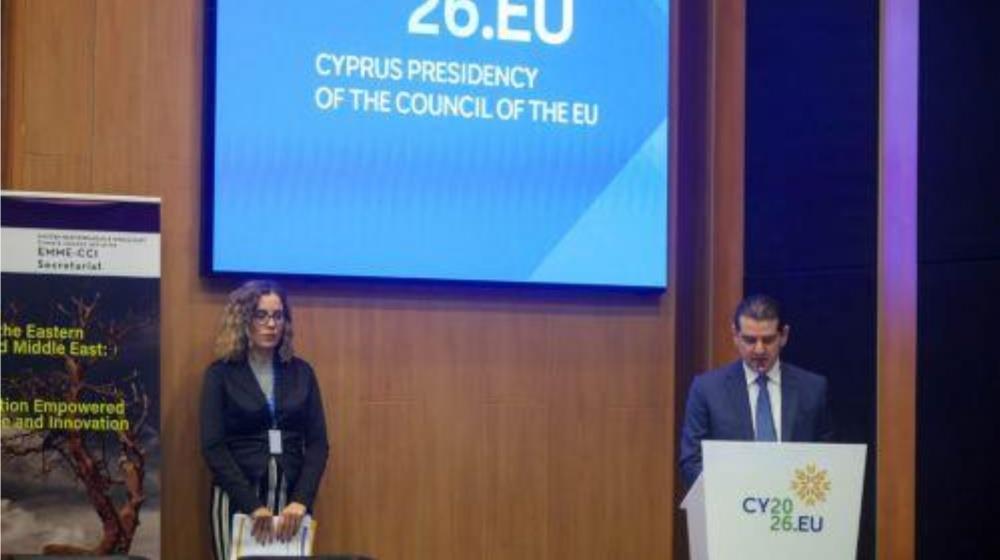
Nicosia has developed a comprehensive strategy to transform Cyprus into a sustainable, competitive, and interconnected energy market, Minister of Energy, Commerce and Industry, Michael Damianos, said on Thursday.
Damianos was addressing the International Conference on Climate Action in the Eastern Mediterranean and Middle East, taking place in Nicosia in the framework of Cyprus’ Presidency of the Council of the EU.
Noting that adversity “can be a catalyst”, the Minister said that every investment made in storage, in LNG, in interconnection, in renewables, in green hydrogen, is a step towards a more resilient, sovereign, and sustainable energy future.
Damianos said that the Eastern Mediterranean and the Middle East are warming at roughly twice the global average rate and that the region faces intensifying heatwaves, prolonged droughts, declining freshwater availability, and rising sea levels that threaten coastal populations, critical infrastructure, and biodiversity. “For small island economies such as Cyprus, these are not abstract projections - they are present realities”, he said.
Noting that Cyprus “is the only EU Member State with no electricity interconnection to any other country”, Damianos said the island is “almost entirely” dependent on imported liquid fuels for power generation. “This structural isolation has a direct consequence: Cyprus has among the highest electricity prices in the European Union, both in nominal terms and in purchasing power parity terms”, he said.
Cyprus’ current energy mix “reflects this challenge starkly”, he said, noting that fossil fuels account for 85.5% of electricity generation – 84% oil products and 1.5% solid fuels – while renewables stand at 14.5% of electricity generation and 21% of final energy consumption. He also said that a significant share of renewable energy produced in Cyprus is currently being curtailed, “amounting to a substantial loss of clean electricity”. “This is the cost of isolation and the clearest possible argument for interconnection, storage, and market reform”, he said.
The Minister also noted that 15% of Cypriot households – approximately 50,000 families – are classified as energy poor, unable to meet their energy costs. The green transition, he said, “must reach them too”, adding that it must be a just transition.
Against this backdrop, he said, the Ministry has developed a comprehensive strategy to transform Cyprus into a sustainable, competitive, and interconnected energy market.
He said this rests on four pillars: the introduction of natural gas, the expansion of renewables and storage, the strategic pursuit of physical interconnection with the European grid, and the modernisation of Cyprus’ energy market.
Damianos said the development of regional electricity interconnections in the Eastern Mediterranean and the Middle East “remains a strategic priority” for enhancing stability and energy security in the region. These will not only enable the diversification of energy sources and greater stability in supply, which is critical for small and isolated energy systems like Cyprus, he said, but also allow countries to export potential surplus electricity from renewable sources. By increasing the penetration of renewable energy and, consequently, reducing carbon emissions, cross-border electricity projects contribute to a more sustainable, resilient, and reliable energy system, he added.
“Regional electricity interconnections are a strategic priority for the entire Eastern Mediterranean and Middle East area”, he noted, adding that shared grids mean shared resilience, and the ability to export surplus renewable electricity across borders accelerates decarbonisation for all of us.
Damianos also referred to the updated National Energy and Climate Plan, submitted to the EU in December 2024, which, he said, commits Cyprus to a 33.17% share of renewables in gross final energy consumption by 2030, energy savings of 349,000 tonnes of oil equivalent, and a binding annual reduction of 1.9% in public sector energy consumption. From 2030, all new buildings in Cyprus must achieve Zero-Emission Building status.
In parallel, he said, Cyprus is also advancing its green transition in the industrial sector through a comprehensive and forward-looking industrial policy that integrates decarbonisation, advanced technologies, and competitiveness. Nicosia is now finalising a new Policy Paper on the Competitiveness and Internationalisation of Cyprus Industry for 2026-2030, “placing the green transition at its core”, while it also finalised the National Hydrogen Strategy, approved by the Council of Ministers in June 2025, which focuses on green hydrogen from renewable electricity, with a full regulatory framework expected by 2027.
He also said that his Ministry “actively supports enterprises in reducing their carbon footprint by promoting energy efficiency, the integration of renewable energy systems, and the adoption of cleaner production technologies”.
Damianos also said that Cyprus also plays “a central role” in advancing regional energy cooperation in the Eastern Mediterranean and the Middle East by contributing actively to initiatives such as the East Mediterranean Gas Forum and by forming partnerships with key international companies. The Framework Arrangement signed with Egypt on 30 March 2026 covers the development of gas fields in Cyprus’ Exclusive Economic Zone, including “Cronos” and “Aphrodite,” and establishes a Joint Committee for gas sales negotiations, he said.
The Host Government Agreement for Block 6 with Eni and TotalEnergies targets first production in 2028, he added, noting that discussions with Israel on the “Ishai” area "further highlight the depth of cross-border cooperation in our region”.
“These initiatives diversify energy routes, support economic growth, and strengthen Cyprus’ role as a reliable energy hub and pillar of stability in the region”, he said.
Damianos also said that Cyprus “is committed” to managing its hydrocarbon resources in a manner consistent with its European and climate obligations – using natural gas as a responsible transitional fuel, while the renewable transformation scales up.
“As Cyprus holds the EU Presidency, I would also note that the Energy Grids Package – currently before the Council – is one of our top priorities. We aim to secure a General Approach at the Energy Council in June 2026, delivering a framework that will benefit not only EU Member States, but the broader regional energy architecture” he noted.
Cyprus, he said, “knows what energy vulnerability means. But we also know that adversity can be a catalyst. Every investment we are making – in storage, in LNG, in interconnection, in renewables, in green hydrogen – is a step towards a more resilient, sovereign, and sustainable energy future”.
Concluding, he said that the Eastern Mediterranean and the Middle East “can be a region not merely of climate vulnerability, but of climate leadership”.
(Source: CNA)