





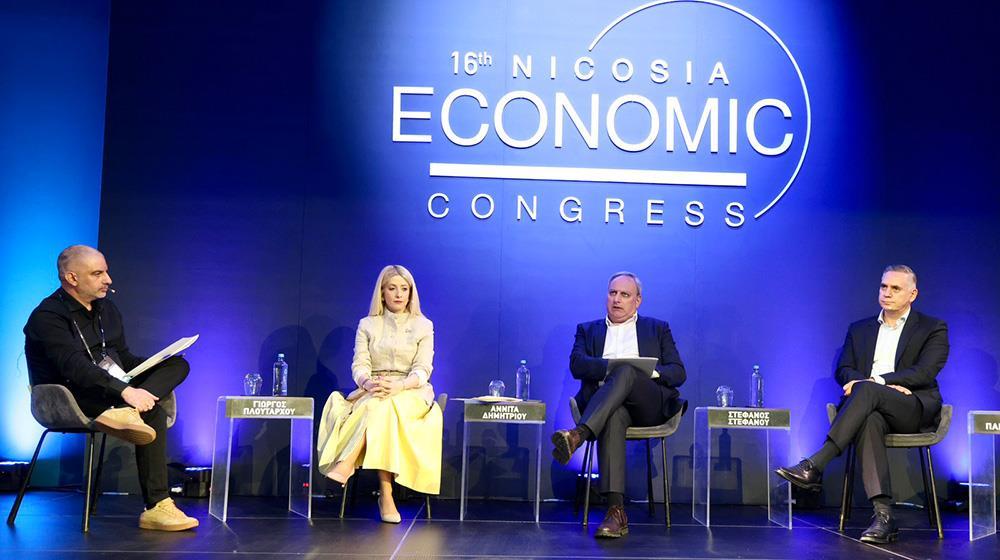
With the Parliamentary Elections only a few weeks away, the economy was at the centre of political debate at the 16th Nicosia Economic Congress, with party leaders presenting their different approaches to the country's development model, fiscal policy and the role of entrepreneurship in the Cypriot economy.
In a period of international uncertainty, with geopolitical tensions in the region, energy pressures and rising costs of living, political leaders were called upon to take a position on issues that directly affect the daily lives of citizens, such as punctuality, wages, housing, social policy and the need to maintain economic stability.
At the same time, the focus of the discussion was on the challenges facing the Cypriot economy as a small and open economy, the need to strengthen the production model, as well as the maintenance of a stable investment environment that enhances growth and employment.
The discussion was attended by Annita Demetriou, President of the Democratic Rally (DISY) of Cyprus, Stefanos Stefanou, General Secretary, Progressive Party of Working People (AKEL), Nikolas Papadopoulos, President, Democratic Party of Cyprus, DIKO.
Targeted social policy, not at the expense of fiscal stability
Annita Demetriou placed at the centre of her statement the importance of maintaining the country's economic stability and credibility, warning of the dangers that may arise from policies that undermine public finances.
As she mentioned, Cyprus has managed in recent years to strengthen its fiscal image and regain the trust of international markets and rating agencies, a fact which, as he said, must be preserved.
She stressed that social policy must be targeted and not horizontal, underlining that supporting citizens cannot be at the expense of fiscal stability.
Concern about political destabilisation
At the same time, she expressed concern about the possibility that the new Parliament that will emerge from the elections will lead to political destabilisation, noting that the composition of the body should be able to respond to major crises and complex challenges.
Characteristically, she questioned whether a Parliament with fragmented political forces would be able to manage crises such as a pandemic, geopolitical developments in the Middle East, the green transition, or pressures from punctuality and fuel increases.
"A simplistic approach is not allowed. A synthesis and holistic approach is needed," Demetriou noted.
"AKEL does not demonise profit"
For his part, Stefanos Stefanou stated that the Cypriot economy, as a small economy, has the flexibility to adapt quickly to international developments, however, at the same time it is particularly exposed to external crises.
As he noted, the country's economy remains largely dependent on the services sector and finance, which makes it vulnerable to international turmoil.
For this reason, as he said, it is important to strengthen the productive base of the economy and ensure that the benefits of growth are distributed more fairly in society.
He stressed that AKEL does not demonise profit, however, it believes that in times of crisis there must be fair taxation, especially in cases of excess profits.
As he mentioned, recently and due to the energy crisis, many European Union countries have discussed imposing taxation on excess profits, so that the revenues can be used to support society and the economy.
He expressed the hope that this issue will also be discussed in the context of the new Parliament that will emerge from the upcoming elections.
"We all live off the profits of Cypriot businesses"
On his part, Nikolas Papadopoulos stressed the need to formulate a clear strategy for the country's economy, which takes into account both the advantages and disadvantages of Cyprus.
As he mentioned, Cyprus is a small country in terms of population and area, which limits the potential for development in heavy industry or in sectors that require large natural resources.
For this reason, as he noted, the country's economic strategy must focus on sectors where Cyprus has competitive advantages, such as tourism, services, technology, innovation and higher education.
At the same time, Papadopoulos emphasised the importance of strengthening human capital and increasing the country's productive population.
The DIKO President also underlined that entrepreneurship and the profitability of businesses are a basic prerequisite for the functioning of the economy and for maintaining a strong social state.
As he stated, "we all live off the profits of Cypriot businesses," as they finance both employment and the state's social policies.
At the same time, he expressed concern about the possibility that the new Parliament will be led to policies that will undermine the business environment. As he noted, policies that ignore the functioning of the modern economy or that criminalise entrepreneurship may lead the country into difficult economic adventures, such as those experienced by the Cypriot economy during the 2013 crisis.
The discussion was moderated by George Ploutarchou, Journalist, Political Editor, REPORTER.
(Source: InBusinessNews)