








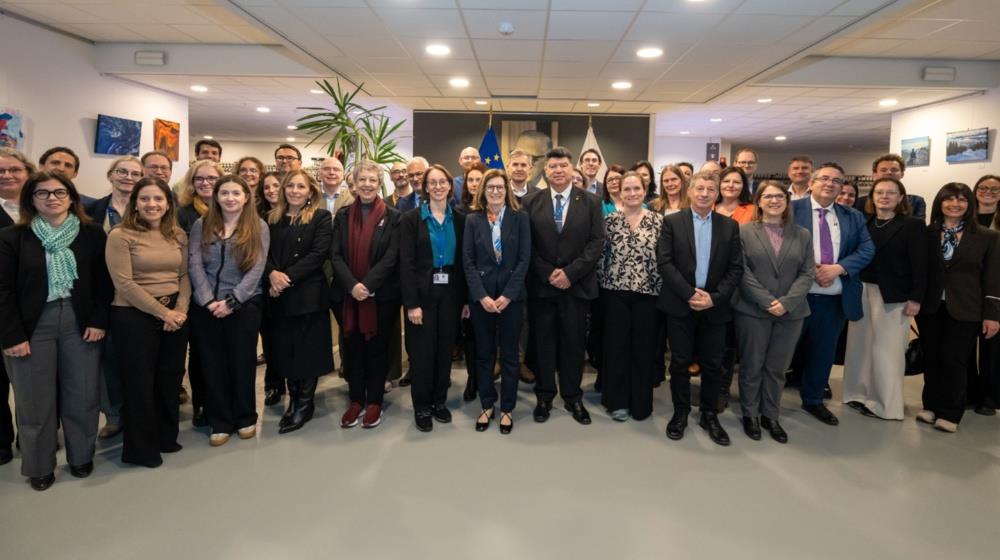
The Chief Scientist of the Republic of Cyprus recently took part in international meetings focusing on the use of artificial intelligence in healthcare, cooperation between Cyprus and Greece, and discussions at EU level on the future of vocational education and training.
The Chief Scientist of the Republic of Cyprus participated in the Panhellenic Conference “Haematology as an Interdisciplinary Meeting Point: From the Algorithm to the Human Being”, held in Ioannina from 26 to 28 March 2026.
The conference brought together more than 60 speakers from the fields of medicine, nursing, research, law, informatics, and artificial intelligence. A welcome message was delivered by the Minister of Health of Greece, Adonis Georgiadis, who highlighted the innovative character of the conference, and the role of technology in advancing healthcare, while also referring to the participation of Cyprus led by the Chief Scientist, Demetris Skourides.
During the conference, the Chief Scientist participated in a roundtable discussion on shaping an AI strategy in medicine in Greece and Cyprus. The discussion was moderated by Eleftheria Chatzimichael, Distinguished Haematologist and Academic researcher, and Dr. Savvas Chatzichristofis, Professor of Artificial Intelligence and Vice Rector for Research and Innovation at Neapolis University Pafos, with the participation of Giorgos Dafoulas, Special Advisor on Digital Health at the Office of the Minister of Digital Governance of Greece.
The discussion focused on the different approaches followed by Greece and Cyprus in adopting artificial intelligence in healthcare, the level of maturity in each country, and the common European framework within which both operate. Reference was made to the European AI regulatory framework and the challenges of its implementation, leading to a shared conclusion that the next phase requires both national preparedness and stronger cooperation between the two countries. The conference program also included a dedicated session on national strategies for AI in medicine, highlighting the importance of collaboration among healthcare professionals, researchers and policymakers.
As part of the conference, Dr. Savvas Chatzichristofis, member of Cyprus’s AI National Taskforce, delivered a training seminar for physicians and researchers on the contribution of artificial intelligence in the research process. The seminar focused on formulating research questions, conducting evidence-based literature searches, synthesizing scientific findings, and improving scientific writing, with an emphasis on using technology to support rather than replace scientific judgement.
On 30 May, the Chief Scientist also participated in a DGVT meeting in Brussels, focusing on the future of Vocational Education and Training (VET) in Europe, held under the Cyprus Presidency of the Council of the EU. The meeting was chaired by the Permanent Secretary of the Ministry of Education, Sports and Youth, Marios Panayides, and the Director of the Directorate of Technical and Vocational Training, Dr. Ilias Markadjis. The panel included Demetris Skourides, representing the Ministry of Education of Cyprus, Daniel Wisniewski, Secretary General of the European Federation of Education Employers (EFEE) from Belgium, Andre Arce, Adjunct Lecturer & researcher at the University of the Basque Country Spain, and Elisabet te Hennepe from Netherlands.
During his intervention, Mr. Skourides presented the current state of AI strategy in Cyprus, and the new guidelines developed for education professionals by the Ministry of Education, Sports and Youth. He also explained how Cyprus intends to tackle the challenge of cognitive offloading and how assessment methods can be adapted to better capture real competencies.
He further highlighted the role of AI-powered tutoring systems in expanding access to high-level technical education, particularly for disadvantaged students, as well as their contribution to supporting future career paths. Cyprus’s participation in these European processes comes at a time when the future strategy of vocational education and training is being shaped and the integration of AI is gaining momentum at European level
