






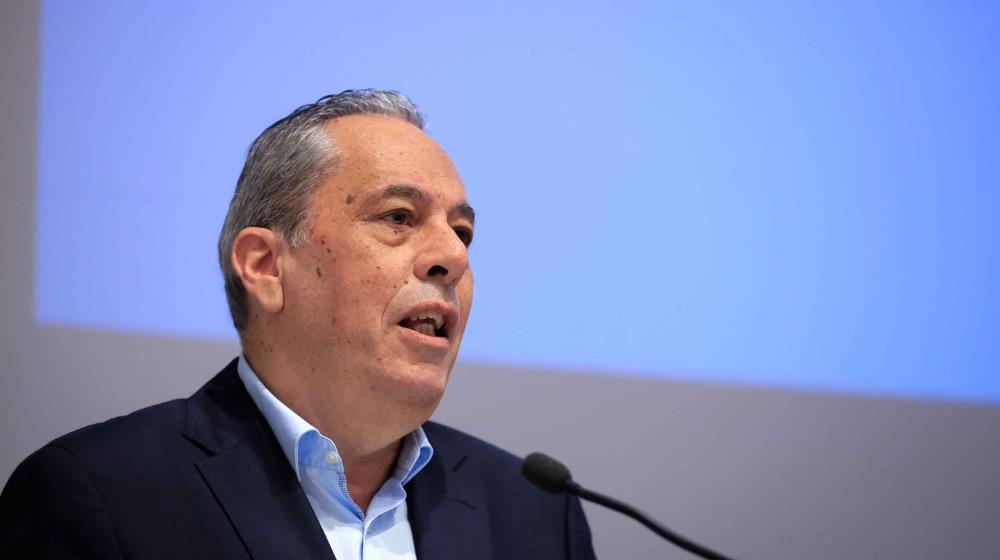
Strengthening the Republic of Cyprus’ deterrent capability, adapting to evolving security dynamics shaped by conflicts in the Middle East and Eastern Mediterranean, advancing critical infrastructure projects, and leveraging European tools such as the SAFE programme are among the Ministry of Defence's top priorities, Minister Vasilis Palmas has said.
Presenting the Ministry’s annual review at a press conference on 23 March, Palmas placed particular emphasis on the planned upgrades of the 'Evangelos Florakis' Naval Base in Mari and the 'Andreas Papandreou' Air Base in Paphos. He stressed that both projects will proceed regardless of external funding, underlining their strategic importance for Cyprus’ regional role. He also made clear that both facilities remain under the exclusive ownership, control and management of the Republic of Cyprus.
Referring to the loss of 13.6 kilograms of explosive material from a firing range, Palmas spoke of “an unfortunate moment” for both the Ministry and the National Guard. He confirmed that responsibilities have been identified and will be assigned, while police investigations are ongoing and no scenario, including theft, can be ruled out at this stage.
Palmas said that 2025 has been marked by significant shifts, including the escalation of existing conflicts, the strengthening of strategic alliances and a reshaping of the global security architecture. He noted that the prolonged Turkish occupation of Cyprus, combined with developments in the Eastern Mediterranean and the Middle East, has created new challenges for the Republic.
Three-pillar approach
According to the Minister, the Ministry’s strategic approach is built on three main pillars: “enhancing deterrence and security, promoting environmentally sustainable practices, and advancing digital transformation."
These priorities, he said, “are aligned with the government’s broader programme and aim at strengthening the country’s defence capabilities.”
Reviewing key achievements, Palmas highlighted progress in the implementation of the National Guard’s armaments programme.
He also pointed to the efficient management of financial resources, noting that budget absorption for defence reinforcement reached 95%, which he said, “reflects effective planning and execution.”
On infrastructure, the Minister reiterated that the decision to upgrade the naval and air bases was taken in response to the evolving geopolitical environment and Cyprus’ defence policy of providing facilities to partner countries within bilateral and multilateral frameworks, as well as EU commitments.
Defence diplomacy
In terms of defence diplomacy, Palmas described cooperation with Greece as being at a “very high level,” citing the recent deployment of two frigates and four F-16 fighter jets to support Cyprus’ defence. He added that cooperation with countries such as Israel, Egypt, Jordan and Armenia continues to deepen, while new partnerships are being pursued with Serbia, the United Arab Emirates and India.
The Minister also highlighted the strengthening of ties with the United States through the State Partnership Programme, which includes regular joint exercises and the establishment of an annual defence and security dialogue. In this context, procedures are underway to place a Ministry representative in New Jersey in 2026.
At the European level, Palmas underlined Cyprus’ participation in EU missions and initiatives, including operations in the Red Sea and training programmes for Ukrainian personnel, as well as contributions to United Nations missions such as UNIFIL in Lebanon.
SAFE programme
Particular importance was attached to the EU’s SAFE programme, with approved funding of €1.118 billion expected to support key defence needs. Palmas said, “the investment plan has already been approved and is being implemented, with completion scheduled by 2030.”
He also referred to efforts to strengthen the domestic defence industry, including support for Cypriot companies to participate in future armaments programmes and the development of a national defence industry strategy with EU backing.
The Minister also highlighted reforms concerning Contracted Soldiers (SYOP), including salary increases, higher allowances and legislative changes extending their service up to the age of 57. The reforms also introduce merit-based procedures for career advancement to non-commissioned officer ranks.
Referring to Cyprus’ Presidency of the Council of the European Union, he said the country aims to contribute to a more secure and resilient Europe. Priorities include continued support for Ukraine, strengthening the European defence industry, enhancing maritime security, and supporting humanitarian and civilian evacuation operations.
Concluding, Palmas reaffirmed the government’s commitment to safeguarding the Republic’s territorial integrity and sovereign rights through the continuous enhancement of defence capabilities.
Responding to a question on modern warfare, he stressed that Cyprus is adapting its armaments programmes to new realities, particularly the growing role of unmanned systems such as drones in conflicts in the Middle East and Ukraine.
(Source: CNA)