








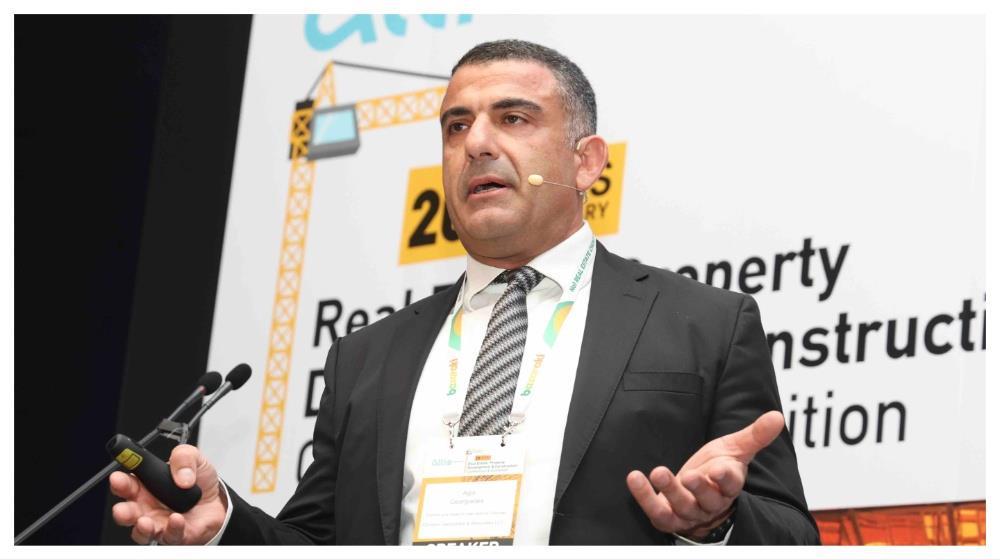
The importance of regulating the profession of land development and construction entrepreneurs was analysed at the recent 20th Real Estate, Property Development & Construction Conference & Exhibition organised by Altia, by Partner and Head of International Disputes, Christos Georgiades & Associates LLC, Agis Georgiades.
In his presentation entitled 'Shaping the Future of Property Development: Regulating the Profession', he referred to the public benefits that arise from regulating the profession, noting that it contributes to "creating conditions of transparency, control and accountability", to "better market organisation", to "reducing unfair practices" and to "enhancing credibility."
As he explained, the objectives of the regulation are the "protection of a critical sector of the Cypriot economy," the "substantive control before registration", the "active control during the practice of the profession," as well as the existence of "remedies and mechanisms to protect buyers beyond property law and contract law."
In this context, the main provisions of the relevant bill were presented, which include the "creation of a Council for the Registration and Control of Land and Building Development Entrepreneurs", the "maintenance of a Register of Entrepreneurs" and the "establishment of minimum criteria". At the same time, "active control", "criminal offenses", "disciplinary procedures" and "regulation of issues through regulations" are provided for.
Georgiades also presented the criteria for registration in the Registry, noting, among other things, that the entrepreneur must permanently employ a "civil engineer or architect or a person qualified in real estate management," maintain or collaborate with a "project design and supervision office", employ at least one "designer registered with the Cyprus Scientific and Technical Chamber (ETEK)", as well as an "experienced real estate salesperson."
In addition, they must have an "office properly staffed with qualified personnel and equipped", have appointed a "qualified auditor" and have paid "the fee for examining an application for registration or renewal of registration."
It was also mentioned that, when submitting an application for registration, the interested party must have erected and made available to third parties at least one three-story apartment building or sixteen apartments and have another similar development under construction, or alternatively, have erected a complex of at least ten residences and is constructing another similar project.
Presenting practical examples of the application of the regulation, he stated that an individual without prior experience who simply wishes to sell a property he owns "does not require registration," while an individual who wishes to develop a property "must register as an EAG probationer, provided that he meets the criteria."
In the case of the development of an apartment building using the compensation method, where a contractor intends to place the apartments allocated to him on the market, it was noted that "registration of the contractor as a construction contractor or a trainee construction contractor is required."
Finally, provisions for offenses were presented, such as "development without registration in the Registry," "presentation as an entrepreneur without registration" and "failure to indicate a registration number in a document or advertisement". As Georgiades stated, in conclusion, "the possibility of issuing a decree to cease operations and subjecting to disciplinary proceedings with administrative sanctions is provided for."
(Source: InBusinessNews)
