








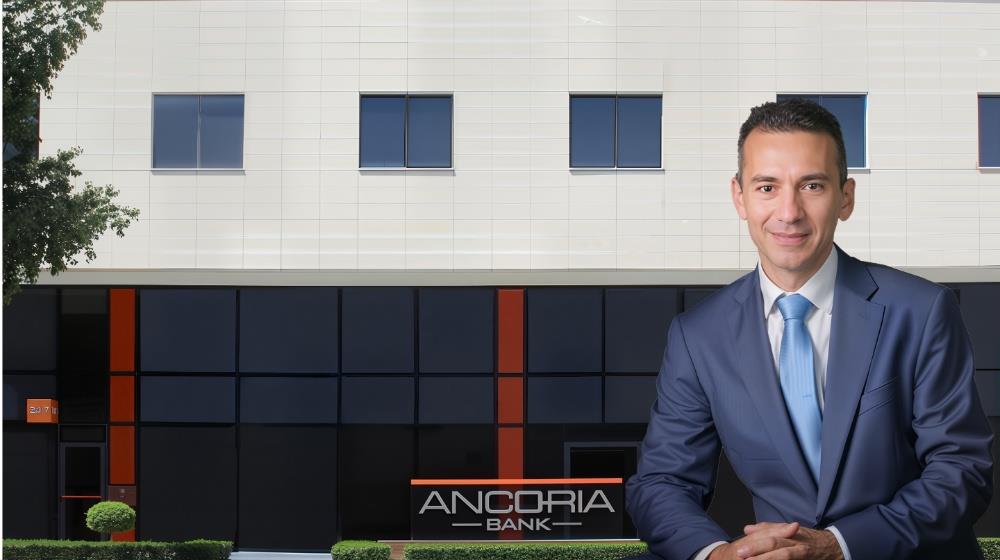
Ancoria Bank's new CEO Marios Hadjikyriacos has analysed the bank's main goal and his own main priorities as Chief Executive Officer, while also expressing his opposition to the possibility of new taxation of banks.
In an interview with InBusinessNews on the occasion of assuming his new duties, Hadjikyriacos comments on both the developments and actions being taken within Ancoria Bank, as well as more broadly on the trend of acquisitions and mergers recorded in recent years and which is reshaping the banking sector in our country, underlining that "our orientation remains clear, since Ancoria Bank is safeguarding its long-term course as a purely Cypriot bank, aiming for sustainable development with transparency and integrity."
Within this context, he also states that, for Ancoria Bank, the priority is to ensure its long-term development path, through technological superiority and excellent service, emphasising that the bank's strategic goal is to increase its market share, always based on maintaining the quality of its portfolios.
Regarding the discussions on imposing additional taxes on banks, Hadjikyriacos indicates that "unstable and opportunistic taxation, however, may bring about the opposite results if we do not take the long-term perspective of the issue seriously."
First of all, congratulations on your new duties, which you are admittedly taking on at a young age, having had a very successful career in the banking sector. What do you consider to be the most important milestones in your career?
Thank you very much for your kind words, although 28 years of experience in the banking sector also has the corresponding impact on age. Looking back on my career, I would say that the most important milestones reflect the experiences I gained during the founding and operation of two new banks in Cyprus and abroad.
With these resources, I look forward to a similar and successful path for Ancoria Bank, guided by a new strategy, in collaboration with all my colleagues, the board of directors and with the unwavering support of its shareholders.
Goals and priorities
What goals did you set on assuming the duties of CEO of Ancoria Bank? What are your main priorities for the bank?
Taking on the role of CEO of Ancoria Bank, the main objective is to strengthen the bank's position and presence as a modern and flexible organisation. Our main priorities are the dynamic and at the same time healthy growth of the loan and deposit portfolio, as well as the improvement of the customer experience through the expansion of products, both in banking centres and digitally.
At the same time, investing in our people, as well as in technology, is a priority, since this is where the competitiveness of banks in today's environment is largely determined.
What we want to achieve, and we are quite optimistic about this since we already have a solid foundation, is for Ancoria Bank to become more outward-looking and offer the best and most direct service to its customers. More generally, the bank's strategy focuses on sustainable development with a modern character, without moving away from the customer-centric approach that characterises it.
How do you anticipate that the banking sector will act in 2026? What are the biggest trends/changes you expect to occur, and what are the most significant challenges?
First of all, I would say that the significant geopolitical developments we are experiencing in our region are creating short-term uncertainty, which may cause medium-term impacts, but which may also create significant development opportunities.
It is too early to make predictions, but the most important factors that may cause negative impacts are the duration of hostilities and the extent of damage to energy infrastructure.
More generally, the banking sector is constantly evolving in line with global market trends and broader economic conditions. These are dynamic elements, however, the banking sector in Cyprus is expected to move in an environment of stabilisation and adjustment.
This is due to the very strong capital adequacy in the sector, as well as the increasing liquidity of the system, as the increase in deposits continues to outpace the increase in lending.
In terms of trends, 2026 will be characterised by two main directions. The main trend is digital transformation, as customers increasingly see banking as an experience that should be immediate, simple and fully digital. Having grown up actively using technology on a daily basis, the new generation demands solutions that work in real time, without bureaucracy and physical presence.
The second direction, in my opinion, and which is supported by the first, is the improvement of productivity and the general rationalisation of costs. After the very significant investments made in the sector, organisations will seek to maximise synergies, since we are now operating in a very competitive environment and alongside non-traditional providers in transactional services.
Acquisitions and mergers
A strong trend that seems to be taking hold in Cypriot business is that of acquisitions and mergers. How do you evaluate the moves that have already been made in the banking sector?
The recent mergers and acquisitions in the banking sector are part of a broader restructuring of the industry worldwide. Significant transactions have already taken place, which have changed the market map and created more integrated organisations of larger scale with greater investment potential, especially in terms of technology and new products and services.
The regulatory environment, compliance costs and digital transformation favour these synergies.
At the same time, however, the high concentration in the sector has created significant space for smaller and perhaps more flexible banks, which can differentiate themselves through specialisation and personal relationships with customers.
Are these moves generally worrying you as a small bank?
Based on the above framework, we evaluate developments carefully and examine the data realistically. Although we are a small, Cypriot bank, we do not believe that success is a function of the current footprint, but of the correct and targeted strategy in the new environment.
For Ancoria Bank, the priority is to ensure the bank's long-term growth path through technological excellence and excellent service.
Actions at Ancoria Bank
At the moment, however, significant movement is also being recorded within Ancoria Bank, as existing shareholders are expected to significantly increase their stakes. Do you anticipate that these actions will also lead to changes in the bank's development plan?
First of all, the moves to strengthen participation by existing shareholders are, above all, a vote of confidence in the bank and its growth prospects, as well as in the banking model we apply. Regarding the development plan, the new shareholding structure significantly strengthens the ability to implement the strategic plan and the path towards technological upgrade.
At the same time, our orientation remains clear, as Ancoria Bank ensures its long-term course as a purely Cypriot bank, aiming for sustainable growth with transparency and integrity.
What is the bank's share of deposits and loans today, and how can you increase it? Are you considering increasing your presence with physical stores?
At the end of 2025, Ancoria Bank's market share in terms of deposits was 1.68% and in terms of loans it reached 1.30%. Our strategy is undoubtedly to increase our market share, always based on maintaining the quality of the portfolios. We have already built a solid foundation, since we are able to offer competitive deposit and loan products.
Regarding the expansion of the bank's physical network, and understanding the value of personal contact with our customers, this is an issue that is being examined based on our future strategy, always within a logical framework and in relation to the needs that will arise.
During this time, proposals from political parties for additional taxation of banks have come to the fore again. What is your position on these, and what risks lie ahead for the country's banking system?
Discussions about additional taxation of banks come to the fore, particularly in times of profitability. Banks must contribute to the economy and society, and they already do so to a greater extent than any other sector, through the payment of corporate tax, but also the very significant deposit levy.
However, volatile and opportunistic taxation may have the opposite effect if we do not take the long-term perspective into account. During favourable periods, banks have the opportunity to strengthen their capital reserves and thereby support economic growth to a greater extent.
At the same time, their ability to absorb shocks that may arise during unfavourable economic cycles is enhanced.
It might have been more meaningful if the discussion had shifted to more strategic and long-term productive solutions, such as supporting green finance, strengthening financial literacy, and investing in technology.
In sectors, that is, in which banks can offer productive services, both to society and to the economy.
(Source: InBusinessNews)
