








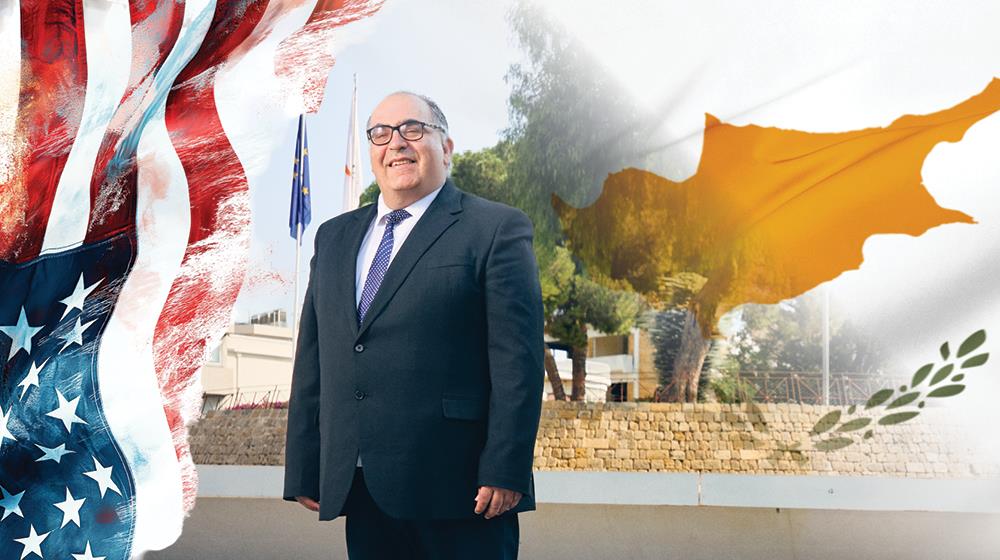
Marios Tannousis, CEO of Invest Cyprus, explains how the Agency and the Government are working together to attract more US companies to the island, to partner with American innovators and ensure the long-term policy predictability that is vital for US investors.
In a recent interview with GOLD magazine, Tannousis also reveals the economic sectors he considers to be providing the strongest investment opportunities for US businesses in Cyprus, and, among other things, shares Invest Cyprus’ top priorities for strengthening economic ties with the United States over the next decade.
What makes Cyprus a compelling gateway for US companies seeking access to the EU, the Middle East and North Africa?
Cyprus serves as a strategic bridge due to its unique geographical position at the crossroads of Europe, the Middle East and Africa. For US companies, Cyprus offers a stable, EU-regulated environment that acts as a safe harbour for regional operations. Key factors include (a) the launch of the Cyprus-US Strategic Dialogue in October 2024 which formalised cooperation in security, energy and technology, signalling a high level of political and economic stability, (b) Cyprus’ legal system, which is based on English Common Law principles and is highly familiar and predictable for US businesses and legal teams, and (c) access to a highly educated, English-speaking workforce and a favourable headquartering policy that allows US tech firms to relocate key personnel efficiently. Another important competitive advantage of Cyprus is that it operates on Eastern European Time (EET), which offers a significant advantage for investors by enabling businesses to effectively bridge working hours between Asian, European and American markets from a single location. This is very important for global business coordination as the time zone allows for effective communication and business operations with Asia/Middle East in the morning and with Europe/Americas in the afternoon. This facilitates seamless global operations for companies with international partners and clients.
Cyprus is a trusted bridge between Europe and its wider neighbourhood, built on a long record of strong and reliable partnerships. As the only EU member state in the region, Cyprus plays a constructive role in advancing peace, stability and security. It has turned geography into a strategic strength, facilitating dialogue, humanitarian response and cooperation at critical moments, and influencing far beyond its borders. The current Presidency of the Council of the EU reinforces the country’s capacity to shape both the regional and European agenda. Its diplomatic and geopolitical role strengthens broader economic and security partnerships. Cyprus also offers something rare in a complex neighbourhood: strategic significance combined with a human element, creating a space where cooperation feels tangible and personal.
Cyprus is looking to expand its global presence in a variety of economic sectors. Which of these currently present the strongest investment opportunities for US businesses in Cyprus?
While traditional sectors like energy remain strong, the ‘new economy’ is where the most significant growth lies. Cyprus is branding itself as an emerging ‘Tech Island’ where US giants like DataArt, Wrike, Oracle, Microsoft, IBM, Kyndryl, and NCR already have a longstanding presence, while newer specialised firms are following, as seen with the recent visit by Amazon delegates. Collaborative efforts in the Eastern Mediterranean, involving US majors like Chevron and ExxonMobil, focus on both natural gas and the Great Sea Interconnector for renewable energy. Sustainable tourism and real estate with high-end residential and commercial projects catering to international professionals are also attracting interest, as are education and life sciences that include partnerships with US universities for regional research hubs. Space exploration is another important sector – NASA welcomed Cyprus as the 46th signatory to the Artemis Accords in October, 2024. This agreement promotes peaceful and responsible space exploration, with Cyprus committing to cooperate on lunar missions and beyond. Cyprus aims to leverage its strategic location to play a key role in the international space community.
We have seen increased interest by US companies in areas such as fintech, AI, cybersecurity and deep tech, as evidenced by recent collaborations with NVIDIA and Tenstorrent. How do you expect these to benefit Cyprus and the business climate on the island?
Indeed, this interest came about after President Christodoulides became the first Cypriot President to lead an investment and business mission to the US, where he met with leaders of major multinational companies and institutions, accompanied by key government ministers, the Chief Scientist and the Chairman of Invest Cyprus. The recent engagement with NVIDIA (through its Inception programme and local partnerships) and Tenstorrent, the AI chip pioneer led by Jim Keller, marks a shift toward Deep Tech. Tenstorrent recently signed a Memorandum of Understanding (MoU) with the Cyprus Research and Innovation Foundation (RIF) to explore building AI clusters and data centres in Cyprus, thereby positioning the island as a regional AI processing hub. Additionally, these collaborations provide US companies with a testing ground for AI and cybersecurity solutions within an EU regulatory framework, benefiting local talent and attracting specialised venture capital. US companies such as Bcentriqe and Arisant are also operating in Cyprus, while we have seen visits by Plug & Play, Tessaract and Amazon with a view to exploring the setting-up of operations in Cyprus.
What regulatory and/or tax advantages does Cyprus offer US-linked structures operating within the EU?
Cyprus offers one of the most attractive tax regimes in the EU, fully compliant with OECD/G20 standards. Corporate tax is a competitive 15% and US tech firms can benefit from an effective tax rate as low as 2.5% on qualifying profits arising from Intellectual Property developed in Cyprus. Also, a robust Double Tax Treaty exists between Cyprus and the US, preventing the double taxation of income and, through Notional Interest Deduction (NID), we encourage equity over debt financing by allowing a tax deduction on new equity capital.
How is Cyprus adapting its financial services ecosystem to meet US compliance and transparency standards?
Cyprus has undergone a rigorous transformation to align with US and international transparency standards. First comes our cooperation with US authorities. The Government has invited the FBI and the US Department of Justice to assist local authorities in investigating financial crime and ensuring strict compliance with international sanctions. As for AML/KYC protocols, the Central Bank of Cyprus has implemented a zero-tolerance policy on shell companies and strictly follows FinCEN guidelines to ensure the banking system remains clean and integrated with the US dollar clearing system.
What are Invest Cyprus’ top priorities for strengthening economic ties with the United States over the next decade?
Our primary objective is to move from a relationship based simply on service provision toward a model of substantive strategic partnership. We are committed to deepening our technological ecosystem by scaling the number of US-based unicorns and tech firms that choose Cyprus not only for their headquarters but also for the establishment of research and development centres. Simultaneously, we are working intensely to attract venture capital, with the aim of positioning Cyprus as a central hub for US-backed private equity and venture capital funds seeking opportunities in startups across the Eastern Mediterranean and Europe. At the core of our strategy lie the digital and green transition and sustainability, as we look to partner with American innovators to achieve our Vision 2035 goals, focusing specifically on renewable energy projects, energy storage facilities and smart city technologies. Finally, we place immense value on institutional strengthening by maintaining the momentum of the Strategic Dialogue to ensure the long-term policy predictability that is vital for US investors.
This interview first appeared in the February edition of GOLD magazine. Click here to view it.
