







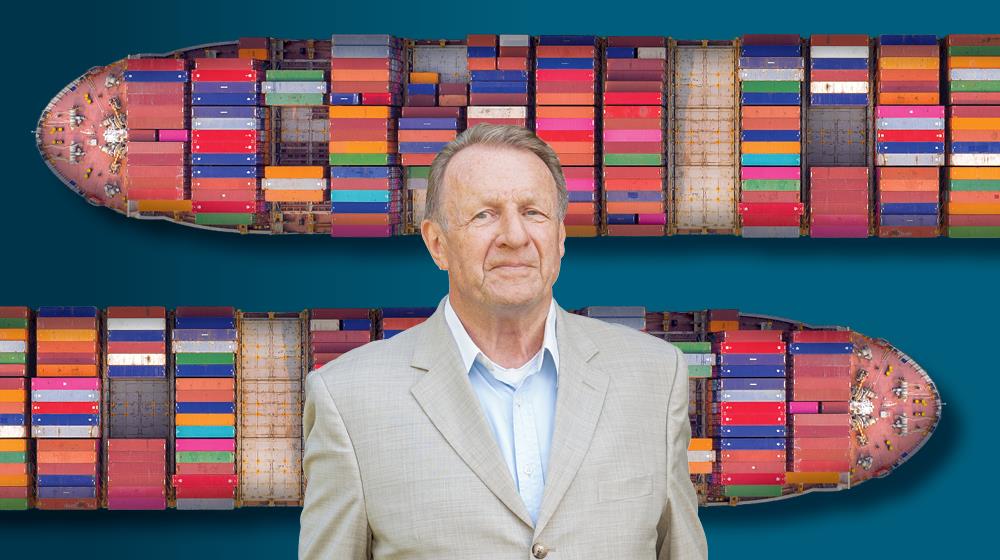
Dagfinn Lunde has navigated shipping finance through booms, busts and bank retreats. Now Chairman and Co-founder of eShipfinance, a fintech filling the gap left by traditional lenders, he discusses how alternative capital is reshaping the sector, why investors often misread volatility and what makes him still love the maritime industry after five decades.
“I think 27 hours in a day will be just about right!” jokes Dagfinn Lunde, a name that still carries considerable weight in shipping circles. He once helmed shipping banking at some of the world’s largest lenders but has since moved on with the times. In 2018, he co-founded eShipfinance, a fintech platform designed to fill the widening gap left by traditional finance. After nearly half a century in shipping, retirement holds little appeal – and the day still feels too short. “I’m having too much fun,” he says. “There’s so much I can still do and the world is full of opportunities. I look at excellent projects every day and think, ‘This can work.’ I really love shipping.”
Banks, once the industry’s dominant lenders, never truly recovered their appetite after the 2008 global financial crisis – Lunde watched that retreat from the inside. During the boom years, banks were eager to finance ships whenever markets were buoyant, an enthusiasm that, in retrospect, proved part of the problem. From 2003-04, China’s rapid expansion in shipping and shipbuilding, driven by surging exports and container volumes, fuelled global demand. It also sowed the seeds of excess. By the time the cycle turned, massive order backlogs had locked in oversupply. When the American subprime crisis spilled into shipping, freight markets collapsed and demand evaporated but too many vessels were already on the water or on their way. “What was interesting, of course, was that banks were not prepared to handle all these problems,” he notes. At the time, Lunde was at DVB Bank. “We sensed trouble early. In March 2008, we already had a bad feeling about what was happening in the US, so we immediately increased our equity,” he recalls. By July, the bank again raised capital, just to be safe. “So, when the crisis became global in September that year, we were in better shape than most of our competitors,” he adds. The downturn, though, proved prolonged. Then came another blow. In 2014, the offshore market collapsed, compounding the damage. One crisis followed another, each narrowing banks’ tolerance for shipping risk. By then, though, Lunde had left banking.
The reinvention of shipping finance
In 2013, together with his life partner Marina Tzoutzouraki, who had led shipping at Eurobank, he founded Dagmar Navigation, an advisory business based in Limassol. The firm also invested selectively. “Even though the market was bad, we did very well,” he says. “But we also saw banks struggling more and more, and we realised that shipowners had very few alternatives.” The conclusion was inescapable: shipping finance needed reinvention. So, working alongside Tzoutzouraki, as well as long-time colleague Tarun Gulati, and joining forces with specialists in banking IT systems as well as other partners, they brought eShipfinance to life.
Prospective borrowers register their projects on the fintech’s platform, submit detailed information and undergo rigorous scrutiny. Know-your-customer (KYC) checks, compliance and related requirements are addressed upfront. “I’m worse than a normal credit committee because I will go through that project to be really sure that it works,” stresses Lunde. “When we go to a financier, our own names are on the line. We wouldn’t sell them a project if it wasn’t good enough, because we want to be sure that they get their money back with the yield we have agreed.” Only once that threshold is met does a project graduate from a loan application into an investment proposal. eShipfinance maintains relationships with over 60 funding sources worldwide, spanning banks, private equity firms, high-yield funds and other capital providers, each with distinct risk appetites. By 2025, the fintech had analysed more than 600 projects, generating indicative term sheets exceeding US$3 billion.
While based in Cyprus, eShipfinance is deliberately unencumbered by geography. “I will tell you a secret – we don’t have any employees. No fixed offices either. You know, I hate fixed costs,” he says. Lunde’s aversion is longstanding. Early in his career, he was repeatedly tasked with restructuring companies and high fixed costs were always the first target. The platform, therefore, operates through partners, remunerated via dividends rather than salaries, keeping overheads exceptionally low. Lunde himself has lived in the Netherlands since 2000.
Packaging projects to match mandates and portfolios
The retreat of banks has not reduced the supply of capital. Quite the opposite: there has never been so much money available. So, the challenge lies elsewhere: packaging projects to match the mandates and portfolios of increasingly diverse investors. This new cohort demands a level of presentation and explanation far removed from what many shipowners were accustomed to – longstanding banking relationships once meant that little persuasion was required. “We maintain a clear view of each investor’s and financier’s preferences and approach them selectively with suitable projects,” Lunde notes.
Yet abundance brings its own risks, with chief among them inexperience, particularly among first-time investors. The most common misunderstanding, Lunde argues, concerns volatility. In banking terms, shipping scores poorly on the probability of default, mainly because freight markets swing violently. That, in turn, drives up regulatory capital requirements. But loss given default (LGD) – the portion of a debt that a lender loses if the borrower defaults – has historically been low, even on troubled loans. “If you have liquidity to survive two bad years, you usually come out fine. And that was the fault of many banks; they pulled back at the bottom of the market. I learned this – very badly or very well – in 1986, while working for a Norwegian bank in Luxembourg and the shipping crisis came,” he says. Den norske Creditbank had recruited Lunde to help deal with mounting losses in its shipping portfolio, then estimated at more than US$250 million – an exceptional sum at the time. Examining the exposures more closely, he found that many were in syndicated loans. French and American banks in the syndicates had panicked. Meetings were dominated by lawyers rather than shipping specialists – a tell-tale sign. That ignorance created opportunity. Lunde offered to buy the foreign banks out of their positions at steep discounts, paying between 20% and 50% of face value. “People thought I was crazy but the head of the bank was also ex-shipping, so he understood what I was doing. When the market turned in 1989, we recovered more than half of our potential losses,” he recalls. The lesson, he says, remains hard to convey. Some investors fixate on volatility; persuading them not to panic is another matter altogether. This misalignment helps explain why bank shipping loans have grown so costly. Regulation focuses overwhelmingly on the probability of default, pushing up capital charges. “Even when I was a banker, more than 12 years ago, onboarding a new customer could cost US$250,000 in administrative expenses. Today’s it’s probably double,” he notes. As a result, traditional bank financing has converged with alternative funding on price. The balance of the market has shifted, perhaps permanently.
A changing market
Recent data underscores how much the market has changed. The Petrofin Research index, which tracks ship-financing activity across the world’s 40 largest banks, recorded a mere 2% increase between 2020 and 2024. To Lunde, this simply reflects strong earnings, particularly among container owners over the past two to three years, and the widespread use of surplus cash to repay bank debt. Other market changes include Chinese leasing structures, which have been reshaped to sidestep new American port fees on vessels owned or operated by Chinese entities, introduced amid rising trade tensions. By shifting from ownership to mortgage-style arrangements, operators retain title while borrowing against the ship, removing the “Chinese-owned” label without changing the economics. Leasing has also become a popular financing option, especially in regions like the Middle East, where Islamic (Sharia-compliant) rules ban direct interest charges so, instead, a company or bank buys the asset and rents it to the user for fixed payments. “Overall, I would say the shipping market is quite stable. The fleet is still growing as new ships are delivered and those ships need financing,” he says. The critical shift lies in how that financing is provided: bank lending continues to shrink, while alternative capital fills the gap.
Will banks ever return in force? “No,” he replies, without hesitation. “Banks will not come back to shipping finance in any meaningful way.” Greek lenders are a partial exception, he concedes, because shipping remains strategically important to them. Elsewhere, today’s senior management and Boards often struggle to grasp the sector. “They see it as dangerous, with a high probability of default.” Legal complexity compounds the unease. Ships are mobile assets, crossing jurisdictions that many banks are ill-equipped to navigate, so enforcing a mortgage in Colombia or Venezuela is not a textbook credit exercise.
When disruptions are a boon
As shipping finance is being swallowed by alternative capital, paradoxically, for those who can navigate volatility, disruptions in global trade can be a boon. Today’s macroeconomic turbulence, from trade wars to mounting geopolitical tension, is exactly that, Lunde says. “Closing the Suez Canal, for example, increases tonne-miles dramatically. The same applies to the Black Sea situation. Disruptions increase demand, unless ships themselves are attacked, of course.”
So, disruption is good?
“Disruptions are fantastic. If you close the Arabian Gulf, for instance, it couldn’t be better!” he says in jest. More seriously, he adds, “In general, demand in the global market is steady and positive. Fortunately, we’ve also had a shortage of shipbuilding capacity, so we don’t have too many ships. But shipowners are chronic people. In the high market, they just buy ships and in the low market, they hold back, so they create extra cycles with their behaviour.” For him, that means that in around three years, depending on the segment, there will again be a bit too many ships going around.
Regulation, too, looms large. The recent postponement by the International Maritime Organization (IMO) of its net-zero framework, delayed under pressure from shipowner associations, including the Cyprus Union of Shipowners (CUS), might have been expected to weigh on sentiment. Lunde is unconvinced. “Honestly, I don’t think the immediate impact of that decision is very significant. Any real effect is at least five years down the road. I don’t see an immediate difference, whether they voted for or against.” He points to a practical reality often overlooked in policy debates: conventional fuel remains significantly cheaper than alternative options. “I often ask audiences whether they’ve ever seen a voyage calculation for a ship,” he says. “If you have, you immediately understand why conventional fuel is still used – the price differences are simply too large to justify LNG, methanol or any other alternative.”
So, after five decades in an industry that swings as widely as the tides, how has that affected his outlook? Does he consider himself an optimist, a pessimist or a realist?
“I’m an eternal optimist,” he says with a smile. “All my life, whatever I’ve been involved in, we’ve been able to make good money – it’s just a question of doing things the right way, with the right people and at the right time.”
This interview first appeared in the January edition of GOLD magazine. Click here to view it.